


Terry Nichols went on trial for his life in the Oklahoma City bombing and was alternately portrayed as an eager participant in the attack and a fall guy in a conspiracy wider than the government has acknowledged.
Nichols hated the US government and worked hand-in-hand with Timothy McVeigh in assembling and detonating the "huge, monstrous bomb," prosecutor Lou Keel said during opening statements on Monday in the state murder trial.
"These two were partners, and their business was terrorism," Keel said.
Nichols, wearing a gray sport jacket over a white, buttoned-down collar shirt, occasionally whispered to his attorneys but showed no emotion during the prosecution's opening statement.
Defense attorney Brian Hermanson countered that McVeigh and other conspirators were responsible for the bombing and Nichols was manipulated by McVeigh to take the blame.
"Timothy McVeigh set him up so McVeigh could cover up the others who acted in this conspiracy," he said.
Nichols, 48, is already serving a life sentence on federal changes for the deaths of eight federal law officers in the April 19, 1995, blast that killed 168 people. The state charges are for the 160 other victims and one victim's fetus.
Prosecutors brought the state charges in hopes of sending Nichols to the death chamber for his role in the bombing -- the deadliest act of terrorism on US soil at the time. McVeigh was executed in 2001.
Prosecutors allege that Nichols conspired with McVeigh to build the bomb in a plot to avenge the FBI siege against the Branch Davidian sect at Waco, Texas, exactly two years earlier.
Keel said that Nichols bought 1,800kg of ammonium-nitrate fertilizer for the bomb in 1994 and stole blasting caps to set it off. Nichols, who met McVeigh in the army, also robbed an Arkansas gun dealer of weapons and gold and silver coins to help finance the plot, Keel said.
The blasting caps were stolen from a Kansas rock quarry and drill marks on a padlock at the quarry matched a drill bit found in Nichols' basement, he said.
The bomb was delivered in a Ryder truck that exploded outside the Alfred P. Murrah Federal Building. Prosecutors say Nichols helped McVeigh pack the bomb inside the truck.
"This huge, monstrous bomb was detonated right in front of that building," Keel said. He said those not killed in the initial blast died because of glass that was sent "flying like bullets."
Keel said Nichols "had long been mad at the federal government" and was outraged by the siege in Waco that killed about 80 people.
Hermanson said prosecutors were relying heavily on "assumptions and circumstantial evidence." He said the state was going to "leave things blank" in its evidence against Nichols, who was home in Kansas when the bomb went off.
The first prosecution witness was an FBI agent who searched Nichols' home two days after the bombing. Mary Jasnowski testified she found four 208-liter drums that looked like the ones prosecutors say were used in making the bomb.
She also testified that she found a receipt for 900kg of ammonium nitrate fertilizer and found small white bits of ammonium nitrate outside the house.
The trial will go on with 12 jurors and three alternates. It is expected to last four to six months.
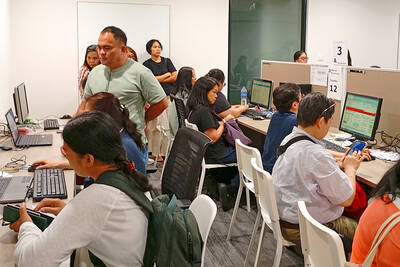
A new online voting system aimed at boosting turnout among the Philippines’ millions of overseas workers ahead of Monday’s mid-term elections has been marked by confusion and fears of disenfranchisement. Thousands of overseas Filipino workers have already cast their ballots in the race dominated by a bitter feud between President Ferdinand Marcos Jr and his impeached vice president, Sara Duterte. While official turnout figures are not yet publicly available, data from the Philippine Commission on Elections (COMELEC) showed that at least 134,000 of the 1.22 million registered overseas voters have signed up for the new online system, which opened on April 13. However,
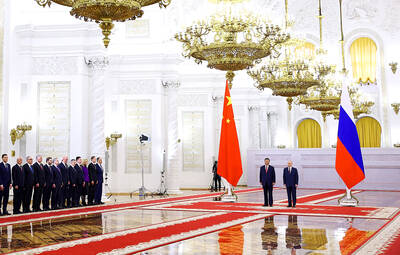
ALLIES: Calling Putin his ‘old friend,’ Xi said Beijing stood alongside Russia ‘in the face of the international counter-current of unilateralism and hegemonic bullying’ Chinese President Xi Jinping (習近平) yesterday was in Moscow for a state visit ahead of the Kremlin’s grand Victory Day celebrations, as Ukraine accused Russia’s army of launching air strikes just hours into a supposed truce. More than 20 foreign leaders were in Russia to attend a vast military parade today marking 80 years since the defeat of Nazi Germany in World War II, taking place three years into Russia’s offensive in Ukraine. Putin ordered troops into Ukraine in February 2022 and has marshaled the memory of Soviet victory against Nazi Germany to justify his campaign and rally society behind the offensive,
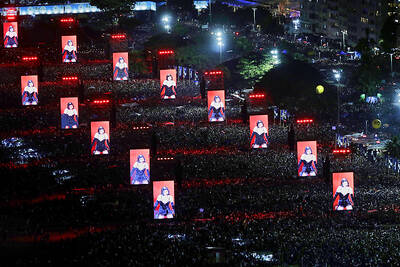
ENTERTAINMENT: Rio officials have a history of organizing massive concerts on Copacabana Beach, with Madonna’s show drawing about 1.6 million fans last year Lady Gaga on Saturday night gave a free concert in front of 2 million fans who poured onto Copacabana Beach in Rio de Janeiro for the biggest show of her career. “Tonight, we’re making history... Thank you for making history with me,” Lady Gaga told a screaming crowd. The Mother Monster, as she is known, started the show at about 10:10pm local time with her 2011 song Bloody Mary. Cries of joy rose from the tightly packed fans who sang and danced shoulder-to-shoulder on the vast stretch of sand. Concert organizers said 2.1 million people attended the show. Lady Gaga
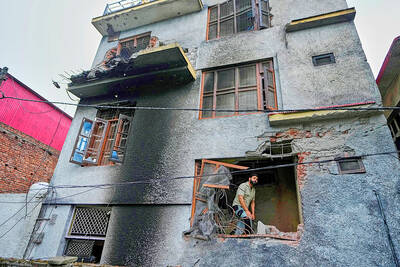
CONFLICTING REPORTS: Beijing said it was ‘not familiar with the matter’ when asked if Chinese jets were used in the conflict, after Pakistan’s foreign minister said they were The Pakistan Army yesterday said it shot down 25 Indian drones, a day after the worst violence between the nuclear-armed rivals in two decades. Pakistani Prime Minister Shehbaz Sharif vowed to retaliate after India launched deadly missile strikes on Wednesday morning, escalating days of gunfire along their border. At least 45 deaths were reported from both sides following Wednesday’s violence, including children. Pakistan’s military said in a statement yesterday that it had “so far shot down 25 Israeli-made Harop drones” at multiple location across the country. “Last night, India showed another act of aggression by sending drones to multiple locations,” Pakistan military spokesman Ahmed


 RSS
RSS