


Venezuela's envoy to the UN quit in protest against President Hugo Chavez's government on Thursday, denting its international image as anti-government demonstrations claimed another life.
The resignation of Ambassador Milos Alcalay was an embarrassment to the leftist leader as he faced a furious opposition campaign for a recall referendum against him that sparked violent street protests across Venezuela.
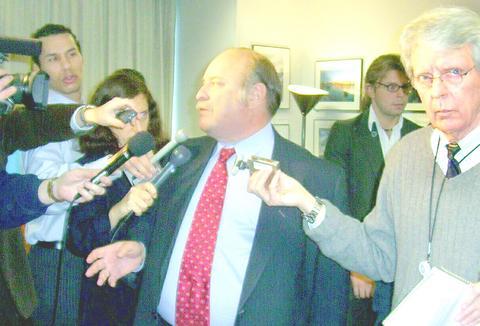
PHOTO: EPA
Alcalay, a career diplomat who had previously backed Chavez, said he objected to a ruling by electoral authorities against the vote bid and to a government crackdown against the protests in which seven people have been shot dead.
"We have a National Electoral Council which instead of providing a solution has put problems before every solution," Alcalay told CNN in Spanish in New York.
He accused Chavez's government of becoming undemocratic and repressive. "I don't feel I can be a spokesman for this situation," he said.
Government officials dismissed his comments and said he was among a group of diplomats who had supported a short-lived coup against Chavez in 2002, but who had kept their jobs.
A woman was shot dead on Thursday after soldiers cleared pro-referendum protesters blocking a highway in the western border town of Machiques. Opposition leaders blamed soldiers, but military officials said a civilian gunman opened fire with a pistol.
In the Andean city of Merida protesters faced off with riot police, but Caracas and other major cities were generally calm on Thursday.
The recent protests are the latest political upheaval to rattle the world's No 5 oil exporter, where Chavez foes accuse the former army paratrooper of edging Venezuela toward Cuba-style communism and dictatorial rule.
The National Electoral Council ruled on Tuesday the opposition had initially failed to collect the 2.4 million valid signatures needed to trigger a vote. Dozens of protesters and several soldiers have been wounded in confused gunbattles since last Friday.
Opposition leaders accuse the electoral council of being biased in favor of Chavez. They are demanding that the body ease conditions for the reconfirmation of around 1 million additional disputed signatures.
Chavez has dismissed the recall vote petition as a "megafraud" filled with forgeries.
But a referendum could still go ahead if around 600,000 of the disputed signatures are validated by voters during the reconfirmation in mid-March. International observers are trying to broker an accord between the opposition and the council on regulations for the additional checks.
Since his 1998 election, Chavez has faced increasing opposition to his self-styled "revolution." But the populist leader maintains a strong following among the poor who applaud his social reforms.
Opponents of Chavez say security forces illegally detained 300 people during the street protests. Officials say the number is much lower and dismiss opposition allegations of abuse.
Referring to this week's events, a top US military commander, General James Hill, head of the US Southern Command, said in Miami on Thursday he saw Venezuela "drifting ... toward authoritarianism."
The US, a key customer for Vene-zuela's state oil company PDVSA, has backed efforts to end the country's conflict through a referendum. But Chavez accuses Washington of supporting his foes, a charge the US routinely dismisses.

Through the noise of rushing papers and whirring belts at a print factory in Kyoto, two creators watch their photo essay come to life in broadsheet form — part of an effort to win new audiences in the age of artificial intelligence (AI). Despite the decline of the publishing industry, self-publication and handmade “zine” magazines are growing in popularity in Japan, reflecting the nation’s enduring love of paper in the digital era. While speaking to Agence France-Presse at the plant, his hands black with ink, one of the creators, Kazuma Obara, said: “I think [paper] is a medium that engages all five
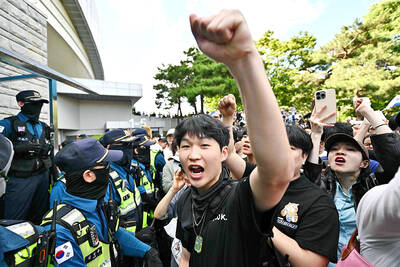
‘ABSURD MISTAKE’: The election commission said that there had been a failure to anticipate turnout after 14 polling stations ran short of ballot papers South Korean riot police yesterday cleared protesters from a Seoul polling station after a 35-hour blockade sparked by a shortage of ballot papers during local elections earlier this week. Wednesday’s election was the first nationwide vote since South Korean President Lee Jae-myung took office following the ouster of Yoon Suk-yeol over his short-lived martial law declaration. Lee’s ruling Democratic Party swept most races, but failed to flip the crucial Seoul mayoral seat. The South Korean National Election Commission apologized, blaming a failure to anticipate turnout after 14 polling stations in Seoul ran short of ballot papers. Some polling stations stayed open until 10pm to

Australian researchers have trained lab-grown brain cells on a silicon computer chip to play the 1990s shooter game Doom and said they are just scratching the surface of what the neurons could be capable of doing. It is the science-fiction work of biotech boffins at Cortical Labs, who researched and developed the technology that harnesses the workings of the brain’s networking system. Each so-called “biological computer” contains about 200,000 living human brain cells, grown from stem cells that were harvested from blood donations. Having mastered the simple computer game Pong, where a paddle is moved up and down to send a ball

France experienced its hottest spring on record, the French weather service said on Tuesday, after an exceptional early heat wave that also broke highs for the season in England and Wales. Meteo-France said the average nationwide temperature over March to May was 13.8°C — about 1.7°C above the norm, and surpassing records set in 2011 and 2020. “The warmest spring since records began in 1900,” it said in a bulletin. All three months were warmer than average, but the onset of an “unprecedented heatwave” late last month pushed the mercury to highs typically seen at the height of the summer. “Our country had never


 RSS
RSS