


From his business-class seat on a flight up the spine of Vietnam on Friday, Nguyen Cao Ky, a former South Vietnamese prime minister, peered down on the cloud-covered northern countryside that he had last seen as a pilot on bombing runs during the Vietnam War.
Now 73 and a visitor to a place whose government outlasted the US and its South Vietnamese ally, Ky was returning to his home city after 50 years. Ky, a former staunch anti-communist, had already spent a busy week socializing, playing golf and sightseeing in Ho Chi Minh City. He said he had been assured of a warm welcome in Hanoi.
The flamboyant clothes that once earned Ky a reputation as South Vietnam's playboy prime minister were gone, replaced by a sedate cashmere sports jacket and tie. His 1960s full brush mustache was trimmed back, and golf clubs for playing on a newly created course near Hanoi were stashed in the hold.
When his countrymen ask about dealing with Americans, he said, "I tell them to be open and frank with the good Americans." For "the bad Americans," he recommended a forceful kick in the seat of the pants.
Asked who the "bad Americans" were, the former prime minister declined to be specific.
His visit has the approval of the Hanoi government, which wants to improve relations with the US, particularly as a balance against China, Vietnam's neighbor and one-time occupier.
But the trip has aroused opposition among a faction of the South Vietnamese exile community in the US, particularly in California, where anti-communist sentiment runs strong and where Ky has spent most of his time as a businessman since fleeing Vietnam after the fall of Saigon in 1975.
Religious groups in the US have also protested what they call the government's persecution of members of ethnic minorities who have become Protestants.
But Ky said he believed it was time for reconciliation, and a new chapter. Those Ky called "the stupid rulers" of South Vietnam -- president Nguyen Van Thieu, under whom Ky served, and president Ngo Dinh Diem, whom Ky helped overthrow -- are both dead, he observed.
"Younger men, in their 50s and 60s, are in charge in Hanoi," he said. "They know they have to get on with America."
As well, he said, the Vietnamese want to balance their complicated relationship with China with better dealings with the US. As China has become stronger in Asia, Vietnam has become more wary, even though the two countries share some communist political beliefs.
"Economically, China can destroy Vietnam, and the government knows it," Ky said. "Vietnam could become a district of China again."
Ky's visit, though informal, comes with some behind-the-scenes encouragement from the Bush administration. Last year, a US official suggested to the government here that it try to mend fences with Ky as a way to help Vietnam improve its image in the US. Picking up on the idea, a deputy foreign minister, Nguyen Phu Bin, went to San Francisco last spring and met with Ky.
Bin, now the Vietnamese ambassador in Paris, suggested the trip to Vietnam.
In the months leading up to Ky's arrival, Vietnam took several conventional steps to foster better relations with Washington.
A US Navy vessel docked in Ho Chi Minh City in November, the third such visit in nearly three decades. The head of the Vietnamese military, Pham Van Tra, visited the Pentagon last fall and met with Secretary of Defense Donald Rumsfeld. Deputy Prime Minister Vu Khoan told Secretary of State Colin Powell in December that Vietnam would try to meet the requirements needed for membership in the World Trade Organization by 2005.
While the government has begun to open up the economy and completed a far-reaching trade agreement with Washington two years ago, Vietnam remains one of the poorest and most corrupt nations in Asia.
Ky said the Vietnamese government needed to move faster or risk the country being left far behind. So far he has given two main pieces of advice to government officials: cut down on corruption and narrow the gap between the rich and the poor.
This week he has given this message, he said, to Thanh Vo Viet, until recently a mayor of Ho Chi Minh City and now Ky's new golf partner there.
In his autobiography, Buddha's Child, written with Marvin Wolf, Ky gives an unvarnished account of how he fled the country.
As the North Vietnamese were pushing ever closer to Saigon in 1975, he proposed defending the city house to house, person to person.
But when he failed to persuade anyone, Ky said he loaded up a helicopter with some colleagues and flew out to sea. As he approached the US aircraft carrier Midway, Ky said, he ditched the ivory-handled revolver that John Wayne had given him.
The Americans would disarm them, and Ky said he preferred to disarm himself. After Ky landed, the American sailors unceremoniously pushed his helicopter over the side.

Gaza is rapidly running out of its limited fuel supply and stocks of food staples might become tight, officials said, after Israel blocked the entry of fuel and goods into the war-shattered territory, citing fighting with Iran. The Israeli military closed all Gaza border crossings on Saturday after announcing airstrikes on Iran carried out jointly with the US. Israeli authorities late on Monday night said that they would reopen the Kerem Shalom crossing from Israel to Gaza yesterday, for “gradual entry of humanitarian aid” into the strip, without saying how much. Israeli authorities previously said the crossings could not be operated safely during
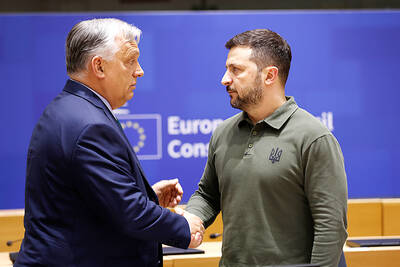
Hungarian authorities temporarily detained seven Ukrainian citizens and seized two armored cars carrying tens of millions of euros in cash across Hungary on suspicion of money laundering, officials said on Friday. The Ukrainians were released on Friday, following their detention on Thursday, but Hungarian officials held onto the cash, prompting Ukraine to accuse Hungary’s Russia-friendly government of illegally seizing the money. “We will not tolerate this state banditism,” Ukrainian Minister of Foreign Affairs Andrii Sybiha said. The seven detained Ukrainians were employees of the Ukrainian state-owned Oschadbank, who were traveling in the two armored cars that were carrying the money between Austria and

Kosovar President Vjosa Osmani on Friday after dissolving the Kosovar parliament said a snap election should be held as soon as possible to avoid another prolonged political crisis in the Balkan country at a time of global turmoil. Osmani said it is important for Kosovo to wrap up the upcoming election process and form functional institutions for political stability as the war rages in the Middle East. “Precisely because the geopolitical situation is that complex, it is important to finish this electoral process which is coming up,” she said. “It is very hard now to imagine what will happen next.” Kosovo, which declared

MORE BANS: Australia last year required sites to remove accounts held by under-16s, with a few countries pushing for similar action at an EU level and India considering its own ban Indonesia on Friday said it would ban social media access for children under 16, citing threats from online pornography, cyberbullying, online fraud and Internet addiction. “Accounts belonging to children under 16 on high-risk platforms will start to be deactivated, beginning with YouTube, TikTok, Facebook, Instagram, Threads, X, Bigo Live and Roblox,” Indonesian Minister of Communications and Digital Meutya Hafid said. “The government is stepping in so that parents no longer have to fight alone against the giants of the algorithm. Implementation will begin on March 28, 2026,” she said. The social media ban would be introduced in stages “until all platforms fulfill their


 RSS
RSS