


North Korea is ready to make a deal but it won't abandon its nuclear-weapons program unless it gets significant security guarantees and long-term economic aid, the top UN envoy to the communist nation said.
Maurice Strong told a panel discussion at the World Economic Forum on Thursday that the US and North Korea both have a sense that time is on their side -- but that he thinks they are wrong and "the crunch will come this year."
Other panelists, including US Representative Jim Leach, a Republican, were less certain.
Strong, who is Secretary-General Kofi Annan's personal envoy, said North Korea is a lot further "down the track" toward developing nuclear weapons than Iraq was, and UN nuclear agency chief Mohamed ElBaradei said "it is almost certain that they have nuclear weapons."
If nothing happens, Strong warned, there will be "almost a de facto acceptance" of North Korea's ability to develop and deliver nuclear weapons, which Pyongyang would prefer.
"The stakes really are very high," ElBaradei said. "We need all to bite the bullet and get a settlement as soon as we can. Everybody will lose" if there is no settlement.
Strong said the US has been very focused on getting rid of the North's nuclear weapons program.
"The real question is does the United States really want to complete an agreement with a regime that many people in the US do not believe is legitimate and want to see gone? The US position so far has been to negotiate" and President George W. Bush has said he wants a diplomatic solution, Strong said.
But an agreement remains elusive.
Beijing has been trying to organize a second round of six-party talks involving the US, North Korea and the other interested parties, China, Japan, South Korea and Russia.
The US has said it is willing to give some form of security guarantees, but North Korea says this falls short of the non-aggression pact they are demanding, Strong said.
The North Koreans also want simultaneous actions -- with their first step of freezing their nuclear program matched by corresponding action on the US side.
But the Bush administration wants the North Koreans to roll back their program before it takes any action, he said.
"The North Koreans are ready for a deal. There is no question about that. But they are not going to abandon their program unless there is a significant security and economic support package," Strong said.
ElBaradei said "whether they are a democracy or a dictatorship ... they need security assurances and they need mainstream trade and economic relations" as well as food.
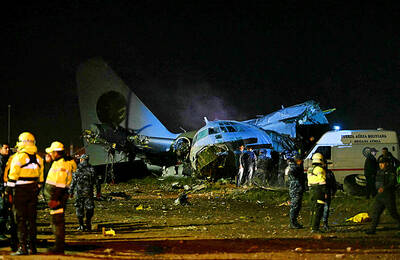
MONEY GRAB: People were rushing to collect bills scattered on the ground after the plane transporting money crashed, which an official said hindered rescue efforts A cargo plane carrying money on Friday crashed near Bolivia’s capital, damaging about a dozen vehicles on highway, scattering bills on the ground and leaving at least 15 people dead and others injured, an official said. Bolivian Minister of Defense Marcelo Salinas said the Hercules C-130 plane was transporting newly printed Bolivian currency when it “landed and veered off the runway” at an airport in El Alto, a city adjacent to La Paz, before ending up in a nearby field. Firefighters managed to put out the flames that engulfed the aircraft. Fire chief Pavel Tovar said at least 15 people died, but
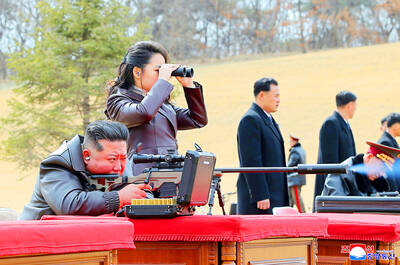
LIKE FATHER, LIKE DAUGHTER: By showing Ju-ae’s ability to handle a weapon, the photos ‘suggest she is indeed receiving training as a successor,’ an academic said North Korea on Saturday released a rare image of leader Kim Jong-un’s teenage daughter firing a rifle at a shooting range, adding to speculation that she is being groomed as his successor. Kim’s daughter, Ju-ae, has long been seen as the next in line to rule the secretive, nuclear-armed state, and took part in a string of recent high-profile outings, including last week’s military parade marking the closing stages of North Korea’s key party congress. Pyongyang’s official Korean Central News Agency (KCNA) released a photo of Ju-ae shooting a rifle at an outdoor shooting range, peering through a rifle scope
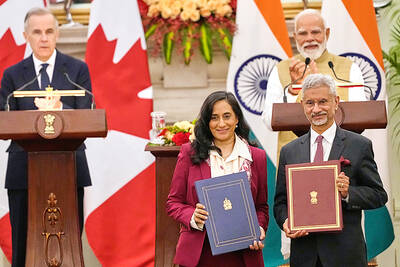
India and Canada yesterday reached a string of agreements, including on critical mineral cooperation and a “landmark” uranium supply deal for nuclear power, the countries’ leaders said in New Delhi. The pacts, which also covered technology and promoting the use of renewable energy, were announced after Indian Prime Minister Narendra Modi and Canadian Prime Minister Mark Carney hailed a fresh start in the relationship between their nations. “Our ties have seen a new energy, mutual trust and positivity,” Modi said. Carney’s visit is a key step forward in ties that effectively collapsed in 2023 after Ottawa accused New Delhi

Gaza is rapidly running out of its limited fuel supply and stocks of food staples might become tight, officials said, after Israel blocked the entry of fuel and goods into the war-shattered territory, citing fighting with Iran. The Israeli military closed all Gaza border crossings on Saturday after announcing airstrikes on Iran carried out jointly with the US. Israeli authorities late on Monday night said that they would reopen the Kerem Shalom crossing from Israel to Gaza yesterday, for “gradual entry of humanitarian aid” into the strip, without saying how much. Israeli authorities previously said the crossings could not be operated safely during


 RSS
RSS