


The nuclear-tipped enmity between India and Pakistan has produced a half-century of warfare, vicious political discourse and countless skirmishes -- some deadly, some petty.
But when things get personal, the situation changes quickly. India and Pakistan may feud over religion and nationalism, but the 1.02 billion Indians and 146 million Pakistanis share an ancient history, a common culture and a colonial albatross.
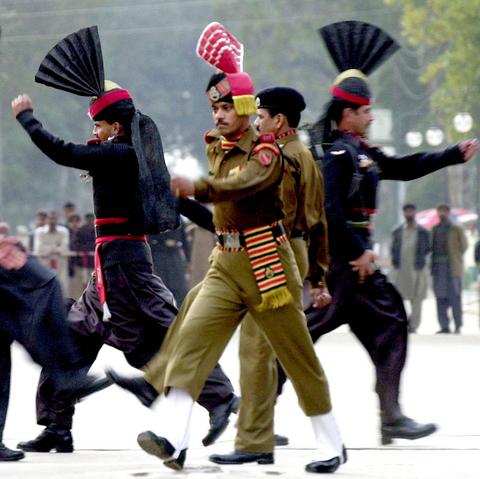
PHOTO: AP
"We are a part of them, they are a part of us," said Irfan Chaudhry, 28, a Pakistani businessman in the city of Lahore. "The Indian culture, their traditions, the way they live, the way they speak, the way they deal with people -- everything is similar to us."
The past few weeks have seen enormous steps toward peace: Talks have been announced, travel links have been reopened and even Kashmir -- the bloody, beautiful Himalayan region claimed by both countries but divided between them -- will be part of the negotiations.
Across the region, there's hope -- cautious given the many false starts of the past -- that a new era is at hand.
The modern history of the Indian subcontinent was born in bitterness and bloodshed. In 1947, when British colonial India was given independence, it came with a partition that carved overwhelmingly Muslim Pakistan from largely Hindu India. Sectarian savagery killed more than 1 million people and uprooted millions more.
But the ties survived, because minus the religious component, these are two peoples who share far more than what divides them.
There are nearly as many Muslims in India as there are in Pakistan. Urdu, the main language of Pakistan, is just a few small linguistic steps from Hindustani, the colloquial language of much of India.
The two nations share the heritage of British colonialism. English is the language of diplomacy. Intellectuals on both sides speak it with the cadence of Oxford scholars. Cricket, that most English of sports, is both countries' favorite. Both countries model their legal and parliamentary systems on Britain's.
Actually going from one country to another, though, has long been a challenge, requiring creativity and often plenty of money. Until the recent peace initiatives eased border restrictions, the trip took nearly a full day of travel, and changing planes in the Persian Gulf.
Direct flights only resumed on Jan. 1, bus service a couple months earlier. The first cross-border train went through in the middle of this month.
But even the most liberal of border-crossers carry decades of emotional baggage.
"With all your so-called open mind and liberal attitudes ... somehow when you land in the space called Pakistan, you realize you're still a hostage to the brainwashing you've had for almost 54 years, of being in `enemy territory,'" said Mahesh Bhatt, an Indian movie director known for sexually charged films and liberal views.
When they do get to visit each other, they can expect a warm welcome.
During the last brief spell of detente, in July 2001, Pakistani President General Pervez Musharraf added a poignant touch to his New Delhi visit by dropping by the mansion where his family lived until the subcontinent was partitioned.
Filmmaker Bhatt, whose mother was Muslim and father Hindu, recently made his first trip across the border. What he got in Pakistan were warm receptions by everyone from government communications officials to hotel waiters to aspiring actors who stopped him on the street to ask about work.
"I felt more at home in Pakistan than I do in some parts of my own country," Bhatt said.
As a powerful player in Bollywood, the Bombay-based Indian movie industry, Bhatt in many ways transcends the border.
India has nearly as many Muslims as Pakistan's entire population, and some of the most famous Indian movie stars are Muslim. Even when relations are at their worst, Bollywood's hundreds of formulaic musicals of romance and adventure are fantastically popular in Pakistan.
Technically, it's illegal to show them in Pakistan. But they are available everywhere on videotape and DVD and in thousands of small video parlors.
Only when relations plummet do the crackdowns come.
"Whenever the situation gets bad, we have to take the India movies and their posters from display, and put them in storage," grumbled Pervez Ahmed, a DVD and video dealer in the Pakistani port of Karachi.
With the recent burst of peace talk, private Pakistani TV stations are airing Indian movies again, and Ahmed hopes he can soon put his videos back on display. Some of that, certainly, has to do with profits. But he insists there are nobler reasons as well -- to "enable people to see Indian culture."
Indians would reply that their real culture has little to do with pelvis-thrusting synchronized dance routines. Still, the Pakistani love of Indian movies reflects a kinship that is able to get beyond the bitterness that has long been fueled by both governments.
The bitterness ebbs and flows with surges in militant violence, and the reactions of both governments to such attacks. When India's parliament was attacked in December 2001, the Indian government blamed Pakistan-backed militants, and clearly fed the anti-Pakistan furor that swept the country.
That anger, though, has died down, and both countries now appear eager for the benefits, from financial to diplomatic, they hope will come with peace.
Reflecting that, not surprisingly, is cricket. In March, India's national cricket team is to begin its first tour of Pakistan in more than a decade.
Cricket is a fairly accurate barometer of India-Pakistan relations. India hasn't played a classic five-day match in Pakistan since the 1989-1990 season, when the Kashmiri militancy erupted and India's leaders began accusing the Pakistani government of backing it.
As the atmosphere began to ease late last year, India's youth cricket team visited Pakistan, and Pakistan's second-string team visited India.
But despite cricket diplomacy, there's still plenty of bigotry to be found on both sides. And though it may be officially fostered, it finds a willing audience.
Go just about any evening to the border town of Wagah, the only place where travelers can legally cross the frontier on foot, and hundreds of Indians and Pakistanis are assembled on opposing sides of the gates for a ritual of patriotism and cross-border insult.
Chants of "Pakistan forever!" compete with "Long live India!" as border guards from both countries close the gates for the night in a choreographed ceremony heavy on strutting soldiers, thrust-out chests and aggressive stares.
As the gates close, the crowds surge toward the fence screaming for blood. Then everyone goes off for snacks, smiling and laughing.
It's an anger long nurtured by politicians on both sides, who use fear of the other to build support and win votes.
More than 50 years after Pakistan was formed, its very existence is still questioned by some of the most ardent Indian nationalists.
"We could have solved our problems among ourselves if Pakistan had not been created," Ashok Singhal, one of India's most prominent Hindu militants, told reporters recently.
Singhal leads the World Hindu Council, the ideological "family" that includes Prime Minister Atal Bihari Vajpayee's governing Bharatiya Janata Party. He calls the latest rapprochement with Pakistan "incomprehensible" and warns darkly of Muslim plotting to create semi-independent Islamic homelands deep inside Indian territory.
No evidence of such schemes has ever surfaced, but such talk terrifies many in Pakistan, who suspect India of creating a pretext to swallow up their country.
The rivalry is felt most acutely in Kashmir, where 65,000 people, most of them Muslim civilians, have died in a bloody 13-year cycle of revolt and repression.
The border is replete with tales of people stuck on the wrong side: teenage boys who accidentally wandered across unfenced areas and wound up in prison accused of espionage; fishermen whose boats drifted the wrong way and spent years in jail; people who tried to commit suicide by throwing themselves in rivers and were arrested after being pulled out on the other side.
And many have to choose sides, a decision that can seem nearly as terrible.
Firdous Javed, a 27-year-old Pakistani, married an Indian Kashmiri five years ago, crossing the border to live with him in Srinagar, the capital of Indian-controlled Kashmir.
Her family remains in Pakistan, less than 320km away. In five years, she's been able to get home only once.
"What can I do?" she asked. "I have a home there and a home here. It is difficult to choose between the two. That's what we had to do, though, and it was agonizing."
Perhaps, though, the recent easing of travel restrictions means she'll be able to go visit again soon.
"I hope this agony will be over," she says.
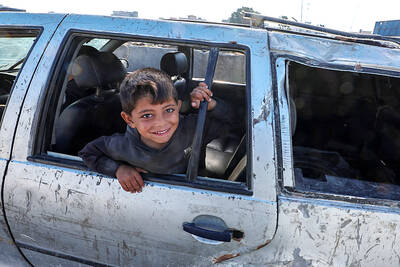
Gaza is rapidly running out of its limited fuel supply and stocks of food staples might become tight, officials said, after Israel blocked the entry of fuel and goods into the war-shattered territory, citing fighting with Iran. The Israeli military closed all Gaza border crossings on Saturday after announcing airstrikes on Iran carried out jointly with the US. Israeli authorities late on Monday night said that they would reopen the Kerem Shalom crossing from Israel to Gaza yesterday, for “gradual entry of humanitarian aid” into the strip, without saying how much. Israeli authorities previously said the crossings could not be operated safely during
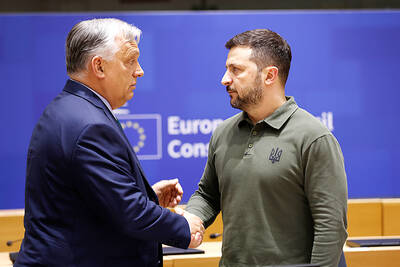
Hungarian authorities temporarily detained seven Ukrainian citizens and seized two armored cars carrying tens of millions of euros in cash across Hungary on suspicion of money laundering, officials said on Friday. The Ukrainians were released on Friday, following their detention on Thursday, but Hungarian officials held onto the cash, prompting Ukraine to accuse Hungary’s Russia-friendly government of illegally seizing the money. “We will not tolerate this state banditism,” Ukrainian Minister of Foreign Affairs Andrii Sybiha said. The seven detained Ukrainians were employees of the Ukrainian state-owned Oschadbank, who were traveling in the two armored cars that were carrying the money between Austria and
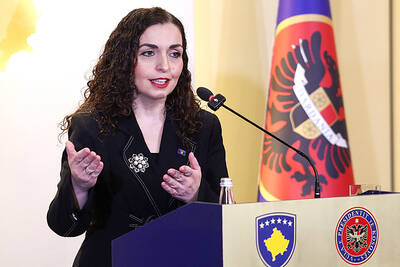
Kosovar President Vjosa Osmani on Friday after dissolving the Kosovar parliament said a snap election should be held as soon as possible to avoid another prolonged political crisis in the Balkan country at a time of global turmoil. Osmani said it is important for Kosovo to wrap up the upcoming election process and form functional institutions for political stability as the war rages in the Middle East. “Precisely because the geopolitical situation is that complex, it is important to finish this electoral process which is coming up,” she said. “It is very hard now to imagine what will happen next.” Kosovo, which declared

MORE BANS: Australia last year required sites to remove accounts held by under-16s, with a few countries pushing for similar action at an EU level and India considering its own ban Indonesia on Friday said it would ban social media access for children under 16, citing threats from online pornography, cyberbullying, online fraud and Internet addiction. “Accounts belonging to children under 16 on high-risk platforms will start to be deactivated, beginning with YouTube, TikTok, Facebook, Instagram, Threads, X, Bigo Live and Roblox,” Indonesian Minister of Communications and Digital Meutya Hafid said. “The government is stepping in so that parents no longer have to fight alone against the giants of the algorithm. Implementation will begin on March 28, 2026,” she said. The social media ban would be introduced in stages “until all platforms fulfill their


 RSS
RSS