


In the year before terrorists killed more than 200 revelers in a Bali nightclub, the head of Indonesia's intelligence agency, General A.M. Hendropriyono, said he was a lonely man.
He alerted Indonesian leaders that terrorists were at work, and could strike at anytime. No one listened, he said. After the World Trade Center attack, some politicians who noticed his friendship with the US ambassador, denounced him as a steward of the Americans.
"I warned all of these things might happen," the general, dressed in a bold, blue-checked shirt, said over a takeout Chinese brunch his staff had laid out elegantly in his spacious, wood-paneled office.
"Instead of listening to me, they blamed me," he said.
To illustrate how prescient he was, the general has a presentation titled "The Problem of Terrorism in Indonesia" ready for viewing in an adjoining conference room.
Prominently featured is the Indonesian vice president, Hamzah Haz, saying, "I guarantee there are no terrorists in Indonesia," juxtaposed with portraits of the Islamic militants who have been arrested in the 14 months since the Bali attack.
Hendropriyono -- widely known in Indonesia as "Hendro" -- says he feels less alone today, now that his political colleagues can no longer deny that terrorism is a problem for Indonesia, the world's most populous Muslim nation.
He has in fact become an important component in Indonesia of the US campaign against terror and has helped Jakarta arrest scores of militants from Jemaah Islamiyah, the homegrown terror organization responsible for the Bali attack and for another attack on the Marriott Hotel in Jakarta in July that killed 12 people.
Beyond satisfying the demands of the Americans themselves, it is no easy job being a crucial ally of the US in a region where US policy has generated deep resentment. One of Hendropriyono's colleagues, Foreign Minister Hassan Wirajuda, in a speech before the US ambassador, said this week that America's "arbitrary" war in Iraq had made the world more dangerous.
That may be more true for Indonesia than some other places. While Hendropriyono is convinced that terrorists here are now on the run, that only makes the hunt harder, he says.
"Jemaah Islamiyaah is no longer intact," the general said, "so their communication is limited. So it is difficult to trace individuals one by one."
His most wanted man, Jemaah Islamiyah's chief bomb-maker, Azahari Husin, recently slipped through the fingers of the Indonesian police. The general said that Azahari had been isolated and knew that he could no longer conduct reconnaissance of prospective target sites.
While most spymasters are reluctant to talk about their work, the general is not above trying to build a higher profile for himself in the rivalry between the police and his intelligence agency as they compete for credit. He is also keen to demonstrate that the intelligence agency, which has a reputation for wielding a strong hand at home, is today a less secretive, more modern outfit.
He agreed to an interview to coincide with the publication of Intel: Inside Indonesia's Intelligence Service, an account of the service's history since its founding 50 years ago. The book was written by an American expert, Kevin Conboy and published by Equinox, an English language press in Jakarta.
Born in central Java in 1945, Hendropriyono followed in his father's footsteps and chose a military career. As a special forces officer, he received training in Australia.

Through the noise of rushing papers and whirring belts at a print factory in Kyoto, two creators watch their photo essay come to life in broadsheet form — part of an effort to win new audiences in the age of artificial intelligence (AI). Despite the decline of the publishing industry, self-publication and handmade “zine” magazines are growing in popularity in Japan, reflecting the nation’s enduring love of paper in the digital era. While speaking to Agence France-Presse at the plant, his hands black with ink, one of the creators, Kazuma Obara, said: “I think [paper] is a medium that engages all five
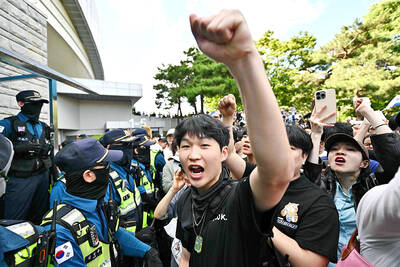
‘ABSURD MISTAKE’: The election commission said that there had been a failure to anticipate turnout after 14 polling stations ran short of ballot papers South Korean riot police yesterday cleared protesters from a Seoul polling station after a 35-hour blockade sparked by a shortage of ballot papers during local elections earlier this week. Wednesday’s election was the first nationwide vote since South Korean President Lee Jae-myung took office following the ouster of Yoon Suk-yeol over his short-lived martial law declaration. Lee’s ruling Democratic Party swept most races, but failed to flip the crucial Seoul mayoral seat. The South Korean National Election Commission apologized, blaming a failure to anticipate turnout after 14 polling stations in Seoul ran short of ballot papers. Some polling stations stayed open until 10pm to

Australian researchers have trained lab-grown brain cells on a silicon computer chip to play the 1990s shooter game Doom and said they are just scratching the surface of what the neurons could be capable of doing. It is the science-fiction work of biotech boffins at Cortical Labs, who researched and developed the technology that harnesses the workings of the brain’s networking system. Each so-called “biological computer” contains about 200,000 living human brain cells, grown from stem cells that were harvested from blood donations. Having mastered the simple computer game Pong, where a paddle is moved up and down to send a ball

France experienced its hottest spring on record, the French weather service said on Tuesday, after an exceptional early heat wave that also broke highs for the season in England and Wales. Meteo-France said the average nationwide temperature over March to May was 13.8°C — about 1.7°C above the norm, and surpassing records set in 2011 and 2020. “The warmest spring since records began in 1900,” it said in a bulletin. All three months were warmer than average, but the onset of an “unprecedented heatwave” late last month pushed the mercury to highs typically seen at the height of the summer. “Our country had never


 RSS
RSS