


Arnold Schwarzenegger, who arrived in the US 35 years ago as a bodybuilder dreaming of fame and fortune, was sworn in as governor of California and said he was ready to take on the "massive weight we must lift off our state."
With his wife, Maria Shriver, holding a 192-year-old Kennedy family Bible, Schwarzenegger took the oath of office Monday from California's chief justice on the steps of the state Capitol.
The 56-year-old Hollywood action hero then gave a 12-minute speech in which he invoked presidents John Kennedy -- his wife's uncle -- and Ronald Reagan and called himself, like JFK, "an idealist without illusions."
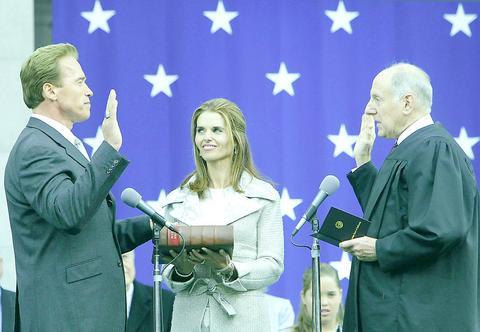
PHOTO: AFP
"Perhaps some think this is fanciful or poetic, but to an immigrant like me -- who, as a boy, saw Soviet tanks rolling through the streets of Austria -- to someone like me who came here with absolutely nothing and gained absolutely everything, it is not fanciful to see this state as a golden dream," Schwarzenegger said in becoming California's 38th governor.
He promised to put the state's finances in order, and added: "I will not rest until California is a competitive, job-creating machine."
Although he had no experience as an elected official, the Republican was swept into office in the Oct. 7 election that ousted Democratic governor Gray Davis, reviled by the voters for his handling of the state's sickly economy.
An immigrant from Austria who arrived in the US at age 21 barely able to speak English, Schwarzenegger is now the leader of the nation's most populous state and the world's sixth-biggest economy.
Schwarzenegger faces a budget deficit that he put at more than US$24 billion; a business climate that some economists say is the nation's worst; and a Democrat-dominated legislature that may not be in a cooperative mood.
"There's a massive weight we must lift off our state. Alone, I cannot lift it. But together, we can," he said.
He promptly made good on at least one campaign promise: He repealed the tripling of California's car-registration tax, which means the state must find an additional US$4.2 billion to make up for the lost revenue.
Schwarzenegger then called the legislature into special session to address the budget and reform the workers' compensation system.
He has also promised a balanced budget that does not include any new taxes or significant cuts in education and local governments, and he wants to repeal a bill granting driver's licenses to undocumented immigrants.
In addition, Schwarzenegger said he wants the legislature to put a massive bond proposal before voters in March, in combination with a state spending cap aimed preventing similar financial problems in the future -- both items that lawmakers will need to act on before Dec. 5. The session was scheduled to begin yesterday.
"I learned something from all those years of training and competing," he said. "What I learned is that we are always stronger than we know. California is like that, too."
As he was sworn in, Schwarzenegger was accompanied by four of the five living former governors of California, including Davis. Only Reagan, who is suffering from Alzheimer's disease, was not present.
The ceremony was devoid of much of the usual inaugural pageantry. Bitterness over the recall vote and the state's financial troubles prompted Schwarzenegger to push for a more low-key ceremony.
Nevertheless, the inauguration had 7,500 invited guests, in addition to several thousand people watching from the street, and drew such celebrities as Dennis Miller, Jamie Lee Curtis, Danny DeVito, Rob Lowe and Vanessa Williams, who sang the national anthem. Hun-dreds of journalists from around the globe covered the event, some from Japan, France and Austria.
The recall movement was launched in February by activists angered over the state's budget woes and the prospect of higher taxes.
Schwarzenegger won with 48 percent of the vote over a list of 134 other candidates vying to replace Davis, who was bounced by 55 percent of the voters.
The governor of California is paid US$175,000 per year, but Schwarzenegger, has not said whether he would accept it. He will have a residence in Sacramento, but his family is not expected to move from Los Angeles.

‘CROSSING THE LINE’: China’s embassy in Seoul criticized US Forces Korea Commander General Xavier Brunson, asking if his ‘hostile’ remarks were authorized by Washington South Korea and the US are in talks over recent public remarks by the commander of US Forces Korea, Seoul’s presidential office said yesterday, after the comments drew sharp criticism from China. In a recent podcast interview, US Forces Korea Commander General Xavier Brunson described South Korea as “the dagger in the heart of Asia” from China’s east coast, prompting the Chinese embassy in Seoul to say that he had “truly crossed the line.” The interview came amid growing speculation that Washington might seek to expand the role of US Forces Korea in countering the growing regional influence of China, a key

Through the noise of rushing papers and whirring belts at a print factory in Kyoto, two creators watch their photo essay come to life in broadsheet form — part of an effort to win new audiences in the age of artificial intelligence (AI). Despite the decline of the publishing industry, self-publication and handmade “zine” magazines are growing in popularity in Japan, reflecting the nation’s enduring love of paper in the digital era. While speaking to Agence France-Presse at the plant, his hands black with ink, one of the creators, Kazuma Obara, said: “I think [paper] is a medium that engages all five

Australian researchers have trained lab-grown brain cells on a silicon computer chip to play the 1990s shooter game Doom and said they are just scratching the surface of what the neurons could be capable of doing. It is the science-fiction work of biotech boffins at Cortical Labs, who researched and developed the technology that harnesses the workings of the brain’s networking system. Each so-called “biological computer” contains about 200,000 living human brain cells, grown from stem cells that were harvested from blood donations. Having mastered the simple computer game Pong, where a paddle is moved up and down to send a ball

A surprising gut feeling may help pigeons find their way home. Animals use various techniques to navigate, including following the stars and remembering key landmarks. Birds, fish and turtles orient themselves using Earth’s magnetic field as a compass, but it is not yet clear how exactly they do this. Pigeons are a well-known group of frequent flyers that can traverse hundreds of kilometers in a single day. For thousands of years, humans have used them to carry news, notes and military messages. Scientists have long tried to untangle how pigeons travel without getting lost. Some think the birds detect magnetic cues using light-sensitive


 RSS
RSS