


Indignant at police raids on Hong Kong's gay bars, activist Kenneth Cheung has decided to take on the law by running for public office.
"I want to reflect the views of minority groups who don't speak for themselves," explained Cheung, one of a new breed of independent candidates in local elections whose political zeal was awakened by "people power" protests against the Beijing-backed government this year.
Hong Kong's District Council elections are usually drab affairs, reflecting the mundane work of bodies that deal with issues like rubbish collection and park management.
But in these politically heady times, campaigning has turned into an exercise in grass-roots democracy that is likely to make Chinese leaders in Beijing nervous.
"There has been an explosion of civil society since July 1," said Sonny Lo, politics lecturer at the University of Hong Kong, referring to the mass demonstrations that forced the government to withdraw anti-subversion legislation and led to the resignations of three ministers.
"More people have come out to fight for gay rights, the unemployed, ethnic minorities and other marginalized groups," he said.
Cheung, 28, is running as an independent. He joins an assortment of teachers, social workers and fresh school leavers making a pitch to voters who have felt the power that comes through a collective voice.
"People are more politically aware now and we should press for democratic reforms," Chung said.
Rabbi Imran, an electronics trader, is running on an issue close to the hearts of Hong Kong's small Muslim community: halal food in schools.
"Not a single school in Hong Kong has catering services for people who eat halal food," he complained. "Many Muslim children now go hungry until they reach home."
"If I get elected, I will push for schools with Muslim pupils to provide halal food in canteens."
Four hundred seats are up for grabs in the Nov. 23 election. Some 840 candidates have thrown their hats into the ring, up from 800 in the last 1999 polls. A record 2.4 million residents are eligible to cast votes -- 170,000 of them for the first time.
Previously, candidates have been roughly divided into pro-Beijing and pro-democracy camps.
Chinese leaders will be watching these polls closely. Significant gains for the democrats would be seen as a mandate for faster democratization, which Beijing has resisted.
University tutor Mary Ann King, 39, vying to represent the harborfront district of Wanchai, said: "Once I'm elected, I will help to get more compensation for residents who have been ordered out of their homes to make way for redevelopment."
It will be a tough fight for many new faces who lack the financial backing and core of loyal supporters that pro-China politicians command.
One formidable force is the Democratic Alliance for the Betterment of Hong Kong (DAB), a party that showers potential supporters with banquets and free holidays in China.
"Lots of residents don't even allow us to put up our posters in their estates because they are DAB supporters. Some even refuse to have me stand outside their shops," said King.
But the tide may be turning. The DAB fell out of favor with many residents in July when it sided with the government over the unpopular anti-subversion law.


Through the noise of rushing papers and whirring belts at a print factory in Kyoto, two creators watch their photo essay come to life in broadsheet form — part of an effort to win new audiences in the age of artificial intelligence (AI). Despite the decline of the publishing industry, self-publication and handmade “zine” magazines are growing in popularity in Japan, reflecting the nation’s enduring love of paper in the digital era. While speaking to Agence France-Presse at the plant, his hands black with ink, one of the creators, Kazuma Obara, said: “I think [paper] is a medium that engages all five
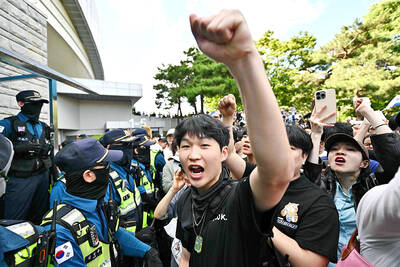
‘ABSURD MISTAKE’: The election commission said that there had been a failure to anticipate turnout after 14 polling stations ran short of ballot papers South Korean riot police yesterday cleared protesters from a Seoul polling station after a 35-hour blockade sparked by a shortage of ballot papers during local elections earlier this week. Wednesday’s election was the first nationwide vote since South Korean President Lee Jae-myung took office following the ouster of Yoon Suk-yeol over his short-lived martial law declaration. Lee’s ruling Democratic Party swept most races, but failed to flip the crucial Seoul mayoral seat. The South Korean National Election Commission apologized, blaming a failure to anticipate turnout after 14 polling stations in Seoul ran short of ballot papers. Some polling stations stayed open until 10pm to

France experienced its hottest spring on record, the French weather service said on Tuesday, after an exceptional early heat wave that also broke highs for the season in England and Wales. Meteo-France said the average nationwide temperature over March to May was 13.8°C — about 1.7°C above the norm, and surpassing records set in 2011 and 2020. “The warmest spring since records began in 1900,” it said in a bulletin. All three months were warmer than average, but the onset of an “unprecedented heatwave” late last month pushed the mercury to highs typically seen at the height of the summer. “Our country had never

A Sherpa guide was found crawling to base camp on Mount Everest a week after he went missing and was reunited with his family, who had given up hope he would return. Dawa Sherpa was last seen on Friday last week descending the mountain, but he did not reach base camp even though his client did. The pair were among the last climbers on the mountain as the climbing season came to an end and the route was dismantled. Dawa was located by a cleaning crew on Thursday morning as he was crawling down the snowy slopes around the Khumbu Icefall, just above


 RSS
RSS