


Sri Lanka's prime minister, embroiled in a power struggle with the president, will meet with her today in their first face-to-face meeting since the country was plunged in political crisis last week, his office said.
The announcement yesterday coincided with Norwegian peace brokers arriving in Colombo and meeting with European monitors overseeing Sri Lanka's ceasefire with Tamil rebels.
The two developments were not related, but they raised hopes that this tropical island of 19 million people will not be pushed back to war with the separatist rebels. A day earlier, President Chandrika Kumaratunga asked Prime Minister Ranil Wickremesinghe to discuss her proposal for a coalition government.
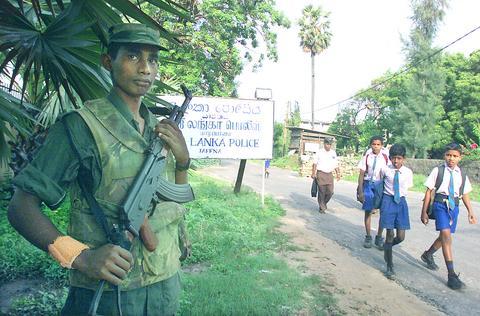
PHOTO: REUTERS
The prime minister's spokesman, G.L. Peiris, said the premier will "discuss ways and means to resolve the present crisis." He did not elaborate.
"Events of last few days have damaged the peace process and the prime minister wants to make it sure that it is not damaged any further," said Peiris, who also heads the government delegation at peace talks.
Meanwhile, Vidar Helgesen, Norway's deputy foreign minister, and special envoy Erik Solheim met with officials from the Sri Lanka Monitoring Mission after arriving in Colombo late Monday, said Tomas Stangeland, a spokesman for the Norwegian Embassy.
A Monitoring Mission spokeswoman said the envoys discussed their proposed meetings with Sri Lankan officials and Tamil Tiger rebels, and expressed confidence in the February truce last year between the two sides.
"We have already told the Norwegian government that we have words from both parties that the ceasefire will hold," said Agnes Bragadottir, spokeswoman for the 55-member mission. "Indeed, the ceasefire is holding and our monitors on the ground are keeping a close watch."
Norway brokered the cease-fire that halted 19 years of fighting and led to six rounds of peace talks. But the rebels walked out of the talks in April, demanding broader administrative powers in Tamil-majority areas of the island.
Face-to-face talks had been expected to start after the rebels submitted a self-government proposal Oct. 31. But the political standoff between the president and prime minister set back those plans, and on Monday, the government said peace talks with the rebels were indefinitely postponed.
Kumaratunga, who sees the rebel proposal as an assault on Sri Lanka's sovereignty, on Nov. 4 wrested control of the ministries of defense, interior and media -- which had spearheaded peace efforts -- from Wickremesinghe.
She also suspended Parliament and briefly declared emergency rule.
The Norwegians also were scheduled to meet with officials from both the president's and the prime minister's parties, Stangeland said. The two envoys, who leave Sri Lanka tomorrow, was due to meet with Wickremesinghe late yesterday.
Pro-rebel Web site TamilNet reported the Norwegian meeting with the Monitoring Mission, saying the two envoys "would try to bring a consensus between ... [the] president [and the] prime minister and the Liberation Tigers of Tamileelam to revive the peace talks."
The report cited unidentified diplomatic officials.
The Norwegians are scheduled to meet with the rebel leadership when they travel tomorrow to Kilinochchi, the de facto capital of rebel-controlled Sri Lanka.

PARLIAMENT CHAOS: Police forcibly removed Brazilian Deputy Glauber Braga after he called the legislation part of a ‘coup offensive’ and occupied the speaker’s chair Brazil’s lower house of Congress early yesterday approved a bill that could slash former Brazilian president Jair Bolsonaro’s prison sentence for plotting a coup, after efforts by a lawmaker to disrupt the proceedings sparked chaos in parliament. Bolsonaro has been serving a 27-year term since last month after his conviction for a scheme to stop Brazilian President Luiz Inacio Lula da Silva from taking office after the 2022 election. Lawmakers had been discussing a bill that would significantly reduce sentences for several crimes, including attempting a coup d’etat — opening up the prospect that Bolsonaro, 70, could have his sentence cut to

A powerful magnitude 7.6 earthquake shook Japan’s northeast region late on Monday, prompting tsunami warnings and orders for residents to evacuate. A tsunami as high as three metres (10 feet) could hit Japan’s northeastern coast after an earthquake with an estimated magnitude of 7.6 occurred offshore at 11:15 p.m. (1415 GMT), the Japan Meteorological Agency (JMA) said. Tsunami warnings were issued for the prefectures of Hokkaido, Aomori and Iwate, and a tsunami of 40cm had been observed at Aomori’s Mutsu Ogawara and Hokkaido’s Urakawa ports before midnight, JMA said. The epicentre of the quake was 80 km (50 miles) off the coast of
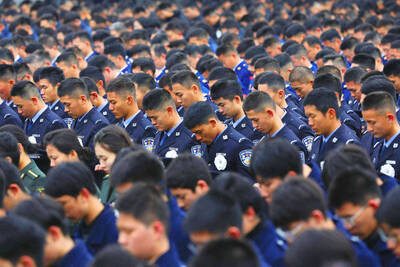
China yesterday held a low-key memorial ceremony for the 1937 Nanjing Massacre, with Chinese President Xi Jinping (習近平) not attending, despite a diplomatic crisis between Beijing and Tokyo over Taiwan. Beijing has raged at Tokyo since Japanese Prime Minister Sanae Takaichi last month said that a hypothetical Chinese attack on Taiwan could trigger a military response from Japan. China and Japan have long sparred over their painful history. China consistently reminds its people of the 1937 Nanjing Massacre, in which it says Japanese troops killed 300,000 people in what was then its capital. A post-World War II Allied tribunal put the death toll

A passerby could hear the cacophony from miles away in the Argentine capital, the unmistakable sound of 2,397 dogs barking — and breaking the unofficial world record for the largest-ever gathering of golden retrievers. Excitement pulsed through Bosques de Palermo, a sprawling park in Buenos Aires, as golden retriever-owners from all over Argentina transformed the park’s grassy expanse into a sea of bright yellow fur. Dog owners of all ages, their clothes covered in dog hair and stained with slobber, plopped down on picnic blankets with their beloved goldens to take in the surreal sight of so many other, exceptionally similar-looking ones.


 RSS
RSS