


Malaysia's new prime minister, Abdullah Ahmad Badawi, made an emotional maiden speech to parliament as leader yesterday, vowing no let-up in the war on terror and promising to tackle corruption.
Abdullah, who an aide said would take over the finance portfolio, said he would stick to the policies of his predecessors and would make the country more attractive to foreign investors.
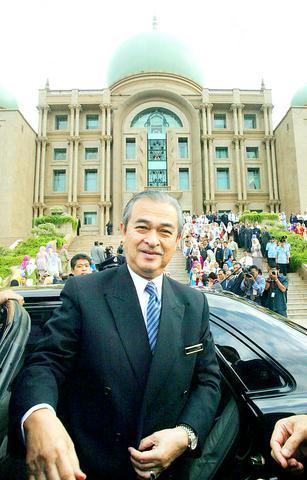
PHOTO: REUTERS
"I assure that I will continue with the policies that have been laid out by the leaders who came before me," Abdullah, who took over on Friday from veteran leader Mahathir Mohamad, told parliament.
The new premier, who was overcome by emotion as he ended his speech, said he would be tough on security and law and order.
"We cannot compromise when dealing with the threat posed by extremism, terrorism and militancy," said Abdullah, a veteran of an old anti-communist psychological warfare department. "Attempts to undermine national security and public order must be dealt with firmly."
There have been no militant attacks in mostly Muslim Malaysia during the global terrorism alert that followed the Sept. 11, 2001, attacks on the US.
But several Malaysians joined Jemaah Islamiah, a Southeast Asian offshoot of Osama bin Laden's al-Qaeda group, which has been accused of masterminding bombings on the tourist island of Bali a year ago and on a Jakarta hotel in August.
During the past two years, Abdullah -- as interior minister -- has signed almost 90 detention orders allowing police to hold militant suspects without trial.
Prime ministerial aides said Abdullah would take over the finance ministry portfolio previously held by Mahathir, and he was retaining Mahathir's economic adviser, Nor Mohamed Yakcop.
Nor Mohamed helped map out banking reform and corporate debt restructuring and advised Mahathir on the establishment of the ringgit currency peg during the Asian financial crisis of the late 1990s.
Investors have been looking forward to the new leadership but the stock market slipped slightly on profit-taking yesterday after hitting a 38-month high on Friday.
The key stock index was down 0.67 percent at 811.66 points by midday yesterday. The index has gained about 26 percent this year.
The handover of power has gone smoothly, but Abdullah now has the hard job of consolidating his premiership while satisfying the ambitions of competing second-tier leaders in the ruling United Malays National Organisation (UMNO).
"The market is on the watch for a smooth succession. [Abdullah] Badawi is in now, but can he hold the coalition and his own party together?" asked an analyst at a foreign brokerage.
Abdullah is likely to hold the finance portfolio only for the time being and is seen appointing a new finance minister after elections expected early next year, according to sources close to the leadership.
But he could announce his choice of deputy premier in December, after the Muslim fasting month of Ramadan. Although he has given no hint, sources say Defense Minister Najib Razak is favorite for the job.
Najib's late father, Abdul Razak, was Malaysia's second prime minister from 1970 to 1976.
By convention, the deputy prime minister is one of the three vice presidents of UMNO, which has led all of Malaysia's multi-ethnic coalitions since independence from Britain in 1957.

‘CROSSING THE LINE’: China’s embassy in Seoul criticized US Forces Korea Commander General Xavier Brunson, asking if his ‘hostile’ remarks were authorized by Washington South Korea and the US are in talks over recent public remarks by the commander of US Forces Korea, Seoul’s presidential office said yesterday, after the comments drew sharp criticism from China. In a recent podcast interview, US Forces Korea Commander General Xavier Brunson described South Korea as “the dagger in the heart of Asia” from China’s east coast, prompting the Chinese embassy in Seoul to say that he had “truly crossed the line.” The interview came amid growing speculation that Washington might seek to expand the role of US Forces Korea in countering the growing regional influence of China, a key

SEEKING ORDER: Rodrigo Paz said that ‘anyone who wants to destroy the nation will have to deal with this president and the full force of the constitution’ Bolivian President Rodrigo Paz on Wednesday said that the nation was at a “breaking point” after nearly a month of protests that have caused shortages of food, fuel and medicine. Paz, who took office six months ago amid the worst economic crisis there in four decades, is battling a groundswell of fury over his policies. The political capital, La Paz, has been besieged by low-income workers and members of the indigenous majority calling for his resignation. “The country needs order and is reaching breaking point,” the 58-year-old said at a public event in La Paz, renewing his appeal for dialogue. On Tuesday, the Bolivian

Through the noise of rushing papers and whirring belts at a print factory in Kyoto, two creators watch their photo essay come to life in broadsheet form — part of an effort to win new audiences in the age of artificial intelligence (AI). Despite the decline of the publishing industry, self-publication and handmade “zine” magazines are growing in popularity in Japan, reflecting the nation’s enduring love of paper in the digital era. While speaking to Agence France-Presse at the plant, his hands black with ink, one of the creators, Kazuma Obara, said: “I think [paper] is a medium that engages all five

Australian researchers have trained lab-grown brain cells on a silicon computer chip to play the 1990s shooter game Doom and said they are just scratching the surface of what the neurons could be capable of doing. It is the science-fiction work of biotech boffins at Cortical Labs, who researched and developed the technology that harnesses the workings of the brain’s networking system. Each so-called “biological computer” contains about 200,000 living human brain cells, grown from stem cells that were harvested from blood donations. Having mastered the simple computer game Pong, where a paddle is moved up and down to send a ball


 RSS
RSS