


In a country where informants are treated as heroes, your neighbor could well be spying on you and the man you thought was a fiercely anti-government dissident may turn out to be a decorated government agent.
Welcome to the murky world of Cuban espionage and counter-espionage, where it's best to stay clear of flower pots in hotel lobbies and assume that the waiter has long ears.
Western diplomats in Havana say their phones are tapped and their steps watched. The more wary switch off their mobile phones at meetings because they could be bugged.
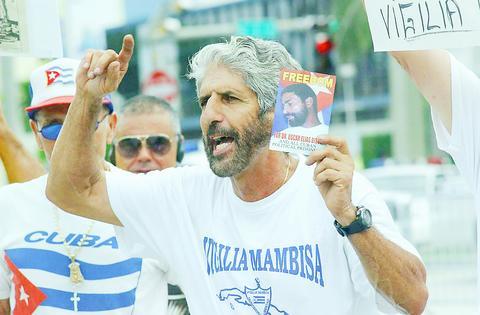
PHOTO: EPA
After four decades as a communist society besieged by the world's most powerful nation just 145km away, Cuba's enduring Cold War climate remains a part of life.
For many it is a world of state vigilance more akin to the omniscient Big Brother of George Orwell's novel 1984 than the antics of Graham Greene's Our Man in Havana, who dispatched vacuum cleaner drawings to London's MI6 as plans for a secret weapon.
"In Cuba anyone can be an agent. It is a society based on fear. There are secret agents everywhere. What works well here is control and propaganda," said Miriam Leiva, a former foreign ministry official who lost her job when her economist husband Oscar Espinosa Chepe became a dissident.
Heroes and villians
He was one of 75 opponents of President Fidel Castro who were arrested in March and jailed for terms of up to 28 years in the harshest crackdown in decades on the communist-run island.
The main witnesses at their one-day trials were 12 dissidents who revealed that they were undercover agents who had infiltrated opposition ranks for many years.
The informants had their stories published in a book and were the toast of the town for posing as "counter-revolutionaries" who got money and support from Cuba's arch-enemy the US.
Far from a shameful occupation, spying is seen as a legitimate weapon by Castro's government to defend itself against its foes.
The CIA has tried countless times to assassinate Castro with cloak and dagger plots such as an exploding cigar and powder to make his beard fall out.
CIA-trained exiles landed in Cuba in 1961 in a failed invasion attempt to oust Castro.
The long arm of Cuban intelligence has penetrated the exile community in Miami to spy on anti-Castro activists planning sabotage and bombings in Cuba from across the Florida Straits.
In 2001, a Miami court convicted five Cubans of espionage and sentenced them to prison terms ranging from 15 years to life.
The spy ring members said they had caused no harm to the US and gathered information only to defend their homeland from exile attacks. They are glorified in anti-American propaganda as "five heroes trapped in the belly of the beast".
In the treacherous world of espionage, Havana has sought to discredit its opponents by showing them to be villains who once collaborated.
A recent book based on secret police files charged that Elizardo Sanchez, Cuba's best known human rights activist, was an agent code-named Juana who had informed on dissidents, diplomats and foreign journalists since 1997.
Photos showed the veteran dissident apparently being decorated for his services by a colonel, handing over documents at a park bench meeting and receiving a bottle of whisky as a present.
"It is a colossal lie," said 59-year-old Sanchez, who heads the Cuban Commission for Human Rights. The book was a montage reminiscent of the KGB's smear campaigns, he said.
"The government is waging a dirty war against us. It's what the KGB used to do, print whole books to discredit people like Solzhenitsyn, Sakharov and Havel," he said.
Infiltrated
The depth to which Cuba's small dissident movement had been penetrated astonished European diplomats who no longer know whom to trust in Havana.
Even after death, Cubans can have their reputations tarnished as moles, as was the case of Jesus Yanez Pelletier, a former Castro aide who later became one of his best-known opponents.
In 2001, on the first anniversary of his death, Yanez's widow was shocked by the arrival of state security agents at the graveside carrying a wreath in a posthumous recognition of decades of duty infiltrating dissident circles.
Cubans have been asked to spy on their families and friends. Eliseo Alberto, the son of noted Cuban poet Eliseo Diego, confessed in a book entitled Report on Myself that he agreed to inform on intellectuals and artists visiting his father.
Neighborhood watch groups called Committees to Defend the Revolution, found on most blocks, have long been the eyes and ears of the government, creating a climate of suspicion and distrust between Cubans, said Roman Catholic priest Jose Corado.
"People have two faces and censor themselves out of fear. They think they are alone and that their neighbor is with the government," Corado said in his parish church in the eastern city of Santiago. "This is pure 1984."

Through the noise of rushing papers and whirring belts at a print factory in Kyoto, two creators watch their photo essay come to life in broadsheet form — part of an effort to win new audiences in the age of artificial intelligence (AI). Despite the decline of the publishing industry, self-publication and handmade “zine” magazines are growing in popularity in Japan, reflecting the nation’s enduring love of paper in the digital era. While speaking to Agence France-Presse at the plant, his hands black with ink, one of the creators, Kazuma Obara, said: “I think [paper] is a medium that engages all five

‘CROSSING THE LINE’: China’s embassy in Seoul criticized US Forces Korea Commander General Xavier Brunson, asking if his ‘hostile’ remarks were authorized by Washington South Korea and the US are in talks over recent public remarks by the commander of US Forces Korea, Seoul’s presidential office said yesterday, after the comments drew sharp criticism from China. In a recent podcast interview, US Forces Korea Commander General Xavier Brunson described South Korea as “the dagger in the heart of Asia” from China’s east coast, prompting the Chinese embassy in Seoul to say that he had “truly crossed the line.” The interview came amid growing speculation that Washington might seek to expand the role of US Forces Korea in countering the growing regional influence of China, a key

Australian researchers have trained lab-grown brain cells on a silicon computer chip to play the 1990s shooter game Doom and said they are just scratching the surface of what the neurons could be capable of doing. It is the science-fiction work of biotech boffins at Cortical Labs, who researched and developed the technology that harnesses the workings of the brain’s networking system. Each so-called “biological computer” contains about 200,000 living human brain cells, grown from stem cells that were harvested from blood donations. Having mastered the simple computer game Pong, where a paddle is moved up and down to send a ball
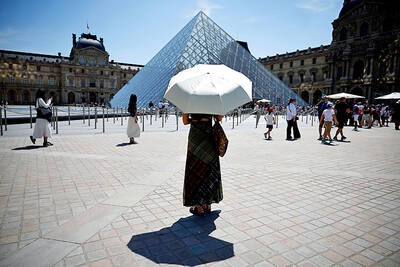
France experienced its hottest spring on record, the French weather service said on Tuesday, after an exceptional early heat wave that also broke highs for the season in England and Wales. Meteo-France said the average nationwide temperature over March to May was 13.8°C — about 1.7°C above the norm, and surpassing records set in 2011 and 2020. “The warmest spring since records began in 1900,” it said in a bulletin. All three months were warmer than average, but the onset of an “unprecedented heatwave” late last month pushed the mercury to highs typically seen at the height of the summer. “Our country had never


 RSS
RSS