


At least 27 people were killed and 116 injured as Typhoon Dujuan slammed into southern China leaving a trail of destruction in its wake, officials said yesterday.
The powerful storm pounded heavily populated Guangdong Province with gale force winds and torrential rains, touching down in Gangkou town around 7:50pm on Tuesday, the Xinhua news agency said.
It swept through several cities in Guangdong, including the capital Guangzhou as well as the economic boom town Shenzhen, and the cities of Shantou and Shanwei, destroying thousands of houses.
Local officials said yesterday they were still struggling to determine the extent of the damage, but information gathered so far reveals an extensive impact.
In Shenzhen, the hardest-hit city, 20 people were killed, including 16 migrant workers who were building a factory on a construction site where several buildings collapsed, according to the Shenzhennews.com Web site and the Xinhua news agency Web site.
Twenty other workers on the site were injured.
Altogether, a total of 98 people were injured in Shenzhen, 20 seriously injured and 78 slightly, said the Web sites, adding that two others were missing.
The typhoon was the worst to hit Shenzhen since 1979, the Shenzhen Web site said.
Some 4,000 people had to be evacuated from unsafe homes, prompting the civil affairs department to open 272 emergency shelters, which housed nearly 5,000 people including evacuees and those whose homes collapsed, the Web site said.
More than 6,000 trees were uprooted and many electricity poles were knocked down, causing two districts in Shenzhen to suffer power outages.
Seventy flights in the city were cancelled.
In other parts of Guangdong Province, seven more people were killed and another 18 injured.
Of the casualties outside Shenzhen, four of the dead and seven of the injured were in Huizhou city -- where the town that the typhoon touched down on is located, according to the China News Service (CNS) Web site.
CNS said the city suffered "serious economic losses".
Two others died and 11 were injured in Shanwei city, including a six-year-old child crushed by a falling ceiling.
"Some 1,500 houses have collapsed. Another 5,000 houses were damaged," said an official surnamed Peng from Shanwei city's disaster relief office. "The typhoon knocked out water and electricity supplies last night, but today supplies have been restored."
The other death was reported in the Guangdong capital Guangzhou, where a man watching TV in his work shed was killed when the roof came crashing down on him, an official from the Guangzhou disaster relief section said.
Strong winds from the typhoon also lashed neighboring Fujian Province's Fuzhou city, but details of damage were not immediately available.
On Tuesday, fears of the typhoon's arrival shut down businesses and schools in Hong Kong, sending residents scrambling for shelter, after the storm lashed Taiwan, leaving two feared dead and causing a major blackout on the island.
Hong Kong was spared a direct hit by Dujuan, but the storm brought heavy rains and powerful winds, injuring 22 people.
Packing winds of 43 meters per second, it also caused massive disruption at Hong Kong's airport, where officials said 151 flights were cancelled and another 115 were delayed.
All land and sea transport resumed yesterday, as schools and offices opened with people heading to work through streets strewn with debris of broken umbrellas and tree branches.
According to the Hong Kong Observatory, Dujuan has weakened into a tropical depression and at 11am was centered in southwestern China's Guangxi Province and is expected to weaken further as it moves west.

Through the noise of rushing papers and whirring belts at a print factory in Kyoto, two creators watch their photo essay come to life in broadsheet form — part of an effort to win new audiences in the age of artificial intelligence (AI). Despite the decline of the publishing industry, self-publication and handmade “zine” magazines are growing in popularity in Japan, reflecting the nation’s enduring love of paper in the digital era. While speaking to Agence France-Presse at the plant, his hands black with ink, one of the creators, Kazuma Obara, said: “I think [paper] is a medium that engages all five
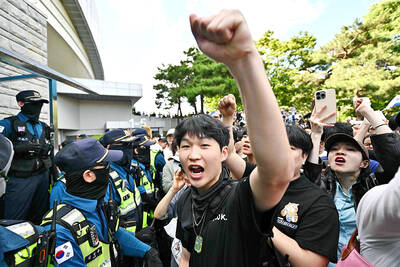
‘ABSURD MISTAKE’: The election commission said that there had been a failure to anticipate turnout after 14 polling stations ran short of ballot papers South Korean riot police yesterday cleared protesters from a Seoul polling station after a 35-hour blockade sparked by a shortage of ballot papers during local elections earlier this week. Wednesday’s election was the first nationwide vote since South Korean President Lee Jae-myung took office following the ouster of Yoon Suk-yeol over his short-lived martial law declaration. Lee’s ruling Democratic Party swept most races, but failed to flip the crucial Seoul mayoral seat. The South Korean National Election Commission apologized, blaming a failure to anticipate turnout after 14 polling stations in Seoul ran short of ballot papers. Some polling stations stayed open until 10pm to

Australian researchers have trained lab-grown brain cells on a silicon computer chip to play the 1990s shooter game Doom and said they are just scratching the surface of what the neurons could be capable of doing. It is the science-fiction work of biotech boffins at Cortical Labs, who researched and developed the technology that harnesses the workings of the brain’s networking system. Each so-called “biological computer” contains about 200,000 living human brain cells, grown from stem cells that were harvested from blood donations. Having mastered the simple computer game Pong, where a paddle is moved up and down to send a ball

France experienced its hottest spring on record, the French weather service said on Tuesday, after an exceptional early heat wave that also broke highs for the season in England and Wales. Meteo-France said the average nationwide temperature over March to May was 13.8°C — about 1.7°C above the norm, and surpassing records set in 2011 and 2020. “The warmest spring since records began in 1900,” it said in a bulletin. All three months were warmer than average, but the onset of an “unprecedented heatwave” late last month pushed the mercury to highs typically seen at the height of the summer. “Our country had never


 RSS
RSS