


Iran's hardline clergy has begun arresting and interrogating journalists, students and political activists in a new attempt to intimidate opposition before next year's parliamentary elections.
In the most extensive wave of detentions in recent years, plainclothes security agents have detained hundreds of student activists as well as journalists and reformist commentators.
"This is not a new process," said Reza Yousefian, a member of parliament and member of the
reformist movement.
"But it has accelerated. They want to prepare themselves for the next round of parliamentary elections," Yousefian said.
"Newspapers and students are the two engines of reform and they have been damaged and disrupted in some way by these arrests," he said.
The most recent detentions include the arrest of Abolghasem Golbaf, the editor in chief of the political monthly Gozaresh.
Ever since the election of reformist President Mohammad Khatami as president six years ago, conservative militants acting through the judiciary and security services appear to have waged a campaign of repression to undermine the reformist movement.
A number of Khatami's allies have been imprisoned, a senior adviser was murdered three years ago and dozens of newspapers have been shut down.
Reformist activists say the pro-democracy demonstrations which erupted in June have provided a fresh opportunity for the conservative clergy to go after the most strident voices demanding reform of the country's theocracy.
Minister of Science, Research and Technology Mostafa Moin submitted his resignation last week amid speculation that he had objected to political interference at universities and had come under pressure to punish student activists after the June demonstrations.
Upon release, many students and other activists are less ready to speak their minds and some journalists choose to stay away from "sensitive" topics. After being freed on bail, dozens of journalists and activists operate under the cloud of a pending trial.
But despite the imprisonment of more than 20 journalists in recent months, the news media and dissident voices are growing increasingly defiant as they test the limits of the system.
Details of psychological torture are emerging and a flurry of open letters to supreme leader, Ayatollah Ali Khamenei, have castigated "authoritarian methods."
In a 32-page letter published last month, Abbas Abdi, a reformist held in solitary confinement, described how the authorities put inmates under extraordinary pressure to extract confessions.
A former student radical who helped to seize the US embassy in 1979, Abdi was imprisoned and accused of plotting with foreign powers after his firm published a poll last year showing more than 70 percent of Iranians favored restoring relations with the US.
The death in custody last month of a Canadian photojournalist of Iranian descent, Zahra Kazemi, shocked the country. Revelations that she died of a blow to the head and that authorities might have tried to hush up details of her case have underlined the reformists' long-held concerns that hardliners are operating parallel security services and unregistered detention centers outside legal authority.
Many voters, disappointed with the pace of reform, are expected to boycott elections next February, allowing the conservatives to win back control of parliament.

Through the noise of rushing papers and whirring belts at a print factory in Kyoto, two creators watch their photo essay come to life in broadsheet form — part of an effort to win new audiences in the age of artificial intelligence (AI). Despite the decline of the publishing industry, self-publication and handmade “zine” magazines are growing in popularity in Japan, reflecting the nation’s enduring love of paper in the digital era. While speaking to Agence France-Presse at the plant, his hands black with ink, one of the creators, Kazuma Obara, said: “I think [paper] is a medium that engages all five
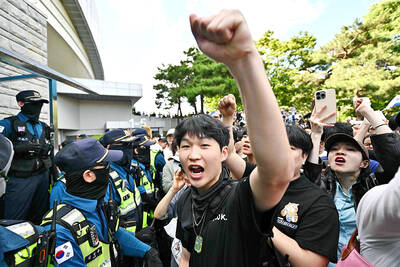
‘ABSURD MISTAKE’: The election commission said that there had been a failure to anticipate turnout after 14 polling stations ran short of ballot papers South Korean riot police yesterday cleared protesters from a Seoul polling station after a 35-hour blockade sparked by a shortage of ballot papers during local elections earlier this week. Wednesday’s election was the first nationwide vote since South Korean President Lee Jae-myung took office following the ouster of Yoon Suk-yeol over his short-lived martial law declaration. Lee’s ruling Democratic Party swept most races, but failed to flip the crucial Seoul mayoral seat. The South Korean National Election Commission apologized, blaming a failure to anticipate turnout after 14 polling stations in Seoul ran short of ballot papers. Some polling stations stayed open until 10pm to

Australian researchers have trained lab-grown brain cells on a silicon computer chip to play the 1990s shooter game Doom and said they are just scratching the surface of what the neurons could be capable of doing. It is the science-fiction work of biotech boffins at Cortical Labs, who researched and developed the technology that harnesses the workings of the brain’s networking system. Each so-called “biological computer” contains about 200,000 living human brain cells, grown from stem cells that were harvested from blood donations. Having mastered the simple computer game Pong, where a paddle is moved up and down to send a ball

France experienced its hottest spring on record, the French weather service said on Tuesday, after an exceptional early heat wave that also broke highs for the season in England and Wales. Meteo-France said the average nationwide temperature over March to May was 13.8°C — about 1.7°C above the norm, and surpassing records set in 2011 and 2020. “The warmest spring since records began in 1900,” it said in a bulletin. All three months were warmer than average, but the onset of an “unprecedented heatwave” late last month pushed the mercury to highs typically seen at the height of the summer. “Our country had never


 RSS
RSS