


All bounty hunters like a good adventure, it comes with the terrain, and for Scott MacLean it was that time in North Carolina when a fugitive held a 9mm handgun to his forehead.
Steady nerves and quick reflexes -- he describes a nice move of using his forehead to slide back the safety catch -- saved his life.
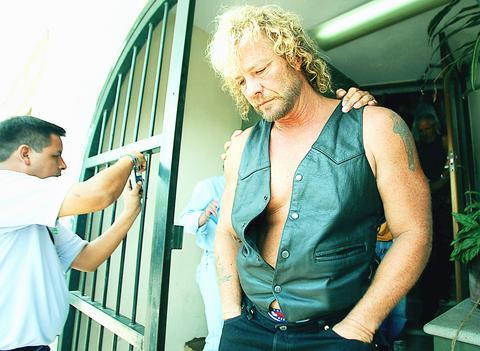
PHOTO: REUTERS
It was also a learning experience, one that MacLean can pass on to other would-be bounty hunters who sign up for his course at the Virginia-based National Association of Bail Enforcement Agents.
The prey had been fast asleep when the bounty hunter walked into his mobile home at 4am. Unluckily for MacLean, the man slept with a gun wedged between the bed and the wall. "That taught me a lesson," he said. "Always check their hands before you wake them up."
Among bounty hunters -- bail enforcement agents to use the designation MacLean prefers -- near-death experiences, betrayal, police obstinancy and personal blunders are common fare. He has encountered more than his fair share of scrapes, clocking up about 860 arrests of bail jumpers since November 1999.
But he was at great pains to point out yesterday that what was uncommon were the unorthodox methods deployed by the bounty hunter Duane Lee Chapman -- or Dog, as he prefers to be known -- in the capture of Andrew Luster, the cosmetics-kingdom heir convicted in absentia on 86 counts of rape.
Luster had eluded police for six months when Chapman, two of Chapman's sons, Chapman's agent and a television crew, wrestled him to the ground at a taco stand in the resort town of Puerto Vallart on Wednesday. Not everyone was impressed.
Although some tributes arrived at Dog's Web site yesterday, other contributors showed little sympathy for Dog and his crew, who spent the day in a Mexican jail.
The FBI said it would not intervene on Dog's behalf, and many of his fellow bounty hunters just winced in annoyance.
Cowboys, sniffs MacLean. "If you do bail enforcement correctly there is no drama," he says. Had he been hunting Luster, he would have immediately notified the US embassy, and handed him over to the authorities.
The way he sees it, bounty hunters are a dying breed in America, unsung heroes making the streets safe for law-abiding citizens, and practitioners such as Dog give them a bad name. And according to MacLean, America's criminal justice would be unsustainable without bounty hunters.
MacLean's idols in the bounty business are self-motivated, independent types, who think on their feet and are skilled at deception. They can come from all walks of life -- he is a former mechanic. Most have a healthy disrespect for police, who are not known for their co-operation with bounty hunters.
Although there are a few celebrities out there -- such as Chapman, and a pint-sized redheaded woman named Mackenzie Green who was profiled in the New Yorker earlier this year -- the real hunters work in the shadows; they are loners.
Most are restricted to a geographical area of the US, where they rely on a steady bank of contacts among petty criminals or the police. A few high-fliers may spread their base of operations further, or trade cases and information coast to coast. But they do not appear to be doing it for the money.
Of the 3,000 members in MacLean's National Association of Bail Enforcement Agents, he estimates all but 300 are part-time operators, who earn perhaps US$10,000 to US$20,000 a year working nights and weekends. MacLean puts himself into a different category altogether.
He won't reveal his income -- bail enforcement is a cash business -- but notes, "My wife drives a BMW and I have two Harley-Davidsons. I do very, very well."
Unlike Britain, America has operated a system of commercial bail since the middle of the 19th century. It is a way of life that could be on the wane as some US states outlaw the practice of bounty hunting, and courts in some jurisdictions assume the role of bail bonds, removing the profit incentive for the hunter.
Until then, however, there will be commercial bondsmen, who will post bail for the accused, usually once they produce evidence of collateral: a house, a car. Sometimes, they can't, and that is where the bond business becomes risky. If the accused fails to turn up for the court date, the bond agent becomes liable for the sum posted.
That is where the bounty hunter comes in, tracking down the fugitive for a typical fee of 10 percent of the value of the bail bond.
They have become a sort of institution in America -- although a largely unregulated one. Nowadays, 20 percent of America's felony defendants jump bail. Almost all are eventually brought back for trial -- not by the police, but by the bounty hunters who track down 88 percent of the fugitives who eventually turn up in court.
That, argues MacLean, shows that the police are either too uninterested or too overburdened to track down bail skips -- particularly those charged with minor offensives. He says the bounty hunters make America safer, preventing criminals from bringing down neighborhoods by returning to their old haunts, and they save the taxpayer money.
That version of the dogged, hardworking investigator has yet to make any imprint on the popular impression of bounty hunters as larger than life romantic figures -- embodied by Chapman's credo of "born on a mountain, raised in a cave, arresting fugitives is all I crave."
The day-to-day work of real bounty hunting is far less glamorous. It starts, say the bounty hunters, with a phone call. The vast majority of people who fail to turn up for court are afraid, or absent-minded, says Solomon Hamilton, a bail agent in the Washington area. Once alerted, most come in of their own accord, although he readily admits to using subterfuge.
"It's a lot better to fool them in than to fight them," he says. "Make the initial phone call, tell them a lie. That's what I tell my people: lie, lie, lie. Bribe, bribe, bribe. Do not pull a gun. Do not fight. Lie."
But almost always -- despite the histrionics of men such as Chapman and the efforts at professionalism of men such as MacLean -- in the end it comes down to the most basic of tactics: tapping the fugitives friends and relations to see who is willing to talk.
"There is always a Judas," says MacLean. "There is always somebody somewhere doesn't like you. My job isn't to find you, my job is to find the person who doesn't like you. Nine times out of 10, you don't even know who that person is."

‘CROSSING THE LINE’: China’s embassy in Seoul criticized US Forces Korea Commander General Xavier Brunson, asking if his ‘hostile’ remarks were authorized by Washington South Korea and the US are in talks over recent public remarks by the commander of US Forces Korea, Seoul’s presidential office said yesterday, after the comments drew sharp criticism from China. In a recent podcast interview, US Forces Korea Commander General Xavier Brunson described South Korea as “the dagger in the heart of Asia” from China’s east coast, prompting the Chinese embassy in Seoul to say that he had “truly crossed the line.” The interview came amid growing speculation that Washington might seek to expand the role of US Forces Korea in countering the growing regional influence of China, a key

SEEKING ORDER: Rodrigo Paz said that ‘anyone who wants to destroy the nation will have to deal with this president and the full force of the constitution’ Bolivian President Rodrigo Paz on Wednesday said that the nation was at a “breaking point” after nearly a month of protests that have caused shortages of food, fuel and medicine. Paz, who took office six months ago amid the worst economic crisis there in four decades, is battling a groundswell of fury over his policies. The political capital, La Paz, has been besieged by low-income workers and members of the indigenous majority calling for his resignation. “The country needs order and is reaching breaking point,” the 58-year-old said at a public event in La Paz, renewing his appeal for dialogue. On Tuesday, the Bolivian
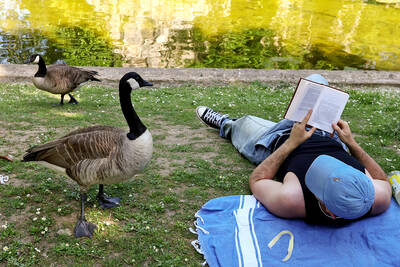
Forecasters in Europe yesterday warned of exceptional heat as record temperatures driven by a “heat dome” push temperatures well above seasonal norms across the continent. The surge follows a record-breaking Monday, with France logging its hottest day in the month of May on record, its weather agency said, and the UK also posting unprecedented highs. A so-called “heat dome” of warm air from northern Africa trapped under a high-pressure system over western Europe is behind the high temperatures not usually seen until high summer. Restrictions on outdoor work were imposed in parts of Italy, beaches in southwest France filled earlier than usual and

Australian researchers have trained lab-grown brain cells on a silicon computer chip to play the 1990s shooter game Doom and said they are just scratching the surface of what the neurons could be capable of doing. It is the science-fiction work of biotech boffins at Cortical Labs, who researched and developed the technology that harnesses the workings of the brain’s networking system. Each so-called “biological computer” contains about 200,000 living human brain cells, grown from stem cells that were harvested from blood donations. Having mastered the simple computer game Pong, where a paddle is moved up and down to send a ball


 RSS
RSS