


The signs of the pain inflicted by the terrorists span New York, from the dust cloud over the southern tip of Manhattan to the faces of the missing tacked onto walls in the East Village to the thousands who watch heartbreaking images of the World Trade Center hulk on giant television screens in Times Square.
But covering all that hurt, not only in New York but across the nation, are countless bandages in red, white and blue. In this city that is so often slow to show its feelings, the American flag bloomed in Manhattan and the boroughs, waved and worn by countless New Yorkers who wanted to do something, anything, to vent their anger and sorrow.
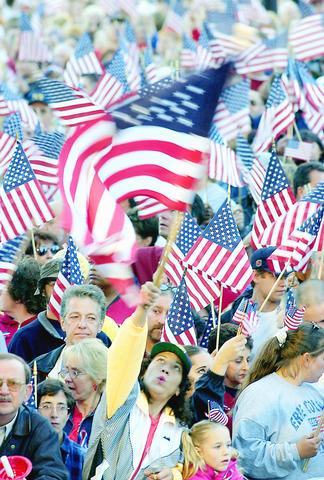
PHOTO: AP
Tiny American flags fluttered from the radio antennas of taxis driven by men from Pakistan, Africa and Latin America. A bicyclist from Belgium, a florist from Korea, a Vietnam veteran from Puerto Rico, all flew the flag in Greenwich Village. Vendors hawked them from midtown sidewalks, patriotism at four bucks a pop.
Watching them, watching us
"Just as the terrorists know that we are watching them, we know that they are watching us," said Moses Davila, an unemployed teacher from Puerto Rico. "When they see us in the streets, wearing the flag, they know that we are not afraid of them, and that we will defeat them."
That sense of patriotism, and defiance, blanketed America.
In Miami, where protests of the government's handling of the custody battle over Elian Gonzalez had included flag desecration (a tow-truck driver dragged the flag through the streets behind his truck), American flags blossomed from porches in Little Havana.
In California and in the South, hardware stores and department stores sold out. In the heartland, tiny flags fluttered like wildflowers in highway medians.
Mohammed Jaje, a cab driver from Pakistan who lives in Brooklyn, had one on his cab until Friday night. Someone took it, he said.
"I am not mad," Jaje said. "Maybe someone needed it. God bless America."
In Hammond, Louisiana, about 130km northeast of New Orleans, Melissa Webb wore a T-shirt decorated with the flag on a shopping trip to the mall.
"We can't do anything to help them because we're down here," said Melissa Webb, 36, who works in a sporting goods store. At least, she said, she can fly the flag to show that her heart is with the rescue crews in New York.
Flag sightings were countless in the nation's capital, one of the biggest billowing from a staff lugged about the city by 82-year-old Joseph Doria, a Filipino-American veteran of World War II.
"For years, I wave this flag in the streets and my neighbors think I'm crazy or a communist," said Doria, who seemed in danger of toppling as he grasped a flag twice his size.
"We divided and scattered after the war. But now, my friend, history repeats," he said of the terror attacks. "And we are learning America's heritage again."
In Greenville, South Carolina, stores sold out of flags by the weekend. Home Depot and Wal-Mart did not have any left.
Around the city, thousands flapped in the wind, outside houses, on mailboxes, everywhere. It seemed that at least one in every three cars in Greenville had a flag on it, sometimes two.
Some did not have to shop for a flag. Bob Krause, a former marine, had flags that have been in the family for generations, flags that flew over old wars. Brock Sanders hung a 48-star American flag inherited from his grandfather who had flown the same flag after Pearl Harbor was bombed.
On Peachtree Road in Atlanta, signs of patriotism marked almost every block -- flags flying at half-staff in Buckhead in front of Lenox Square and Phipps Plaza malls, at the Marta train station. Expensive homes with neatly trimmed lawns have flags draped across the front door.
A red Cadillac with four large flags in each corner, its radio blaring "Stop, hey, what's that sound, everybody look what's going down," pulled out of Rocky's Italian Restaurant on Peachtree where a band was playing a "USA Jam" to raise money for the Red Cross. A woman walked out of a church on Peachtree wearing an antebellum-style Southern bonnet with red, white and blue ribbons.
On a football weekend in the Deep South, cars that would have normally flown college flags now flew one, the same one.
American heartland
In the heartland, the flag waved from the antennas of hot rods. In Brookville, Ohio, gasoline stations and the Holiday Inn pushed flags on 2-foot sticks into their grounds. Hastily made paper flags appeared in windows of trailers and rich people's homes. Flags appeared on the tops of buildings that had never before wore one. In Rockford, Rochelle and Le Roy, Illinois, the flag hung at half-staff and from poles in front of courthouse squares, schools, town halls and police stations.
"There is hope in that familiar sight," wrote Carin Chappelow, in a column for the Journal Review, a daily newspaper with a circulation of 10,000 in Crawfordsville, Indiana. The Wal-Mart there ran out of flags on Wednesday.
At the start of a prayer service in front of the court house in Crawfordsville, Glen Long, a member of the local post of the Veterans of Foreign Wars, clutched three small flags. "Five minutes ago I had 48," he said.
Near Washington, in the well-to-do, normally sedate Chevy Chase Village, on the northwest edge of the capital, six flags appeared on a single block of Grafton Street. John Klein, a retired federal worker, usually puts one up on holidays. Klein's flag is there again. But there is another on the home of Laurence Alvarado, an accounting firm executive, and another at the home of Peter Yeo, a Senate aide, and Ann Urban, a consultant. Another waves across the street, from the stoop of Emilie Downs and Clark Evans Downs, a partner in a law firm in Washington. "Because of what happened," said Julia Downs, one of the couple's two college-age daughters.

SILENCING CRITICS: In addition to blocking Taiwan, China aimed to prevent rights activists from speaking out against authoritarian states, a Cabinet department said The Ministry of Foreign Affairs (MOFA) yesterday condemned transnational repression by Beijing after RightsCon, a major digital human rights conference scheduled to be held in Zambia this week, was abruptly canceled due to Chinese pressure over Taiwanese participation. This year’s RightsCon, the world’s largest conference discussing issues “at the intersection of human rights and technology,” was scheduled to take place from tomorrow to Friday in Lusaka, and expected to draw 2,600 in-person attendees from 150 countries, along with 1,100 online participants. However, organizers were forced to cancel the event due to behind-the-scenes pressure from China, the ministry said, expressing its “strongest condemnation”
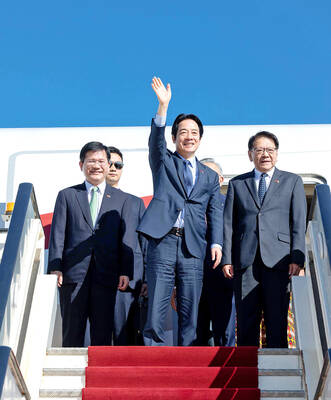
DELAYED BUT DETERMINED: The president’s visit highlights Taiwan’s right to international engagement amid regional pressure from China President Willaim Lai (賴清德) yesterday arrived in Eswatini, more than a week after his planned visit to Taiwan’s sole African ally was suspended because of revoked overflight permits. “The visit, originally scheduled for April 22, was postponed due to unforeseen external factors,” Lai wrote on social media. “After several days of careful arrangements by our diplomatic and national security teams, we successfully arrived today.” Lai said he looked forward to further deepening Taiwan-Eswatini relations through closer cooperation in the economy, agriculture, culture and education, as well as advancing the nation’s international partnerships. The president was initially scheduled to arrive in time to celebrate
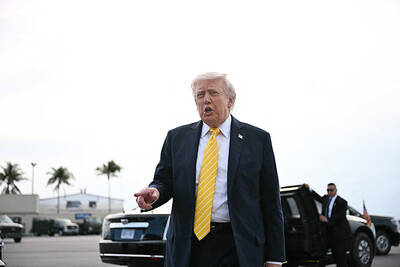
Iran’s Islamic Revolutionary Guard Corp (IRGC) yesterday said the US faced a choice between an “impossible” military operation or a “bad deal” with Tehran, after US President Donald Trump disparaged Iran’s latest peace proposal. Negotiations between the two countries have been deadlocked since a ceasefire came into effect on April 8, with only one round of direct peace talks held so far. Iran’s Tasnim and Fars news agencies reported that Tehran had submitted a 14-point proposal to mediator Pakistan, but Trump was quick to cast doubt on it. “I will soon be reviewing the plan that Iran has just sent to us, but

A group affiliated with indicted Chinese immigrant Xu Chunying (徐春鶯) is to be dissolved for monitoring Chinese immigrants in Taiwan, a source said yesterday. Xu, the secretary-general of the Cross-Strait Marriage and Family Service Alliance, was indicted on March 24 on charges of violating the Anti-Infiltration Act (反滲透法). The alliance “illegally monitored" Chinese immigrants living in Taiwan on behalf of the Chinese Communist Party (CCP) and the Ministry of the Interior is expected to dissolve the organization in the coming days under provisions of the Civil Associations Act (人民團體法), the source said. Xu, who married a Taiwanese in 1993 and became a Republic


 RSS
RSS