


Taipei Times: What is the main role of the International Federation of the Phonographic Industry (IFPI) in Taiwan (國際唱片業交流基金會) and what kind of cooperation are you getting from the government in achieving your organization's goals?
Robin Lee: IFPI Taiwan is a member of IFPI International and our main role is to protect the intellectual property rights (IPR) of the recording industry. For example, we help record companies by persecuting any rulebreakers through legal action. In addition, IFPI Taiwan plays a role as a communications bridge between the recording industry and government authorities. We work closely with government authorities such as the Ministry of Economic Affairs, the Ministry of Education, Intellectual Property Office, the National Police Administration and the Legislative Yuan and they also [approach] IFPI Taiwan and seek our suggestions on certain critical issues from time to time.
TT: What kind of dollar impact is Taiwan's piracy problem having on the local record industry?

PHOTO: GEORGE TSORNG, TAIPEI TIMES
Lee: The population of Taiwan is only some 22 million residents, but Taiwan has shown extraordinary consumption power in the recordings market. Before 1999, Taiwan used to be the second-largest market next to Japan in Asia, and was also the "creative center" for Chinese music. However, due to increasing piracy levels, market sales were down drastically from NT$100 billion in 1999; and to some NT$50 billion in 2001. In 1997, there were only 72 piracy raid cases, but that number jumped to 2,235 cases in 2001 -- almost 30 times more than in 1997. Therefore, we have to warn that the local recording industry may very possibly disappear, following in the footsteps of the local movie industry -- which disappeared within three to five years after the moment piracy reared its head in the industry.
We and the local record industry have spent a lot of time and resources and we are getting some additional help from the police -- but the impact of our efforts seems minimal. Piracy levels went up starting in 1997. The piracy level jumped to around 48 percent between 2000 and 2001 [not including illegal MP3 downloads].
TT: Were IFPI Taiwan's recent protest march against the actions of the music industry successful?
Lee: Whether the march that we held on April 4 was successful or not is a question we can't answer now. It's too early to say so, because the results depend on the actual outcome of the government's decisions.
The major target of the April 4 protest was the Taiwan government. It is a cry from the bottom of the recording industry workers' hearts to ask for government's help in protecting their rights to work and in safeguarding the existence of the Taiwanese recording industry. During the protest march we delivered four major demands to the government. First of all, it must establish a permanent police division to fight piracy exclusively. Secondly, to amend the Copyright Law to make pirating a public offense. Thirdly, to strictly enforce regulations to completely shut down pirating plants. And fourthly, to swiftly pass the laws and regulations governing the actions of ISPs (Internet Service Providers) and other Internet activities.
Later that day, we were very glad to receive Premier Yu Shyi-kun's sincere response to the above requests -- with the exception of his reply to the last request regarding the Internet legislation.
This protest is just the beginning for IFPI Taiwan to achieve its goal, while it will take time to review the results of the government's efforts.
Of course, the protest is not our last action and we plan to participate in several public hearings held by legislators.
TT: Can this type of event help overcome the failure of the education system to instill respect for intellectual property rights in today's youth?
Lee: This is a complicated question and we have to deal with it in many steps. Firstly, we have already asked the Ministry of Education to pay more attention to teaching Taiwan's youth why they should respect intellectual property rights. Also, our foundation has cooperated with many artists from IFPI Taiwan's member companies in drives aimed at educating their young fans -- the drives were held at various events, including concerts and media interviews.
However, the most critical problem is the flaws in our judicial system. Among the more than 2000 raids reported by IFPI Taiwan last year, around 75 percent of the suspects -- or about 1,700 people -- were juveniles, aged between 11 to 17. Because juveniles are below the statutory age for criminal responsibility, judges cannot impose criminal penalties upon them -- they can only reprimand them for their misconduct or send them to a juvenile correctional institute. As a result, criminal organizations frequently employ juveniles to distribute fake discs in order to sidestep legal persecution.
TT: With the US again including Taiwan on its annual Special 301 Priority Watch List this year, what does this say about government efforts on the IPR issue?
Lee: First of all I would like to point out that IFPI Taiwan's main goal is to protect the interests of the domestic recording industry, while of course we also try to protect the legal rights of international copyright owners. I think Special 301 is a positive pressure reminding the government that they have to put more effort into protecting intellectual property. The pressure from Special 301 will go away once the government gets better at protecting IPR.
I think the government has put a lot of effort into IPR issues, but they haven't done things right. The previously mentioned inadequacies in judicial enforcement and legislation are the only reason why Taiwan's government has to face pressure from 301 year after year. That is a good motivation for the industry and the government to review their in IPR-protection plan.
TT: Is the threat from technologies like MP3 downloads and inexpensive CD burners a serious problem in Taiwan?
Lee: Technology is neutral in nature. The record industry never protest any new technology, but we do worry about such new technologies being abused for piracy ends. MP3 technology and the Internet are revolutionizing the distribution of music. However, any newly developed technology should also follow the copyright laws. MP3 downloading is a kind of unauthorized reproduction, and it therefore is against the law.
This is not only an issue in Taiwan but it is also a global problem.
Unfortunately, current legislation does not allow the government to take an active role in controlling MP3 downloads or other Internet peer-to-peer music distribution services. For example, currently there is no law for the prosecution of Internet service providers -- and government can't ask these ISPs to cooperate in any criminal investigation.
This inefficiency has been one of the hurdles preventing copyright holders from protecting their rights.
The Napster case in the US did result in a general rule on the liability of ISP and peer-to-peer service providers. IFPI Taiwan believes the Napster case is a good example that the government can follow in setting up rules on music downloads. IFPI Taiwan also acknowledges there are services similar to Napster in Taiwan -- for example, EzPeer and Kuro. We are now conducting investigations into their activities and will take any necessary legal action against them soon.

A car bomb killed a senior Russian general in southern Moscow yesterday morning, the latest high-profile army figure to be blown up in a blast that came just hours after Russian and Ukrainian delegates held separate talks in Miami on a plan to end the war. Kyiv has not commented on the incident, but Russian investigators said they were probing whether the blast was “linked” to “Ukrainian special forces.” The attack was similar to other assassinations of generals and pro-war figures that have either been claimed, or are widely believed to have been orchestrated, by Ukraine. Russian Lieutenant General Fanil Sarvarov, 56, head

SAFETY FIRST: Double the number of police were deployed at the Taipei Marathon, while other cities released plans to bolster public event safety Authorities across Taiwan have stepped up security measures ahead of Christmas and New Year events, following a knife and smoke bomb attack in Taipei on Friday that left four people dead and 11 injured. In a bid to prevent potential copycat incidents, police deployments have been expanded for large gatherings, transport hubs, and other crowded public spaces, according to official statements from police and city authorities. Taipei Mayor Chiang Wan-an (蔣萬安) said the city has “comprehensively raised security readiness” in crowded areas, increased police deployments with armed officers, and intensified patrols during weekends and nighttime hours. For large-scale events, security checkpoints and explosives

PUBLIC SAFETY: The premier said that security would be tightened in transport hubs, while President Lai commended the public for their bravery The government is to deploy more police, including rapid response units, in crowded public areas to ensure a swift response to any threats, President William Lai (賴清德) said yesterday after a knife attack killed three people and injured 11 in Taipei the previous day. Lai made the remarks following a briefing by the National Police Agency on the progress of the investigation, saying that the attack underscored the importance of cooperation in public security between the central and local governments. The attack unfolded in the early evening on Friday around Taipei Main Station’s M7 exit and later near the Taipei MRT’s Zhongshan
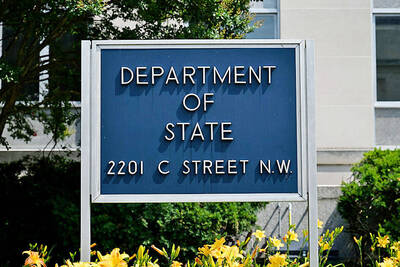
REBUFFED: In response to Chinese criticism over recent arms sales, Washington urged Beijing to engage in meaningful dialogue instead of threats and intimidation Washington’s long-term commitment to Taiwan would not change, the US Department of State said yesterday, urging Beijing to stop pressuring Taiwan and engage in meaningful bilateral dialogues. The remarks came in response to a backlash from Beijing about Washington’s latest approval of arms sales to Taiwan. The US Defense Security Cooperation Agency said in a statement on Wednesday that the Taipei Economic and Cultural Representative Office in the US has asked to purchase an arms package, including Tactical Mission Network Software; AH-1W helicopter spare and repair parts; M109A7 self-propelled howitzers; HIMARS long range precision strike systems; tube-launched, optically tracked, wire-guided missiles; Javelin


 RSS
RSS