


TT: Can you tell us about your decision to enter into a joint venture with Morgan Stanley?
Hu: Actually the reason we announced the news before the Chinese New Year was due to pressure from the press and little bit from the Ministry of Finance (MOF,
We actually, participated in this kind of business in 1999 in Thailand. The market recovered and the timing was perfect. We cannot expect this to happen again any time soon, but who knows. So we have had some previous experience. Therefore, when the government started talking about AMCs [asset management companies], we were probably the only one with experience in this type of business.
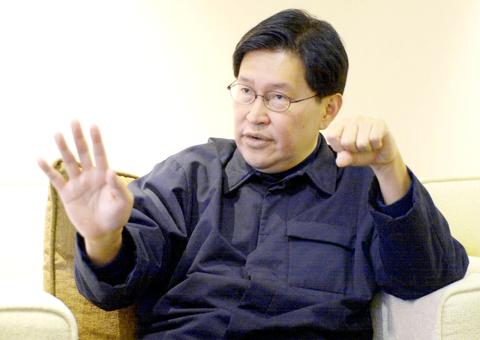
PHOTO: CHIANG YING-YING, TAIPEI TIMES
It's good that the government has given the non-performing loan [NPL] issue the highest priority. But what we have to make sure is that all the banks in Taiwan have sufficient liquidity -- and we have to make sure that we recapitalize them because they are still not powerful enough yet.
TT: Should the government pass relevent laws concerning the resolution trust corporations (RTCs)?
Hu: The government must pass the RTC law. But we have to understand that in the US it took seven years for the [federal] government to pass the law. So it takes a long time.
So, for Taiwan's legislators to understand the significance of AMCs in only a few months is expecting too much.
I am quite confident that we will pass the law, if not this year, then most likely next year.
There should be some incentive for commercial banks to cooperate with AMCs. So we need to use the carrot and stick approach.
The stick is that if you do not cooperate with AMCs and continue bargaining for a higher price to sell down NPLs, then the government will probably not rescue you.
Historically in Taiwan, every time a bank runs into some kind of problem, the government becomes more frightened than the bankers. The government rushes to the rescue, which I don't think is necessarily correct.
The government should allow the "bad students" to collapse. Let's face it; some of the bank owners are not very honest.
TT: So how do AMCs actually work? And through what channels do they dispose of the distressed assets?
Hu: We will have several so-called "owner's vehicles." The most important 50-50 joint venture is the service company.
Let's say for example, First Commercial Bank (
Usually, Morgan Stanley and CDIB, depending upon the risk, will decide how we are going to bid for this. Then we will decide how much we have to own, with the remaining percentage owned by international investors, or even by domestic institutional investors, who are also interested.
The joint venture service company is going to manage all of the owner's vehicles. Two weeks later, for instance, Chang Hwa Bank (
All those vehicles will sign a contract with the service company, which will charge for the service it offers in disposing the NPLs that each vehicle purchases. Apart from the service company, we have also announced that two of us will put in US$600 million into the owners' vehicle.
TT: Between the banks and the AMC, there is going to be another entity called a financial asset service corporation (FASC,
Hu: What happens is that today, if you have a commercial lawsuit, you go to court and you will probably wait for one or three years. In Kaohsuing, I heard it takes about three years. So this a hopeless situation.
Actually, all you need is a commercial process -- there is no judgment here. Based on the Thai, [South] Korean and Japanese experiences, they set up a different court, which is mandated by the government. So you have to be selective, because you have a legal authority.
The government said let the Bankers Association (銀行公會) establish one, because the Bankers Association is kind of a prestigious association. So in the future, if we have a lawsuit, instead of going to court, we go to this company, because the courts are crowded. At the disposal stage, you need go to the FASC because there are lot of debt relationships. So this is a body which will replace the overcrowded court process.
TT: Will the disposal of assets affect the real-estate market?
Hu: Actually, lots of developers are very worried about what is going to happen. They came to us saying "we are already miserable here."
But we need to face reality. First, the price which the real-estate sector is quoting is a historical price, it is not a realistic price. When you ask a developer and he tells you the price is NT$1 million per ping, but when you actually go and ask when he his last trade, he will tell you something like "seven months ago." So you are being quoted a price that is seven months old.
When looking at the real-estate market, it is very important to take a look at the total number of housing transactions during the month. When these transaction figures suddenly increase, you can almost see a run.
Currently, the market is basically stagnant -- there is no trade. So you rescue the local real-estate market not by holding to an artificial price, but by pushing the price down and encouraging transactions.
So it is a fallacy that AMCs are going to disrupt the real-estate market.
TT: In other words, what you are saying is that restructuring will cause some pain?
Hu: This is a temporary pain -- a lot of fresh money will come in. Our real-estate market is exactly the same as the Japanese real-estate market, because the Japanese have their own assessment of the real-estate market.
If you look at the yield in Tokyo it is 3 to 4 percent, and in Taiwan it is about the same, while the figure is about 7 to 8 percent in the US. So this is an opportunity for our real-estate market to become more international.
TT: Should the government play a more active role in the financial restructuring?
Hu: In the case of using AMCs to clean up the system, I think the government should play a more active role, because we are close to a crisis situation.
We are lucky that we avoided the Asian Financial Crisis, because we had a strong semiconductor sector and strong exports to the US. Now all those sectors are slowing down, so we can no longer rely upon strong US demand.
We have to face reality and put our house in order. Cleaning up the financial system is very important because this is like your heart. You don't want problems that can clog your heart.
This is why the government should play a more active role, because AMCs are basically private joint ventures -- they don't have any legal authority, so they cannot force the banks to sell [NPLs].
TT: So how should the government force the banks to sell problematic assets at a discount to AMCs?
Hu: The government has to use a carrot and stick approach to encourage the banks to cooperate and face reality, and then let go of NPLs.
All of those old bankers who have gone through cyclical slowdowns in the past do not believe that we are facing a totally different situation. They think that foreigners are coming to take advantage of them. So in many cases we try to invite banks which are selling NPLs to be partners, so when they release their NPLs and we sell them at a good profit, the banks themselves will dicover that they benefit.
It is very important for the government to be involved, because the government will instruct domestic banks to classify their assets into various grades, depending upon the quality of the assets.
Eventually, the government will say that all of a certain grade of assets have to go.
The incentive for banks to cooperate with the program is that the government will have them amortize those losses over a longer period of time, such as five or 10 years.
TT: Can you elaborate on the international ambitions of China Development Industrial Bank?
Hu: Our ambition is to become a leading technology sector investment bank. We already have a presence in overseas locations such as Silicon Valley, [South] Korea, Japan, Sydney and Tel Aviv.

The Legislative Yuan’s Finance Committee yesterday approved proposed amendments to the Amusement Tax Act (娛樂稅法) that would abolish taxes on films, cultural activities and competitive sporting events, retaining the fee only for dance halls and golf courses. The proposed changes would set the maximum tax rate for dance halls and golf courses at 50 and 20 percent respectively, with local governments authorized to suspend the levies. Article 2 of the act says that “amusement tax shall be levied on tickets sold or fees charged by amusement places, facilities or activities” in six categories: “Cinema; professional singing, story-telling, dancing, circus, magic show, acrobatics

Tainan, Taipei and New Taipei City recorded the highest fines nationwide for illegal accommodations in the first quarter of this year, with fines issued in the three cities each exceeding NT$7 million (US$220,639), Tourism Administration data showed. Among them, Taipei had the highest number of illegal short-term rental units, with 410. There were 3,280 legally registered hotels nationwide in the first quarter, down by 14 properties, or 0.43 percent, from a year earlier, likely indicating operators exiting the market, the agency said. However, the number of unregistered properties rose to 1,174, including 314 illegal hotels and 860 illegal short-term rental
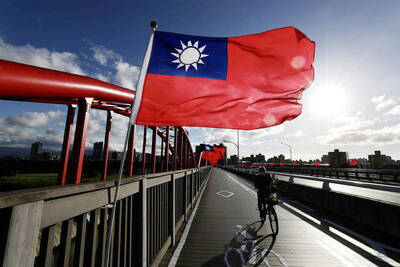
INFLATION UP? The IMF said CPI would increase to 1.5 percent this year, while the DGBAS projected it would rise to 1.68 percent, with GDP per capita of US$44,181 The IMF projected Taiwan’s real GDP would grow 5.2 percent this year, up from its 2.1 percent outlook in January, despite fears of global economic disruptions sparked by the US-Iran conflict. Taiwan’s consumer price index (CPI) is projected to increase to 1.5 percent, while unemployment would be 3.4 percent, roughly in line with estimates for Asia as a whole, the international body wrote in its Global Economic Outlook Report published in the US on Monday. The figures are comparatively better than the IMF outlook for the rest of the world, which pegged real GDP growth at 3.1 percent, down from 3.3 percent
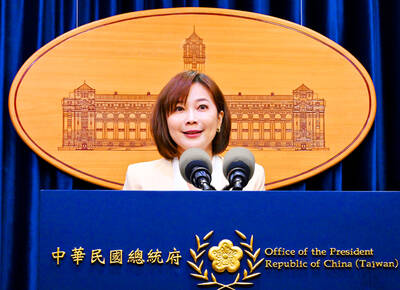
ECONOMIC COERCION: Such actions are often inconsistently applied, sometimes resumed, and sometimes just halted, the Presidential Office spokeswoman said The government backs healthy and orderly cross-strait exchanges, but such arrangements should not be made with political conditions attached and never be used as leverage for political maneuvering or partisan agendas, Presidential Office spokeswoman Karen Kuo (郭雅慧) said yesterday. Kuo made the remarks after China earlier in the day announced 10 new “incentive measures” for Taiwan, following a landmark meeting between Chinese President Xi Jinping (習近平) and Chinese Nationalist Party (KMT) Chairwoman Cheng Li-wun (鄭麗文) in Beijing on Friday. The measures, unveiled by China’s Xinhua news agency, include plans to resume individual travel by residents of Shanghai and China’s Fujian


 RSS
RSS