

An international research team co-led by National Taiwan University (NTU) professor Chou Yi-chia (周苡嘉) has developed a “2D” semiconductor made of boron, carbon and nitrogen, potentially overcoming a longstanding obstacle in chip research.
The material is a high-performance p-type semiconductor that conducts electricity primarily through positively charged carriers known as “holes,” rather than free electrons, the researchers said.
The material could help address a lack of high-performance p-type semiconductors for 2D electronics and can be produced on two-inch wafers and used to manufacture transistor arrays, they said.
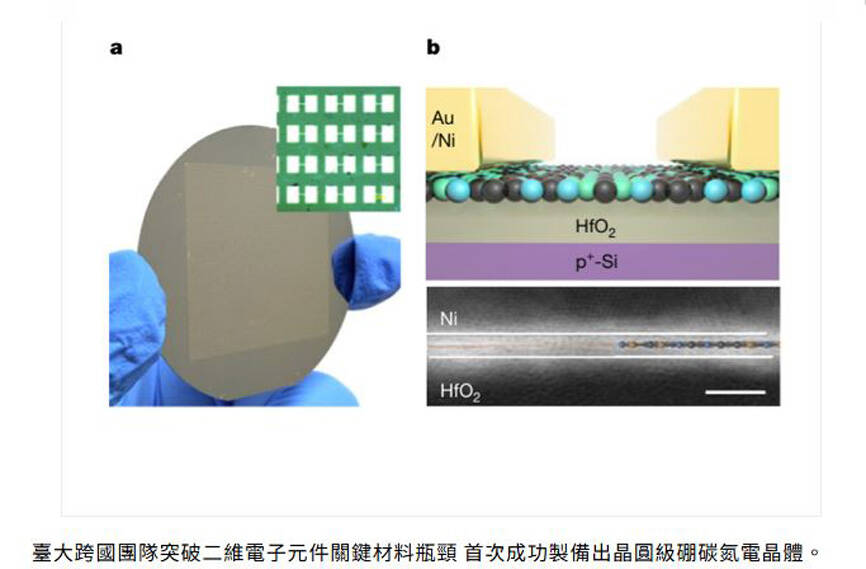
Photo: Screen grab from National Taiwan University’s Web site
The findings could open new possibilities for next-generation transistors and 3D integrated circuits, they said.
The research was published in the international journal Nature.
As semiconductor components continue to shrink, researchers are increasingly exploring 2D materials that are one or a few atoms thick in hopes of overcoming the limitations of conventional materials and advancing smaller, more efficient electronic devices.
Modern electronic circuits commonly use complementary metal-oxide-semiconductor technology, which requires two types of semiconductors working together: n-type and p-type.
N-type semiconductors conduct electricity primarily through electrons, while p-type semiconductors rely on positively charged holes. Together, the two types help control electrical current and reduce power consumption.
Although researchers have made progress in developing high-performance n-type 2D materials, p-type materials have been more difficult to produce at scale while retaining high-electrical performance. That has created a bottleneck in developing next-generation electronic circuits.
Chou’s team collaborated with researchers from the University of Tokyo and Academia Sinica’s Research Center for Applied Sciences.
Using an atomic-scale materials design approach, they introduced carbon atoms into the lattice of single-layer boron nitride, primarily replacing some of the nitrogen atoms to alter the material’s electronic properties, the team said.
That enabled them to produce a p-type boron-carbon-nitrogen semiconductor with high hole mobility, a measure of how efficiently electrical charge moves through the material.
The team also controlled the chemical reaction pathways of two precursor molecules, enabling the material to be produced on two-inch wafers and used to manufacture transistor arrays, they said.
Tests showed hole mobility of approximately 100cm2 per volt-second and an on-off current ratio of about 100 million to one.
The researchers also evaluated 224 transistors across three batches and found their electrical characteristics to be consistent, they said.
The research was jointly led by Chou of NTU, University of Tokyo professor Vincent Tung (童俊智) and Academia Sinica research fellow Pao Chun-wei (包淳偉). NTU postdoctoral researcher Huang Chang-hsun (黃張勳) was among the study’s co-first authors.
More precise control over the position and number of carbon atoms could enable researchers to further adjust the material’s electrical properties, the team said.
It could also be combined with n-type 2D semiconductors such as molybdenum disulfide to develop next-generation complementary electronic circuits, they added.
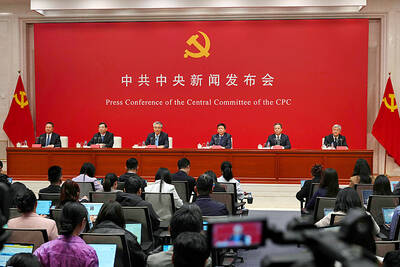
SHORT-TERM OUTLOOK: The Chinese military would most likely focus on rebuilding its organization and leadership in the next few years, experts said Chinese President Xi Jinping’s (習近平) military purge has reduced the risks of a planned war against Taiwan, yet increased the danger of a conflict sparked by a miscalculation or accident, Taiwanese experts said yesterday. They made the comments at a seminar on the Fifth Plenary Session of the Chinese Communist Party’s (CCP) 20th Central Committee held by the research group Secure Taiwan Associate Corp (STA) in Taipei. The wholesale sacking of Chinese People’s Liberation Army (PLA) officers and managers of the aerospace and defense industry is sure to set back Xi’s timetable to prepare the PLA to launch an invasion of Taiwan

BATTLE-TESTED: Czech companies’ drones, software and navigation systems have been tested in the Ukraine war, while other countries’ are lab-tested, a Czech ex-official said Czech manufacturers are interested in setting up drone assembly lines in Taiwan, former Czech Chamber of Deputies president Marketa Pekarova Adamova told a forum in Taipei yesterday. Adamova made the comments at the inauguration of the Global UAV Academy, an organization dedicated to international cooperation in drone supply chains, technological certification and pilot training. The Research Institute for Democracy, Society and Emerging Technology said the Czech Republic is the largest importer of Taiwanese drones and uncrewed aerial vehicle (UAV) components. Adamova, who transitioned to the defense industry after retiring from politics, said the Roman adage “si vis pacem, para bellum” — “If you
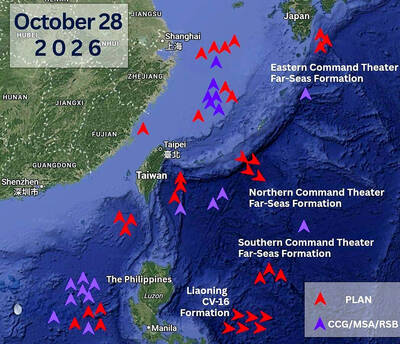
STAY VIGILANT: An aircraft carrier and battle group were located to the east of the Philippines, while other ships were identified off the east and southeast coast of Taiwan China has more than 50 naval and other official vessels operating in a wide swath of sea stretching from southern Japan down to Taiwan and off the Philippines, National Security Council Secretary-General Joseph Wu (吳釗燮) said on Wednesday, calling the threat level “obvious.” Taiwan is stepping up efforts to issue details and maps depicting locations where Chinese warships and coast guard vessels operate. “We are staying vigilant about their activities,” Wu said. “The simultaneous threat to Taiwan, Japan and the Philippines is obvious.” The remarks accompanied a map he posted on X showing the locations of 53 ships, 34 of them navy warships,

WORRIES PILE UP: The planned extension would generate nearly 10 million cubic meters of excavated soil, the disposal of which has not been explained, a former EPA official said Yilan County residents, backed by civic groups, on Wednesday filed an administrative lawsuit to overturn the environmental impact assessment (EIA) approval for the Yilan-bound high-speed rail (HSR) extension. They filed the lawsuit after the Executive Yuan on Sept. 11 rejected an administrative appeal. Former Environmental Protection Administration (EPA) deputy minister and lawyer Thomas Chan (詹順貴) said the project’s EIA review was one of the hastiest he had ever seen during his 30-year career in environmental law. Construction of the line would generate nearly 10 million cubic meters of excavated earth and rock, the disposal of which has not yet been explained to the


 RSS