

Taiwan and the US have yet to build the "hellscape" needed to help Taiwanese forces hold out against a potential Chinese invasion, and they should approach the task with a "sense of urgency" given the "dangerous" geopolitical situation, the chair of a US congressional commission said today.
The US would continue to face shortages of munitions and other key capabilities even a couple of years after Aug. 1 next year, Randall Schriver, chair of the US Congress' US-China Economic and Security Review Commission, told a forum in Taipei.
He was referring to the date by which Chinese President Xi Jinping (習近平) has reportedly directed the People's Liberation Army (PLA) to be ready to take Taiwan by force.
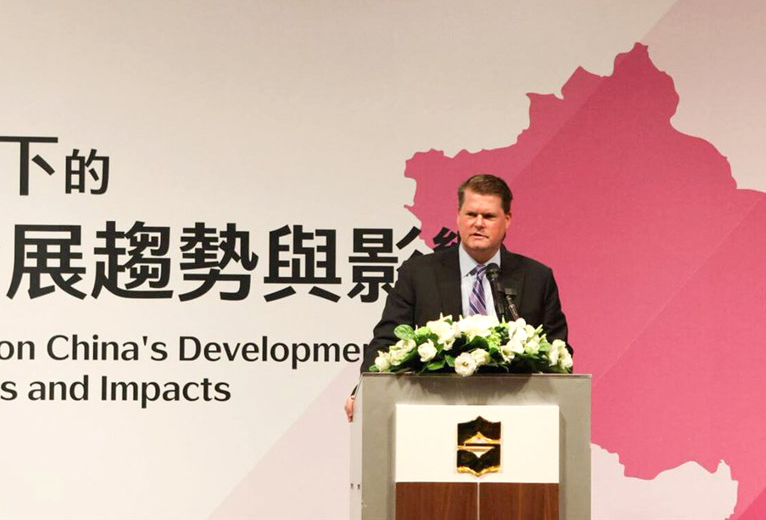
Photo: CNA
Schriver cited the conflict involving the US and Iran, saying it had created an "aircraft carrier gap" after the USS Abraham Lincoln was relieved following an extended deployment in the Middle East.
Against that backdrop, if North Korea and Russia were to coordinate with China to escalate tensions, US forces would have to respond, further stretching their resources and making the current period "particularly dangerous," he said.
Modern warfare is a race, not over who possesses the most advanced artificial intelligence or counter-drone capabilities, but over who can scale those technologies the fastest and integrate them into operational concepts that account for the evolving nature of warfare, Schriver said.
He cited an analogy offered by US Indo-Pacific Commander Admiral Samuel Paparo, who said in a 2024 interview that he wanted to "turn the Taiwan Strait into an unmanned hellscape" for the PLA in a Taiwan contingency to buy time for a US response.
"But remember, hellscape is very aspirational," Schriver said. "We haven't built it out."
"We need to think about not only building things, but the operational concepts, and doing so with some sense of urgency," he said.
Ongoing conflicts suggest a turning point in the longstanding debate over the relative advantages of defense and offense, Schriver said.
Referring to the Russia-Ukraine war, he said, "We're seeing Ukraine win by not losing."
"Frankly, we're seeing Iran do quite well without losing at least the regime and some of its key capabilities," he added.
To improve its drone capabilities, the Legislative Yuan has approved a special budget of NT$240 billion (US$7.37 billion), while the Executive Yuan has proposed an additional NT$145.7 billion in defense spending through a supplementary budget. Of the latter amount, NT$55.9 billion is earmarked for uncrewed systems, including drones.
Meanwhile, the fiscal 2026 US National Defense Authorization Act directs the US Department of Defense to seek to establish a joint program with Taiwan to develop and field uncrewed systems and counter-uncrewed systems capabilities, including through codevelopment and coproduction, for both sides' armed forces.
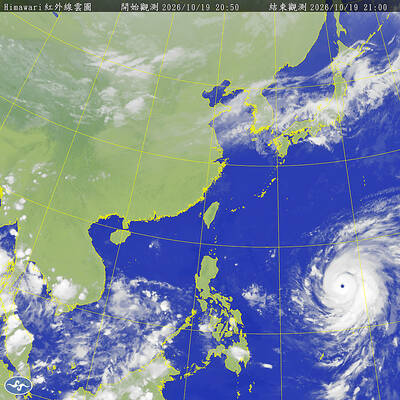
Typhoon Champi is forecast to turn northward earlier than previously expected, sparing Taiwan a direct hit but still bringing heavy rain to the north of the country on Friday and Saturday, the Central Weather Administration (CWA) said yesterday. Typhoon Champi had strengthened and increased in size over the past 12 hours, and as of yesterday afternoon, was packing sustained winds of 198kph near its center, CWA forecaster Cheng Chieh-jen (鄭傑仁) said. However, due to the weakening of a Pacific high-pressure system the storm is now expected to turn northward earlier than initially forecast, likely around Japan’s Ishigaki Island, Cheng said. As Champi brushes
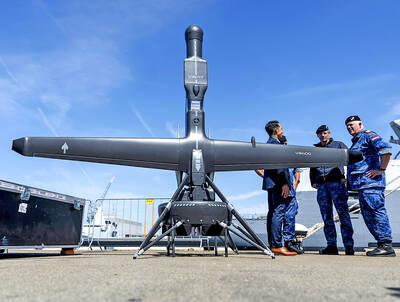
DEFENSE PROCUREMENT: Taiwan could become the largest operator of V-BAT drones outside the US once they are delivered, the Ministry of National Defense said The navy and the coast guard are acquiring 292 units of MQ-35A V-BAT vertical takeoff and landing (VTOL) surveillance drones manufactured by US-based defense technology company Shield AI, making Taiwan one of the largest buyers of the drone. The Coast Guard Administration budgeted NT$1.2 billion (US$37.1 million) to buy 12 drones, which have been delivered, Shield AI said in a report on Oct 13. The navy is planning to spend NT$36 billion under a four-year program code-named Project Yuan Xiao (遠鴞) to acquire 280 V-BAT drones, the Ministry of National Defense’s fiscal 2027 report showed. The combined procurement is expected

MAYORAL RACE: Su Chiao-hui made gains by persuading undecided voters and winning over voters in KMT-leaning districts, a pollster said Legislator Su Chiao-hui (蘇巧慧), the Democratic Progressive Party’s (DPP) candidate for New Taipei City mayor, has a 13.1 percentage point lead over her Chinese Nationalist Party (KMT) rival Lee Shu-chuan (李四川), a poll released yesterday showed. The poll, commissioned by the Taipei Trust in Democracy Association, showed that 43.1 percent of respondents said they would vote for Su, up 7.9 percentage points from a poll conducted in late August, while support for Lee was at 30 percent, down 4.7 percentage points. It showed that 48.6 percent of respondents thought Su would make a suitable mayor, compared with 35.9 percent for Lee. Independent candidate
A Chinese People's Liberation Army (PLA) Navy aircraft carrier group was being monitored after entering the western Pacific, the Ministry of National Defense said today, after Beijing yesterday criticized Taiwan for using a water cannon against a Chinese fishing boat near the Pratas Islands (Dongsha Islands, 東沙群島). A Chinese naval task group led by the aircraft carrier Liaoning (遼寧) yesterday sailed to the western Pacific for training, Chinese state-run Xinhua news agency quoted the PLA Navy as saying. “The drill is part of the annual routine training plan aimed at testing and improving the troops’ combat readiness and enhancing their ability to


 RSS