

A Chinese People's Liberation Army (PLA) Navy aircraft carrier group was being monitored after entering the western Pacific, the Ministry of National Defense said today, after Beijing yesterday criticized Taiwan for using a water cannon against a Chinese fishing boat near the Pratas Islands (Dongsha Islands, 東沙群島).
A Chinese naval task group led by the aircraft carrier Liaoning (遼寧) yesterday sailed to the western Pacific for training, Chinese state-run Xinhua news agency quoted the PLA Navy as saying.
“The drill is part of the annual routine training plan aimed at testing and improving the troops’ combat readiness and enhancing their ability to fulfill missions,” the PLA Navy said, adding that the exercises” are not directed at any specific country or target.”
Photo: CNA
The move has caused heightened tensions and concern among countries in the region, Deputy Chief of the General Staff for Intelligence Pan Chun-kuang (潘俊光) told a news conference in Taipei today.
The ministry would coordinate relevant monitoring and response measures, he said, declining to provide further details about the carrier group’s movements.
Asked whether the ministry expects the PLA to conduct large-scale military exercises around Taiwan this year, Pan said that Beijing has held large-scale exercises encircling Taiwan every year since August 2022.
The ministry would continue to use joint intelligence, surveillance and reconnaissance capabilities to monitor PLA military exercises and movements in real time, he said.
The ministry is aware that Beijing recently used propaganda to amplify the cognitive warfare impact of its military activities, he said, adding that such actions are destabilizing.
The ministry would remain highly vigilant and respond appropriately, he added.
Meanwhile, 15 Chinese military aircraft, 10 naval ships and seven official ships were detected around Taiwan between 6pm yesterday and 6am today, the ministry said in its daily report.
Thirteen Chinese military aircraft crossed the median line of the Taiwan Strait and entered Taiwan’s northern, central, southwestern and eastern air defense identification zones, it said.
The armed forces “monitored the situation and employed [patrol] aircraft, navy vessels and coastal missile systems in response to the detected activities,” the ministry said.
In related news, China’s Taiwan Affairs Office (TAO) spokesman Chen Binhua (陳斌華) yesterday said that Taiwan must "bear the consequences" of its coast guard using a water cannon against a Chinese fishing boat near an atoll in the South China Sea.
On Oct. 1, the Coast Guard Administration dispatched a patrol vessel and expelled two Chinese fishing boats that had entered Taiwan’s prohibited waters near the Pratas Islands.
Taiwan's "treatment of mainland vessels roughly in a dangerous manner that endangers the lives and property of the personnel involved is maliciously stirring up cross-strait confrontation and they must bear all consequences arising from this," Chen said, without elaborating on the consequences.
A Taiwan official with direct knowledge of the situation around the Pratas Islands said that the coast guard carried out "normal law enforcement" during the incident and responded in a "very careful and proportionate way."
The Pratas Islands lie roughly between southern Taiwan and Hong Kong. Security experts see them as vulnerable to Chinese attack due to their distance — more than 400 km — from Taiwan.
Taiwan says China is increasing its use of "gray zone" tactics that stop short of outright military action to pressure the nation.
Speaking at a forum in Taipei, National Security Council Deputy Secretary-General Lii Wen (李問) said that China is using a wider range of ships in its "incremental acts of aggression," including militia boats and research vessels.
"Gray zone activities under the threshold of conflict have raised serious concerns for their potential to disrupt transportation or damage critical infrastructure," he said.
Additional reporting by Reuters and CNA

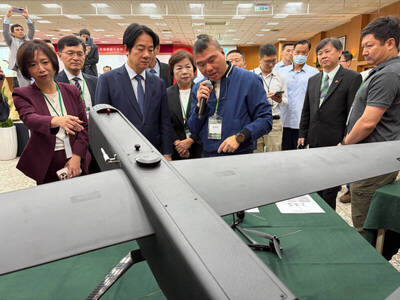
Two executives of drone supplier Jiin Ming Industry Co (錦明實業) have been detained and held incommunicado over the company's alleged use of prohibited China-made chips and camera lenses in drones supplied under recent military contracts, the Taoyuan District Prosecutors' Office said today. In a statement, prosecutors said they raided the offices of Jiin Ming — headquartered in Taoyuan — as well as those of its subsidiaries and its suppliers on Thursday last week. The raids followed a report that the company had breached its procurement contracts by putting the prohibited components into drones delivered to the military. During the raids, prosecutors summoned
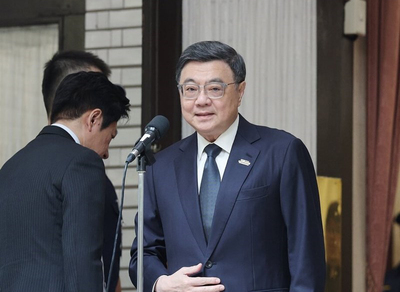
The government would continue monitoring online rumors that a pneumonic plague outbreak has spread from Russia into China and could enhance existing quarantine measures, Premier Cho Jung-tai (卓榮泰) said today. During a legislative meeting, Democratic Progressive Party Legislator Wang Ting-yu (王定宇) said rumors were circulating that the disease had spread across several Chinese provinces. He asked Cho whether the government was prepared to prevent the disease from spreading to Taiwan, given the frequent exchanges between Taiwan and China, and how concerned the government was about the alleged outbreak. The Ministry of Health and Welfare implemented border quarantine measures after briefing the Executive Yuan

South Korean boy band BigBang drew 120,000 fans to three concerts at Taipei Dome from Friday through yesterday, as the band thanked them for their support over their 20-year career. The Taipei Dome concerts were part of BigBang's "2026-2027 World Tour XX: Cosmos." Friday's concert was BigBang's first performance in Taiwan in 11 years. During the encore, group leader G-Dragon (GD) shouted "I love you" in Chinese and said he was especially happy to perform in Taiwan with bandmates Taeyang and Daesung. "Taipei, I'm very grateful to you all," GD said in Chinese, asking fans to wait for the band's return. Daesung thanked
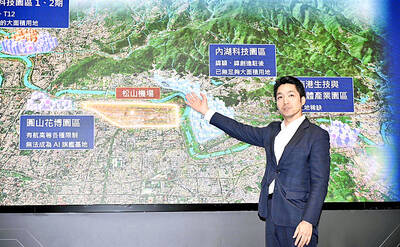
DETAILED PLAN NEEDED: Relocating the airport would affect not just travelers, but also undermine national defense and emergency medical services, a legislator said Taipei Mayor Chiang Wan-an (蔣萬安) yesterday proposed relocating Taipei International Airport (Songshan airport) and turning the site into an artificial intelligence (AI) park, drawing opposition from politicians across party lines. Chiang’s plan would turn the 300 hectares into an AI park featuring tech clusters, residential communities and green space. The industrial cluster would host 200 domestic enterprises, generate NT$12 trillion (US$376.47 billion) in output, and accommodate 65,000 jobs and 35,000 residents, he said. Cabinet spokeswoman Michelle Lee (李慧芝) said the Executive Yuan was surprised by the announcement, as the Taipei City Government did not discuss the proposal with the central government before making


 RSS
RSS