

Anduril Industries founder Palmer Luckey yesterday told a forum in Taipei that “freedom is the most powerful weapon that Taiwan has.”
Luckey, who was sanctioned by China last year due to his defense firm’s weapons and drone sales to Taiwan, made the comments during his keynote speech on Responding to Emerging Threats and Modern Warfare, which was part of a discussion at the Resilient Taiwan for Sustainable Democracy International Forum of the Whole-of-Society Defense Resilience Committee hosted by the Presidential Office at the Grand Hyatt Taipei.
Talking about building his first company and seeing Chinese companies take US-developed technologies and them being protected by their government, Luckey said that he realized what China cannot copy is “a country where people are free to improvise, experiment, to ask, act without permission and come up with a lot of this technology in the first place.”
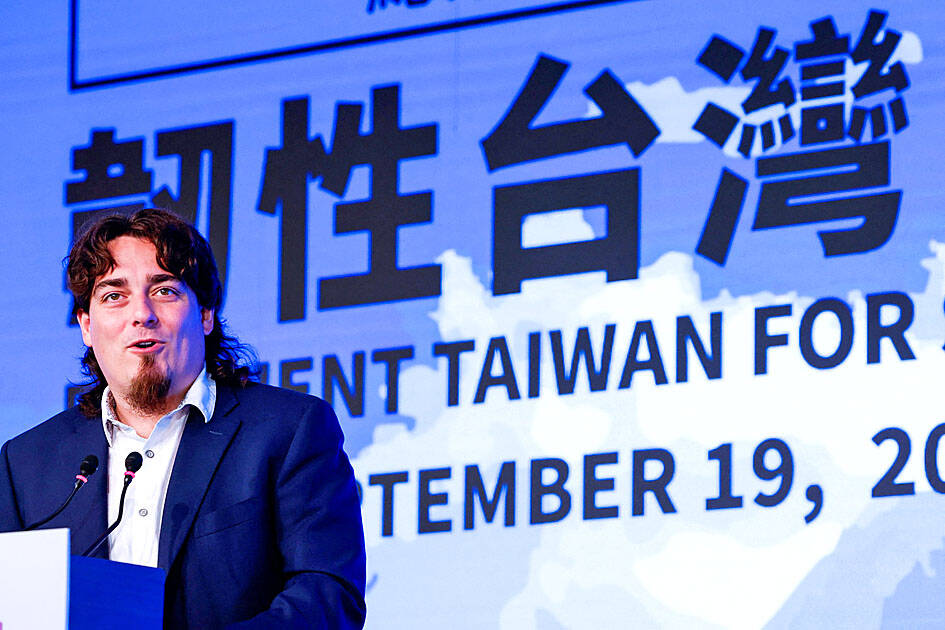
Photo: Ann Wang, Reuters
“Freedom usually gets described as the thing that Taiwan is defending, but I think freedom is the most powerful weapon that Taiwan has,” he said.
Luckey said Taiwan can use this advantage and turn it into resilience, not only economically, but also militarily, and change how Taiwan fights and how Beijing calculates its victory.
Explaining the three aspects of resilience that Taiwan can work on, he said “operational resilience” is not about making scientific breakthroughs that change the nature of technology, but figuring out how to integrate, assemble, mass produce them cost-effectively and use them effectively on the battlefield.
“The kinds of technologies that Taiwan needs to steel itself against adversaries’ assaults are already abundant,” Luckey said, adding that Taiwan is already a leader of many technologies in the industrial and consumer realm, but it needs to apply them to defense.
Luckey said Taiwan needs to ask itself “what the final stage of Taiwan’s deterrence will look like, one that will persist for years, decades and centuries, and start working towards that steady state today.”
He said Taiwan can already make cost-effective and high-quality machine tools, semiconductors, precision components, advanced composites and others, but these production lines need to become increasingly interchangeable with weapons production at volumes measured in the millions.
Luckey said Taiwan’s domestic demand is not enough to sustain the defense industrial base that it needs for a deterrence level that is unstoppable, and that it should make countries depend on the nation for advanced capabilities the way the world already depends on Taiwan Semiconductor Manufacturing Co for commercial capabilities.
“The goal should be for everyone in the world, whether they’re buying from you or just afraid of you, to see a label that says, ‘designed in Taiwan, made in Taiwan,’ on a weapons system, and immediately understand what it means,” he said.
He said this “fortress of freedom” can only be built together by the people from the inside — to convince Beijing that the cost of winning is insanely high and there is no victory in invading Taiwan, as what the Chinese Communist Party (CCP) believes would be a short military operation, would actually be the beginning of a fight that could continue for years.
If Taiwan can reach a durable, shared view of its own future, even though it might look slightly different for everyone, and if the CCP understands that this view can survive any political fight, disagreement, campaign or economic coercion, Beijing would know this war could be winnable, but is not worth winning, he said.
Asked by moderator National Security Council Deputy Secretary-General Lin Fei-fan (林飛帆) to assess China’s military buildup and capabilities, Luckey said the seizure of Taiwan is China’s major strategic objective, so it has been preparing well, but “Taiwan has a lot of home advantages.”
“It is going to be much harder for China to fight on your shores than it will be for you. You don’t need to go and invade China. You just need to make it so painful for them and for them to know that it’s so painful that they don’t come for you,” he said. “I think that that is absolutely a doable task.”
As China spends about eight to 10 times more on defense than Taiwan, Taiwan must “cheat” in fighting back, he said. “You can’t fight fair. You need to come up with things that are more asymmetric… You need to have no honor in fighting.”
Nobody in Taiwan should believe it is a hopeless fight, and that those who say it have a reason to believe it, including many who are funded by adversaries, who want people in Taiwan to give up hope and want to take away their right to self-determination, he said.
If it is an easy win for the adversaries, they would not be flooding social media with ideas of helplessness to make people believe nothing can be done, he added.
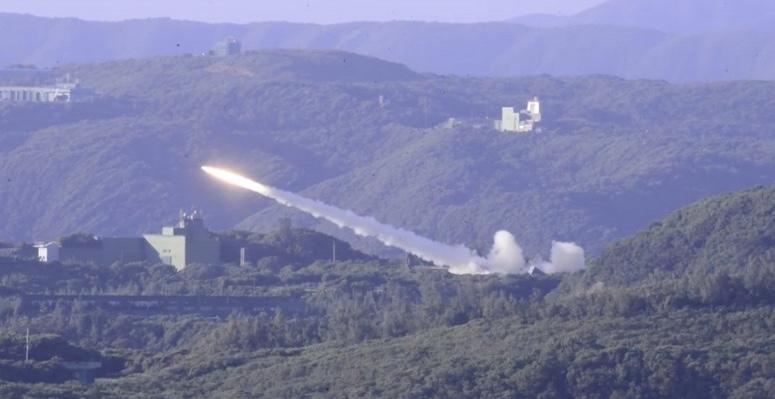
A Chinese military drone was spotted conducting reconnaissance off Taitung County as President William Lai (賴清德) visited Pingtung County this morning to inspect a drill of the armed forces’ precision-strike capabilities, prompting the military to closely monitor its actions. Today was the final day of a three-day military exercise at Jioupeng Base (九鵬基地) to test the joint combat capabilities of the armed forces and coast guard. The exercise began on Wednesday simulating air defense interception and yesterday tested long-range strike capabilities and new air defense weapons. This morning, the military conducted a final exercise involving air defense, anti-ship and drone operations. Military sources said

OCT. 31: The antiviral drugs Tamiflu and Eraflu have been distributed to about 4,000 medical facilities nationwide for people in seven groups who develop flu-like symptoms As the domestic influenza epidemic enters its peak season and continues to escalate, the Centers for Disease Control (CDC) yesterday announced that publicly funded influenza antiviral drugs for seven eligible groups have been extended to Oct. 31, allowing those who develop flu-like symptoms to receive the medication without undergoing a rapid influenza test. The CDC has extended the expanded use of flu antiviral drugs to seven groups: healthcare and influenza-prevention personnel; residents and staff at nursing homes, long-term care facilities and similar institutions; kindergarten and daycare workers and home-based caregivers; students from kindergarten through high school, vocational high school and the
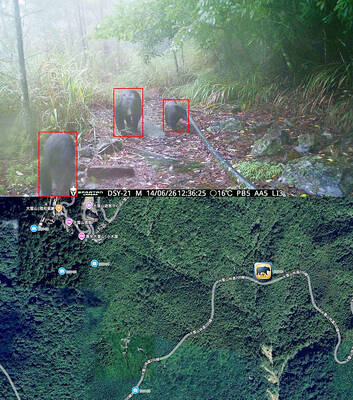
RARE PEEK: The footage released showed one of the bears staying in a cave for as long as 70 days, providing the first record of Formosan black bear’s overwintering The Forestry and Nature Conservation Agency yesterday released tracking records of released Formosan black bears for the first time, showing that they get much closer to human settlements than previously thought. The agency said it had captured two bears, Da Qu-ali (達古阿里) and Aziman (阿里曼), in indigenous villages in Hualien County and began to track them with a camera-mounted satellite collar after releasing them back into the wild. The results confirmed that the bears have moved from deep mountain areas into lowland hills closer to human communities, leading to an increase in human-bear conflicts, it said. The agency has introduced artificial intelligence-assisted early
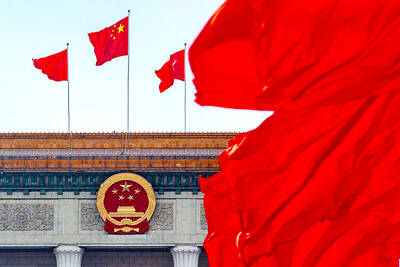
DIPLOMATIC TOUR: Chinese President Xi Jinping began a series of overseas visits last month to Kyrgyzstan, Egypt and India, aimed at securing leverage, an official said Recent Chinese diplomatic and military moves are aimed at creating pressure ahead of a planned meeting between Chinese President Xi Jinping (習近平) and US President Donald Trump, National Security Council adviser Huang Chung-yen (黃重諺) said. Trump when visiting China in May extended an invitation to Xi to visit Washington on Sept. 24. China is yet to officially announce plans for Xi’s visit to the US. In an interview with the Liberty Times (sister paper of the Taipei Times) on Thursday, Huang said Xi’s overseas visits, China’s “gray zone” activities along the First Island Chain and efforts to expand its trade surplus with the


 RSS
RSS