

The Industrial Technology Research Institute (ITRI) is spearheading Taiwan’s drive to enhance technological collaboration with the US, Japan and Europe in critical fields, institute president Chang Pei-zen (張培仁) said in an interview with the Chinese-language Liberty Times (sister paper of the Taipei Times) published yesterday.
Global relationships in technology are valuable to Taiwan’s development of uncrewed systems, critical minerals and optical communications, Chang said.
The institute is also cooperating with the private sector to spur industry upgrades across the economy, he said.
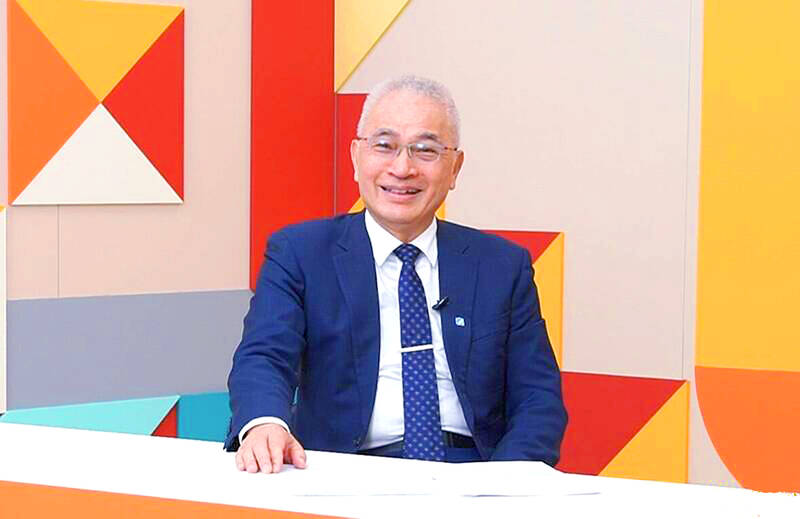
Photo: Yu An-ting, Taipei Times
It played a key role in Taiwan-US collaboration in the Green UAS cybersecurity and supply chain compliance certification program, he said.
The US had expected that it would take 11 months to transfer the certification to Taiwan, but the ITRI’s contribution allowed the process to be completed in five months, he said.
The institute with the Ministry of Economic Affairs’ assistance is also facilitating the development of technology to refine critical minerals, aimed at meeting 50 percent of domestic demand for rare earths by 2030, he said.
The ITRI has established experimental assembly lines for that project on site, which would be scaled up as the program goes forward, Chang said.
The institute is also working closely with Japanese private-sector partners to develop high-efficiency converters for use in artificial intelligence (AI) data centers in exchange for transferring base stations and private networks to Japan, he said.
The cooperation is helping Taiwanese and Japanese enterprises work together to integrate optical communication components and systems, he said.
The institute has a decades-long relationship with Lithuania’s laser industry, which produces the emitters for Taiwan’s laser sector, Chang said.
France and the Netherlands are partners in the ITRI’s bid to develop copackaged optics, an emergent technology believed to have tremendous value to AI data centers, he said.
The institute is also cooperating with European satellite manufacturers to improve Taiwan’s telecommunications capabilities and working with the UK to develop 3D printing tech that could be used in multi-band base station antennas, he said.
Asked about unevenness in technology upgrades in the Taiwanese economy, Chang said sectors “closer to wind” would naturally be faster to adapt to new technologies.
The ITRI is not only helping the nation’s strategic industries to stay on the cutting edge of global developments, but also promoting the distribution of technologies in small and medium-sized industries and traditional industries, he said.
The integration of Taiwanese plastic injection molding and precision machining into semiconductor supply chains is a success story for the ITRI’s efforts to upgrade the nation’s economy, he said.
The institute is mulling changing its strategy of developing, transferring and applying new technologies in sequence, Chang said.
Instead, it is starting the technological research and development process by first interviewing end-users about their needs, as the institute has been doing with robotics, he said.
Every new technology the institute develops in connection with the sector begins with interviewing 10 or more enterprises in the industry, which greatly facilitates the process of translating technology into a commercial product, Chang said.
The ITRI is taking part in the government’s “hundred industries” initiative to help distribute AI technology to traditional industries and small businesses, as the institute carries out its own digitization, he said.
A total of 400 foreign “high- level” professionals have been naturalized as Republic of China (Taiwan) citizens over the past decade as the government has eased nationality rules to attract talent from a wider range of fields, the Ministry of the Interior said yesterday. The 400th high-level professional, who works in the electronics industry, was approved for ROC citizenship on Aug. 26, the MOI said. The MOI quoted the newly naturalized citizen as saying that Taiwan is a leader in fields such as semiconductors, electronics manufacturing, artificial intelligence development and energy technology. He also said
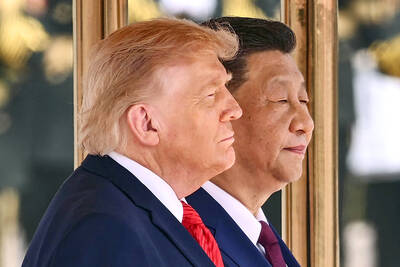
China has warned that it could cancel a planned US-China leaders’ summit if Washington approves new arms sales to Taiwan, a Japanese media outlet quoted sources as saying yesterday. US President Donald Trump, “apparently eager to showcase some diplomatic achievements ahead of November’s midterm congressional elections, places great importance on holding the summit with Chinese President Xi Jinping (習近平),” Japan’s Kyodo News reported. “While preparing for Xi’s upcoming trip, China has restated its position that the Taiwan issue is a ‘red line’ in bilateral relations,” the report said. The report said that when Xi met with Trump in Beijing in May, Xi said
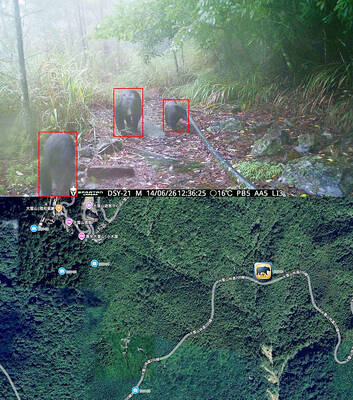
RARE PEEK: The footage released showed one of the bears staying in a cave for as long as 70 days, providing the first record of Formosan black bear’s overwintering The Forestry and Nature Conservation Agency yesterday released tracking records of released Formosan black bears for the first time, showing that they get much closer to human settlements than previously thought. The agency said it had captured two bears, Da Qu-ali (達古阿里) and Aziman (阿里曼), in indigenous villages in Hualien County and began to track them with a camera-mounted satellite collar after releasing them back into the wild. The results confirmed that the bears have moved from deep mountain areas into lowland hills closer to human communities, leading to an increase in human-bear conflicts, it said. The agency has introduced artificial intelligence-assisted early
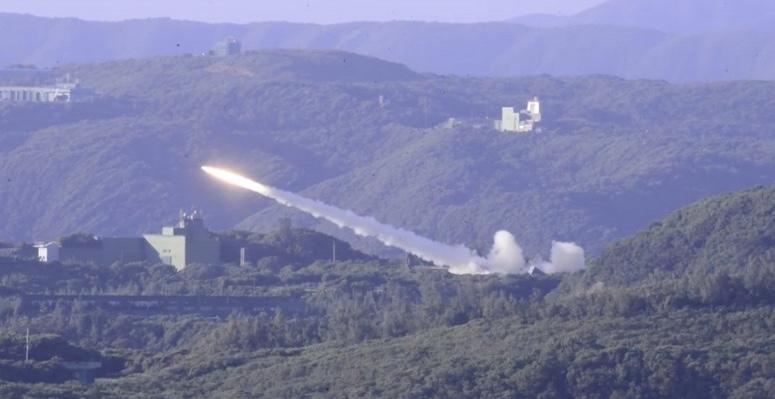
A Chinese military drone was spotted conducting reconnaissance off Taitung County as President William Lai (賴清德) visited Pingtung County this morning to inspect a drill of the armed forces’ precision-strike capabilities, prompting the military to closely monitor its actions. Today was the final day of a three-day military exercise at Jioupeng Base (九鵬基地) to test the joint combat capabilities of the armed forces and coast guard. The exercise began on Wednesday simulating air defense interception and yesterday tested long-range strike capabilities and new air defense weapons. This morning, the military conducted a final exercise involving air defense, anti-ship and drone operations. Military sources said


 RSS
RSS