

Taisun Enterprise Co (泰山企業) today filed a lawsuit against Central Union Oil Corp (CUOC, 中聯油脂) and three other companies seeking NT$1 billion (US$31.56 million) in joint compensation over a food safety scandal involving CUOC-produced oil with excessive levels of the carcinogen benzopyrene (BaP).
The Taichung District Prosectors’ Office on Aug. 18 indicted CUOC, Taisun, Fwusow Industry Co (福壽實業) and Formosa Oilseed Processing Co (福懋油脂) on charges including contraventions of the Act Governing Food Safety and Sanitation (食品安全衛生管理法), forgery and fraud related to distribution of the tainted oil.
The key issue to determine responsibility is when the information about abnormal BaP levels emerged and whether it was promptly passed on, Taisun lawyer Chen Cheng-hsi (陳政熙) said.
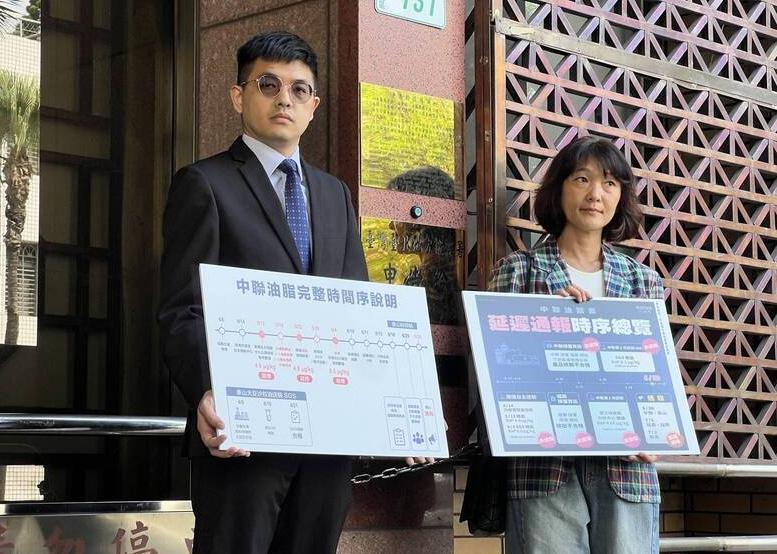
Photo: Chang Wen-chuan, Taipei Times
The indictment says that the Namchow Group (南僑集團) received three test reports on May 13, May 22 and June 4 showing excessive BaP levels, but only privately notified Fwusow, Chen said, adding that neither company fulfilled its obligation to promptly report the findings to authorities.
Fwusow also failed to promptly notify authorities after receiving abnormal test results from Taiwan Sugar Corp (Taisugar, 台灣糖業) on May 18, Chen added.
Comparing the information in the indictment with Namchow’s public statements shows significant differences in when the companies obtained information, how much they knew and how they responded, he said.
The companies’ failure to report the problem meant the tainted oil was not identified or taken off shelves for two months, the lawyer said.
Companies including Taisun continued using the oil without knowing there was a problem, later leading to major losses from product recalls, inventory disposal, consumer compensation, reduced profits and damage to their reputations, he said, adding that Taisun’s loses were about NT$1 billion.
Taisun initially believed that as long as a product bearing its name was on the market, it had a responsibility to consumers, Taisun marketing vice president Niu An-tse (鈕安澤) said.
However, while handling consumer complaints and during the confidential investigation, the company did not know when other companies had discovered problems in their supply chains, Niu said.
After the indictment was released, Taisun compared it with statements and news reports from Fwusow and other companies, as well as its own test results from April and May, and decided to file a lawsuit against the companies to clarify responsibility, she said.
Taisun received the same CUOC soybean oil as Namchow on April 8 and 9, had its own products tested by SGS on April 10 and received passing results on April 21, giving it no reason to believe its products were unsafe, the company said.
If Namchow had disclosed the abnormal test results when they were first detected in mid-May, CUOC and other companies in the supply chain could have begun tracing the source, conducting additional tests and managing the risks, it said.
Mid-May to mid-June was a crucial period for containing the problem, but the delayed sharing of information postponed supply-chain tracing and risk controls, worsening the company’s loses, it added.
The courts should determine CUOC, Fwusow and Formosa Oilseed’s responsibility depending on when they learned of the problem and how promptly they reported it, Taisun said.
Additional reporting by CNA
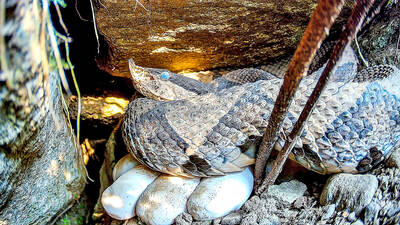
NATURE TAKES ITS COURSE: The agency’s head said he felt a sense of loss watching red-banded snakes eat the babies, as they had decided on non-intervention The Forestry and Nature Conservation Agency yesterday released a documentary on a hundred-pace viper that had incubated 16 eggs, all of which hatched, but only a baby viper escaped after they were attacked by red-banded snakes. The agency’s Taichung branch last year launched the viper reproduction monitoring project soon after forest rangers Lin Chun-yu (林俊佑) and Chou Chia-cheng (周家成) spotted a pregnant hundred-pace viper in a grass-covered burrow near a parking lot in Tbulan Village (松鶴部落). The Atayal village, in Taichung’s Heping District (和平), is headed by Ecyang Yapu, who was positive about the project and assisted in access control and power

The Coast Guard Administration (CGA) yesterday said that it had deployed vessels to “monitor” Chinese ships operating in waters off the east coast. The CGA said it dispatched vessels in response to a China Coast Guard announcement that it had carried out another “routine law-enforcement patrol” in waters off the east coast. “The CGA firmly rejects China’s cognitive warfare campaign of ‘law enforcement in name, jurisdictional expansion in practice,’” it said on X. As of 11am yesterday, two China Coast Guard ships were “loitering and drifting” about 105 nautical miles (195km) and 74 nautical miles east of Green Island (綠島) respectively, it said. It
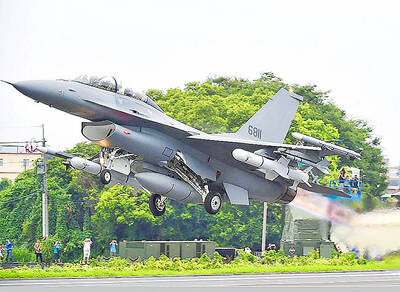
A sharp rise in compensation to be paid by air force officers who leave before completing their required service could indicate an increase in pilots leaving the military early, an analyst said on Friday, warning that the trend could worsen a shortage of experienced personnel. Chieh Chung (揭仲), a researcher at the Association for Strategic Foresight, issued the warning even though the number of volunteer military personnel is expected to increase next year. The planned headcount for volunteer military personnel, covering officers, noncommissioned officers (NCO) and enlisted soldiers, is 158,223 for next year, up 4,258 from 153,965 this year, Chieh said. The increase
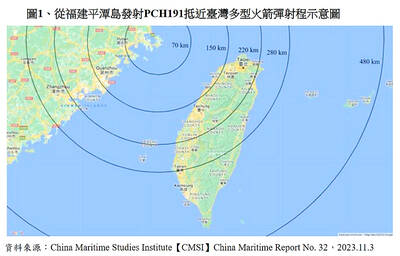
Potential improvements to munitions used by China’s long-range rocket-artillery units could extend their range to cover the entire Miyako Strait, which might give the Chinese People’s Liberation Army (PLA) the ability to secure the strategic waterway, the Mainland Affairs Council (MAC) said in a report. The PLA’s long-range rocket-artillery units deployed along the Taiwan Strait are concentrated along the coast of Fujian Province, including Changle, Pingtan and Shishi, the quarterly report on China said. The artillery brigades of the PLA’s 71st, 72nd and 73rd group armies have been deployed, with preparations for potential battlefield operations under way since August 2022, the report


 RSS
RSS