

Healthcare providers along the east coast are working to build out a drone delivery network, with authorities recently holding a live demonstration of a medical drone flight designed to cater to the needs of remote communities.
The National Health Insurance Administration’s eastern branch runs a holistic care promotion committee to improve healthcare in Hualien and Taitung counties, where the delivery of medical supplies is left vulnerable to distance and weather conditions in high-altitude villages and offshore islands.
As earthquakes, typhoons and torrential rain can sever road links and suspend ferry services, the committee has been developing a medical drone support system to address these challenges.
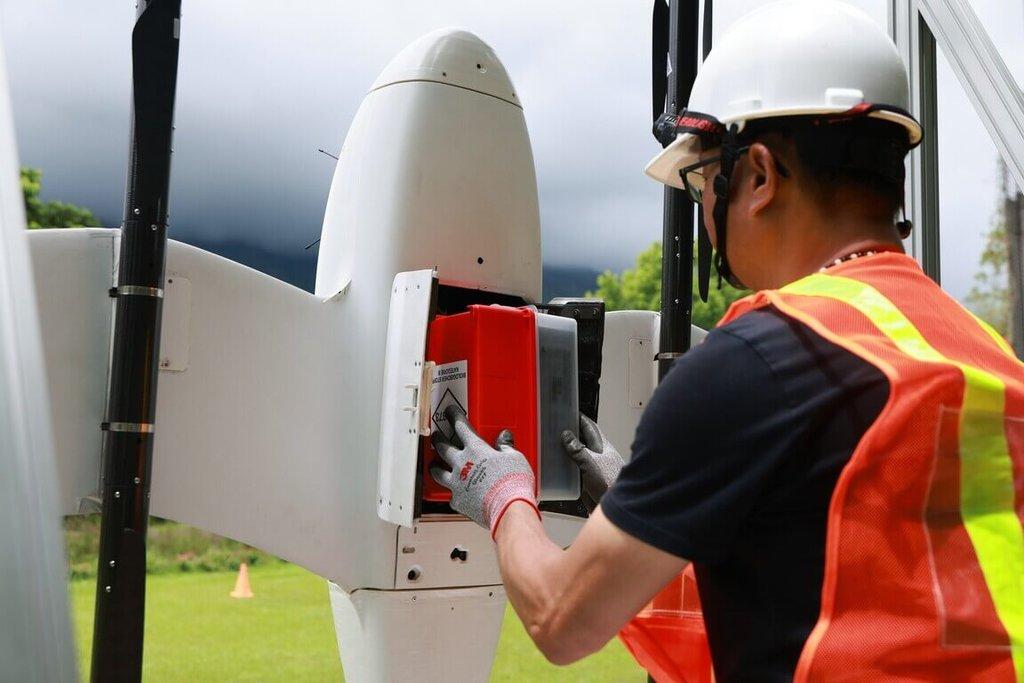
Photo courtesy of Hualien Tzu Chi Hospital
Hualien and Taitung together account for nearly one-quarter of Taiwan’s land area, but only 2.3 percent of its population, branch Director Huang Chao-chieh (黃兆杰) said.
Under the integrated holistic care program, authorities are studying the use of medical drones for both emergency response and routine healthcare services, he said.
To meet the region’s long-distance transportation needs, a vertical takeoff and landing fixed-wing drone was showcased at the demonstration.
The new model can carry between 3kg and 5kg of cargo, with its transport container equipped with cold-chain temperature controls, enabling the delivery of medications, blood, medical equipment and laboratory specimens, Earthbook chief executive officer Hsu Wei-cheng (徐偉城) said.
The new model, which has a maximum range of 120km and travels at speeds of about 100kph to 120kph, can take off not only from the ground, but also directly from windows, he said, adding that the system is capable of automated takeoff, landing and charging, while allowing remote monitoring.
Committee executive secretary and Hualien Tzu Chi Hospital Medical Affairs Office director Chang Ching-yu (張菁育) recalled lessons learned during repeated natural disasters that had prompted the hospital’s involvement in medical drone development.
On April 3, 2024, an earthquake cut off road access to the Tiansiang (天祥) area along the Central Cross-Island Highway in Hualien, while flooding caused by an overflow from a landslide-dammed lake on the Mataian River (馬太鞍溪) last year left some residents of Guangfu Township (光復) unable to reach medical stations, she said.
After doctors confirmed medication needs through telemedicine, prescriptions were issued and medications dispensed by pharmacists, she said.
The supplies were then flown into disaster-hit areas by drone and distributed by local healthcare workers, she added.
Delivering medical supplies by drone involves far more than loading supplies onto an aircraft, requiring demand assessment, route planning, cold-chain management, flight monitoring and delivery verification, she said.
Operating such systems independently would place a heavy burden on individual hospitals, she said, expressing hope that healthcare institutions and public health centers could establish a shared dispatch and scheduling mechanism.
For medical drones to become a practical solution for remote communities, they must be integrated with telemedicine, prescriptions, pharmaceutical dispensing and supply-tracking systems, committee deputy executive director and Hualien Tzu Chi Hospital vice superintendent Chen Hsing-chu (陳星助) said.
Challenges involving flight routes, regulations and operating budgets must also be addressed, he said.
The committee would continue assessing local demand and planning further test flights with the goal of building a medical drone logistics network capable of supporting routine operations and responding immediately during disasters, he said.
The push for medical drones in eastern Taiwan is aimed not only at overcoming transportation disruptions caused by natural disasters, but also at addressing long-term challenges posed by declining birthrates and labor shortages in the logistics sector, he said
During the initial phase, drones would be used to meet urgent medical needs, including the delivery of medications, antivenom, automated external defibrillators and other emergency supplies, Chen said.
The second phase would focus on integrating drones into routine logistics operations by consolidating delivery needs from healthcare institutions and communities, while establishing regular routes, takeoff and landing sites, and dispatch systems, he added.
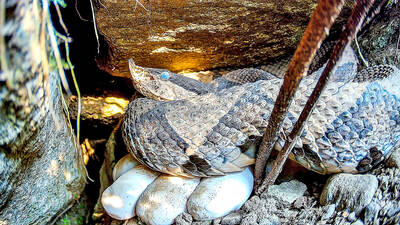
NATURE TAKES ITS COURSE: The agency’s head said he felt a sense of loss watching red-banded snakes eat the babies, as they had decided on non-intervention The Forestry and Nature Conservation Agency yesterday released a documentary on a hundred-pace viper that had incubated 16 eggs, all of which hatched, but only a baby viper escaped after they were attacked by red-banded snakes. The agency’s Taichung branch last year launched the viper reproduction monitoring project soon after forest rangers Lin Chun-yu (林俊佑) and Chou Chia-cheng (周家成) spotted a pregnant hundred-pace viper in a grass-covered burrow near a parking lot in Tbulan Village (松鶴部落). The Atayal village, in Taichung’s Heping District (和平), is headed by Ecyang Yapu, who was positive about the project and assisted in access control and power

The Coast Guard Administration (CGA) yesterday said that it had deployed vessels to “monitor” Chinese ships operating in waters off the east coast. The CGA said it dispatched vessels in response to a China Coast Guard announcement that it had carried out another “routine law-enforcement patrol” in waters off the east coast. “The CGA firmly rejects China’s cognitive warfare campaign of ‘law enforcement in name, jurisdictional expansion in practice,’” it said on X. As of 11am yesterday, two China Coast Guard ships were “loitering and drifting” about 105 nautical miles (195km) and 74 nautical miles east of Green Island (綠島) respectively, it said. It
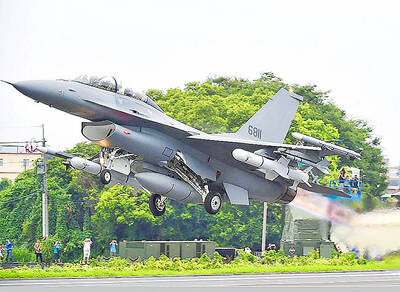
A sharp rise in compensation to be paid by air force officers who leave before completing their required service could indicate an increase in pilots leaving the military early, an analyst said on Friday, warning that the trend could worsen a shortage of experienced personnel. Chieh Chung (揭仲), a researcher at the Association for Strategic Foresight, issued the warning even though the number of volunteer military personnel is expected to increase next year. The planned headcount for volunteer military personnel, covering officers, noncommissioned officers (NCO) and enlisted soldiers, is 158,223 for next year, up 4,258 from 153,965 this year, Chieh said. The increase
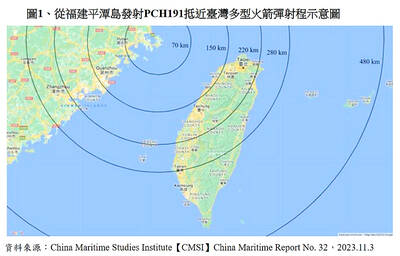
Potential improvements to munitions used by China’s long-range rocket-artillery units could extend their range to cover the entire Miyako Strait, which might give the Chinese People’s Liberation Army (PLA) the ability to secure the strategic waterway, the Mainland Affairs Council (MAC) said in a report. The PLA’s long-range rocket-artillery units deployed along the Taiwan Strait are concentrated along the coast of Fujian Province, including Changle, Pingtan and Shishi, the quarterly report on China said. The artillery brigades of the PLA’s 71st, 72nd and 73rd group armies have been deployed, with preparations for potential battlefield operations under way since August 2022, the report


 RSS
RSS