

Insect repellent or pesticides containing pyrethrins or pyrethroids will be required to include a cat warning label, the Ministry of Environment’s Chemicals Administration said yesterday.
Some commercially available insect repellents or pesticides containing pyrethrins — a mixture of natural chemicals extracted from pyrethrum daisy — and artificial pyrethroids are labeled with the statement “low toxicity to mammals,” it said.
However, pyrethrins have a higher toxicity to cats and such statements might mislead pet owners, it said.

Photo: Su Chin-feng, Taipei Times
Pyrethrins are widely used in the control of public health pests, it said, adding that it is less toxic to humans and most other mammals, as they have higher capacity for toxic metabolism than cats, allowing them to rapidly eliminate pyrethrins.
Cats have slower metabolism of pyrethrins than most other mammals due to congenital deficiency in glucuronidation metabolic capacity, it said.
As a result, pyrethrins are more toxic to cats than other mammals, and they are prone to adverse neurological reactions following exposure, it said.
The agency said it has convened a meeting to consult environmental toxicologists and suppliers of products containing pyrethrins.
The meeting established that a cat warning must be added to the product labels of all products containing pyrethrins, it said.
The warning should read, “Harmful to cats. Read label before use,” it said, adding the font size must be at least 5mm with the warning text colored differently.
Pyrethrin-containing products already circulating on the market would not be recalled, it said.
Sales channel operators are advised to add the warning to the retail area of such products, it added.
People should keep cats away from areas where products that contain pyrethrins or pyrethroids are being used until the treated space is dry and well ventilated, it said, adding that areas where cats frequently visit should be cleaned to reduce exposure risk.
Separetely, a newly built animal protection education park in Tainan’s Syuejia District (學甲) officially opened on Sunday.
Covering nearly two hectares, the park was constructed by the Tainan City Government in collaboration with the Ministry of Agriculture on a NT$403 million budget.
It is expected to help reduce free-roaming animals with an accommodation capacity of 400 dogs and 40 cats, and is Taiwan’s first animal protection zone built as a park, the city government said, adding the park would follow strict standards for sanitation, epidemic prevention and environmental maintenance.
The open park space accessible to the public is expected to help reduce the “not in my backyard” effect, it said.
The goal is to enhance citizens’ animal protection awareness and build Tainan into an animal-friendly city, it added.
Tainan Mayor Huang Wei-che (黃偉哲) said the park would prioritize taking in free-roaming dogs from the district.
Tainan Animal Health Inspection and Protection Office Director Fang Chuan-ho (方川和) said the park has four core facilities, including the animal shelter, an education center, a dog park, and leisure trails.
It is different from traditional animal shelters’ enclosed environment, using landscape greening, the dog park and an ecological basin to create a comfortable environment, he said.
The animal shelter is well-ventilated and well-lit with an advanced drainage system to ensure good living quality for sheltered animals, he added.

NATURE TAKES ITS COURSE: The agency’s head said he felt a sense of loss watching red-banded snakes eat the babies, as they had decided on non-intervention The Forestry and Nature Conservation Agency yesterday released a documentary on a hundred-pace viper that had incubated 16 eggs, all of which hatched, but only a baby viper escaped after they were attacked by red-banded snakes. The agency’s Taichung branch last year launched the viper reproduction monitoring project soon after forest rangers Lin Chun-yu (林俊佑) and Chou Chia-cheng (周家成) spotted a pregnant hundred-pace viper in a grass-covered burrow near a parking lot in Tbulan Village (松鶴部落). The Atayal village, in Taichung’s Heping District (和平), is headed by Ecyang Yapu, who was positive about the project and assisted in access control and power

The Coast Guard Administration (CGA) yesterday said that it had deployed vessels to “monitor” Chinese ships operating in waters off the east coast. The CGA said it dispatched vessels in response to a China Coast Guard announcement that it had carried out another “routine law-enforcement patrol” in waters off the east coast. “The CGA firmly rejects China’s cognitive warfare campaign of ‘law enforcement in name, jurisdictional expansion in practice,’” it said on X. As of 11am yesterday, two China Coast Guard ships were “loitering and drifting” about 105 nautical miles (195km) and 74 nautical miles east of Green Island (綠島) respectively, it said. It

A sharp rise in compensation to be paid by air force officers who leave before completing their required service could indicate an increase in pilots leaving the military early, an analyst said on Friday, warning that the trend could worsen a shortage of experienced personnel. Chieh Chung (揭仲), a researcher at the Association for Strategic Foresight, issued the warning even though the number of volunteer military personnel is expected to increase next year. The planned headcount for volunteer military personnel, covering officers, noncommissioned officers (NCO) and enlisted soldiers, is 158,223 for next year, up 4,258 from 153,965 this year, Chieh said. The increase
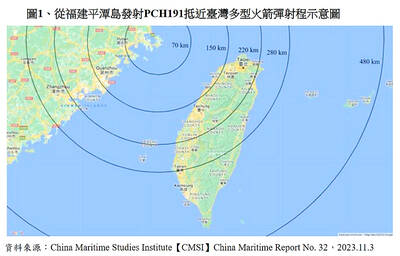
Potential improvements to munitions used by China’s long-range rocket-artillery units could extend their range to cover the entire Miyako Strait, which might give the Chinese People’s Liberation Army (PLA) the ability to secure the strategic waterway, the Mainland Affairs Council (MAC) said in a report. The PLA’s long-range rocket-artillery units deployed along the Taiwan Strait are concentrated along the coast of Fujian Province, including Changle, Pingtan and Shishi, the quarterly report on China said. The artillery brigades of the PLA’s 71st, 72nd and 73rd group armies have been deployed, with preparations for potential battlefield operations under way since August 2022, the report


 RSS
RSS