

The number of Chinese men — excluding those from Hong Kong and Macau — applying to come to Taiwan through marriage since 2023 has reached a nearly 19-year high of 1,508, government data show.
The figure is nearly six times as high as the 256 Chinese men who came to Taiwan through marriage in 2004.
For decades, it was predominantly Chinese women who came to Taiwan through marriages to Taiwanese men, with some later bringing over family members after obtaining Taiwanese identity cards.
Photo copied by Liu Ching-ho, Taipei Times
However, in recent years an increasing number of Chinese men have crossed the Taiwan Strait, with some saying that they made the move to look for work amid worsening economic conditions in China.
China’s property market has been in a prolonged downturn since 2021, with falling home sales, prices and investment continuing to weigh on the broader economy. Youth unemployment has also remained elevated, with official data showing a 14.9 percent unemployment rate among people aged 16 to 24 in 2023, excluding students.
In recent years, intermediaries have emerged specializing in arranging sham marriages for Chinese men who enter Taiwan’s labor market in search of basic necessities and greater freedom, sources said.
A Guangzhou man using the pseudonym A-shun (阿順) is among those who have left China. He said that China’s economy has continued to deteriorate and people have gradually lost confidence.
A-shun decided to pay an intermediary NT$160,000 to come to Taiwan. After passing a difficult interview process, he was required to pay a woman acting as his wife NT$10,000 per month, as well as give the intermediary a cut of his wages for arranging his job, he said.
After living expenses are deducted, he has little more disposable income than he did in China, he said. However, what he has gained is the freedom to openly criticize Chinese government officials and greater personal freedom, he added.
Another man from Fujian Province, using the pseudonym A-wen (阿文), said that he paid an intermediary 40,000 yuan (US$5,960) to come to Taiwan and work at a construction site. About one-third of his monthly income is handed over to the intermediary and his sham wife, while he also has to send money back to his family in China, he said.
Although his life has not improved financially, he no longer has to worry about suddenly disappearing for saying the wrong thing, he said, adding that he hopes to obtain a Taiwanese identity card as soon as possible and become a “real Taiwanese.”
According to data from the National Immigration Agency (NIA) and the Mainland Affairs Council, Chinese who entered Taiwan through sham marriages in earlier years were predominantly women. Some worked in factories during the day or in the adult entertainment industry at night to earn money, to pay their sham husbands and to send money home to support their families.
Chinese men who enter Taiwan through sham marriages mostly work at construction sites or factories, while some illegally operate taxis or work as delivery drivers, sources said. Their economic circumstances are often difficult, and they fear being exposed and arrested, they added.
“When I first arrived in Taiwan, I had almost exhausted all my savings,” A-shun said.
He initially relied on a taxi rented through an intermediary to make a living, but because he was unfamiliar with local roads and feared that disputes with passengers could attract police attention, his income was extremely unstable during his first few months, he said.
He said that more than 20 years ago, women from his hometown had also entered Taiwan through sham marriages. Within a short time, some had begun buying land and building houses in their hometowns, he said.
However, he later learned that life in Taiwan had been extremely difficult for them, he said, adding that some women worked in factories during the day and part-time at snack shops at night, while others worked in the adult entertainment industry at night to earn money.
A-shun said he at one point considered going to host clubs to make “quick money.”
However, the risk of being caught is higher at such establishments, he said. If he were deported to China and authorities learned that he had gone to Taiwan to make a living, he fears that under China’s increasingly strict controls on citizens traveling abroad, the consequences could extend beyond him and affect his relatives.
A senior NIA official said that sham marriages can result in charges of falsifying information in official documents, as well as violations of the Act Governing Relations Between the People of the Taiwan Area and the Mainland Area (臺灣地區與大陸地區人民關係條例).
The phenomenon of Chinese men using sham marriages to enter Taiwan reflects the severity of China’s economic downturn, which is far greater than many people outside China might imagine, the official said.
Although the NIA’s layers of screening have prevented most people from entering Taiwan through sham marriages, the official said some slip through. Authorities will continue to track and investigate such cases to reduce potential national security and public safety concerns, they said.
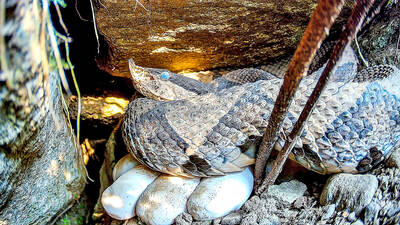
NATURE TAKES ITS COURSE: The agency’s head said he felt a sense of loss watching red-banded snakes eat the babies, as they had decided on non-intervention The Forestry and Nature Conservation Agency yesterday released a documentary on a hundred-pace viper that had incubated 16 eggs, all of which hatched, but only a baby viper escaped after they were attacked by red-banded snakes. The agency’s Taichung branch last year launched the viper reproduction monitoring project soon after forest rangers Lin Chun-yu (林俊佑) and Chou Chia-cheng (周家成) spotted a pregnant hundred-pace viper in a grass-covered burrow near a parking lot in Tbulan Village (松鶴部落). The Atayal village, in Taichung’s Heping District (和平), is headed by Ecyang Yapu, who was positive about the project and assisted in access control and power

The Coast Guard Administration (CGA) yesterday said that it had deployed vessels to “monitor” Chinese ships operating in waters off the east coast. The CGA said it dispatched vessels in response to a China Coast Guard announcement that it had carried out another “routine law-enforcement patrol” in waters off the east coast. “The CGA firmly rejects China’s cognitive warfare campaign of ‘law enforcement in name, jurisdictional expansion in practice,’” it said on X. As of 11am yesterday, two China Coast Guard ships were “loitering and drifting” about 105 nautical miles (195km) and 74 nautical miles east of Green Island (綠島) respectively, it said. It

A sharp rise in compensation to be paid by air force officers who leave before completing their required service could indicate an increase in pilots leaving the military early, an analyst said on Friday, warning that the trend could worsen a shortage of experienced personnel. Chieh Chung (揭仲), a researcher at the Association for Strategic Foresight, issued the warning even though the number of volunteer military personnel is expected to increase next year. The planned headcount for volunteer military personnel, covering officers, noncommissioned officers (NCO) and enlisted soldiers, is 158,223 for next year, up 4,258 from 153,965 this year, Chieh said. The increase
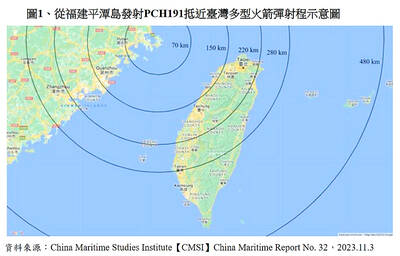
Potential improvements to munitions used by China’s long-range rocket-artillery units could extend their range to cover the entire Miyako Strait, which might give the Chinese People’s Liberation Army (PLA) the ability to secure the strategic waterway, the Mainland Affairs Council (MAC) said in a report. The PLA’s long-range rocket-artillery units deployed along the Taiwan Strait are concentrated along the coast of Fujian Province, including Changle, Pingtan and Shishi, the quarterly report on China said. The artillery brigades of the PLA’s 71st, 72nd and 73rd group armies have been deployed, with preparations for potential battlefield operations under way since August 2022, the report


 RSS
RSS