

The Taiwan Biodiversity Research Institute yesterday announced an action plan for conserving three endangered native plant species under the Forestry and Nature Conservation Agency’s Taiwan Ecological Network program.
The three species are the endangered Kao’s thorowax, and the critically endangered Asiatic sand sedge and Taiwan cork-tree, the institute said.
The conservation plan for the three species is grounded in scientific research, with a comprehensive assessment of their current status, ecological characteristics, population trends, reproductive biology and conservation strategies, it said.
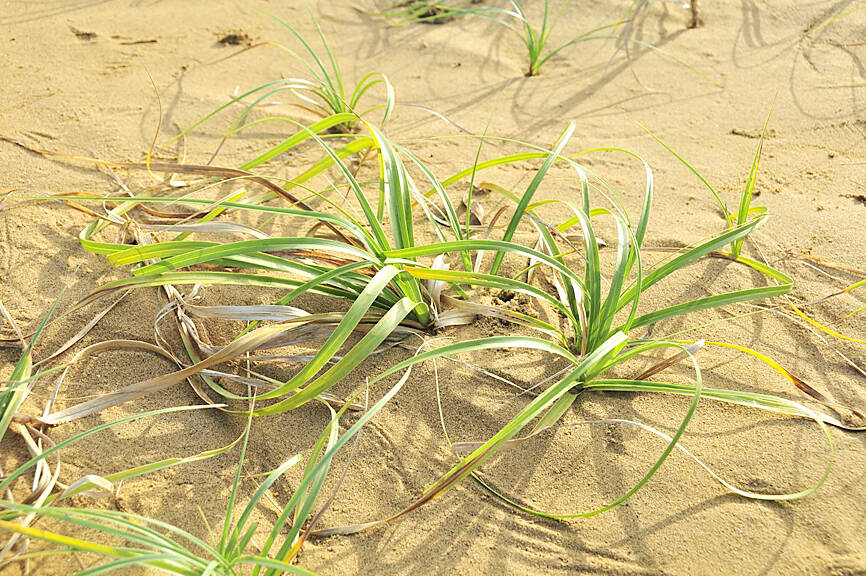
Photo courtesy of the Ministry of Agriculture
Working in collaboration with local governments, academic institutions and civic groups, the goal is to build a roadmap for native plant conservation work and prevent threatened species from disappearing, it said.
The plan for the three species is centered on the vision of protecting plant resources, sustaining ecosystem stability and ensuring sustainable survival of wildlife species in Taiwan, the institute said.
Asiatic sand sedge, or Carex kobomugi, is a perennial herb that grows exclusively on sandy beaches, it said.
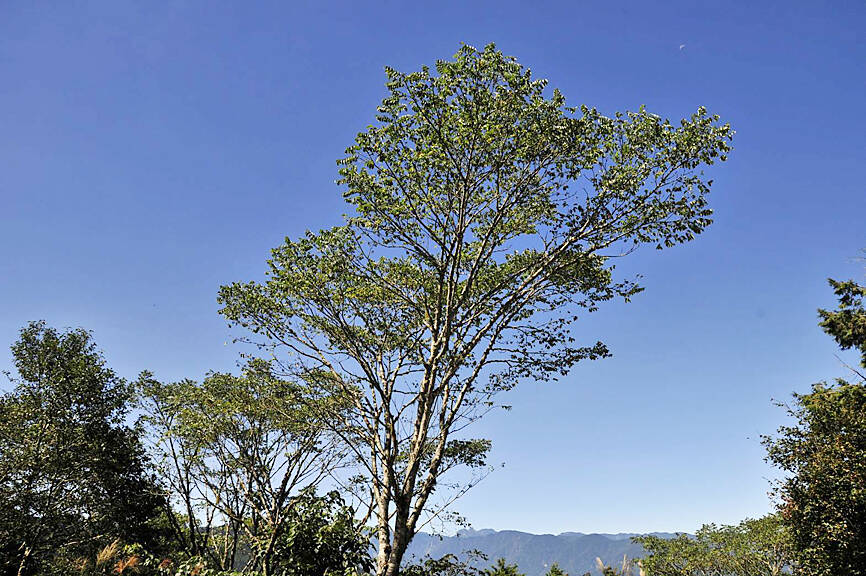
Photo courtesy of the Ministry of Agriculture
This dioecious species is currently restricted to two small populations along the Yanliao (鹽寮) and Fulong (福隆) beaches in northern Taiwan, while an additional population dwells on Dongju Island (東莒島) in Lienchiang County, it said.
Asiatic sand sedge is a temperate coastal plant species distributed across the Ussuri River in Russia, Japan, South Korea and northeastern China, it said, adding that Taiwan marks the southernmost limit of its geographic range.
It has a well-developed underground rhizome system that can stabilize loose sand against coastal erosion, making it an important plant for coastal protection and sand fixation, the institute said.
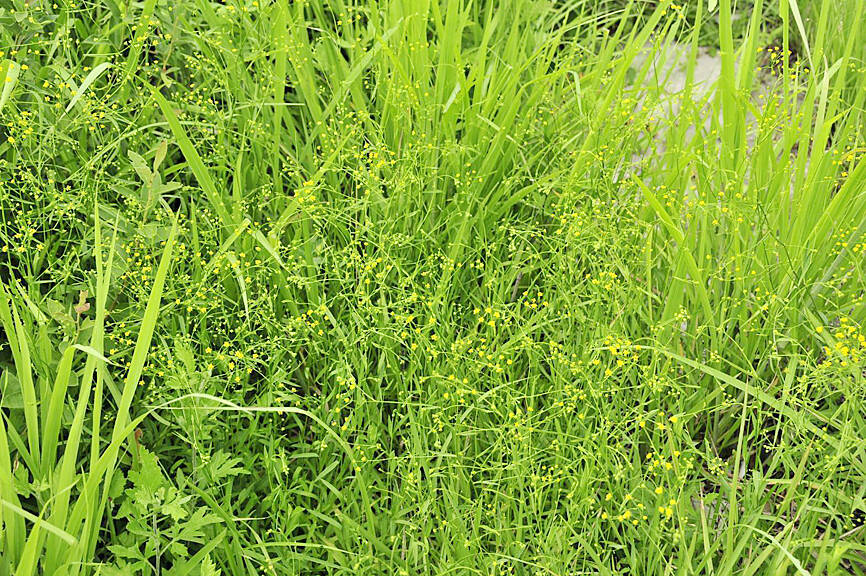
Photo courtesy of the Ministry of Agriculture
Asiatic sand sedge also has genetic resources associated with heat tolerance and adaptation to climate warming, which are considered to have irreplaceable global conservation value particularly amid global warming, it said.
The Taiwan cork-tree, or Phellodendron amurense var. wilsonii, is endemic to Taiwan, the institute said.
It is a dioecious, deciduous tree distributed in northern and central Taiwan at elevations ranging from 1,800m to 2,700m, it said.
The Taiwan cork-tree has long been regarded as an important traditional Chinese medicinal resource, as its bright yellow inner bark contains high levels of berberine, the institute said.
The species is ecologically valuable as its mature fruits provide an important winter food source for wildlife including birds, squirrels and macaques, it said.
Its root system also contributes to soil and water conservation on mountain slopes, the institute said.
The cork-tree’s primary wild populations are restricted to Yilan County’s Taiping Mountain (太平山) and Nantou County’s Cueifong (翠峰) area, it said.
Kao’s thorowax, or Bupleurum kaoi, is an endemic perennial herb that is distributed mainly in low-elevation mountainous areas of northern and central Taiwan, the institute said.
The species typically grows in sunny, low-elevation hills and public cemeteries, thus known locally as “graveyard grass,” it said.
Its roots are rich in saikosaponins, making it a promising native medicinal plant resource, the institute said.
The plant is also listed as a premium medicinal herb in the ancient Chinese medical encyclopedia The Divine Farmer’s Herb-Root Classic (神農本草經), it said.
The publishing of the action plan signals that Taiwan’s conservation efforts have shifted from “prohibition and protection” to “active restoration, scientific management and sustainable utilization,” the institute said.
Malaysian Prime Minister Anwar Ibrahim’s remarks that Taiwan is a Chinese province seeking independence threaten regional peace and stability and could undermine Taiwanese businesses’ confidence in investing in Malaysia, the Ministry of Foreign Affairs (MOFA) said today. Anwar recently made remarks implying that Taiwan is a province seeking to separate from China, effectively legitimizing Beijing’s position on using force to take Taiwan, the ministry said in a statement. The Republic of China, Taiwan, is a sovereign, independent country and is not subordinate to the People’s Republic of China, MOFA said, adding that that fact would not be changed no matter
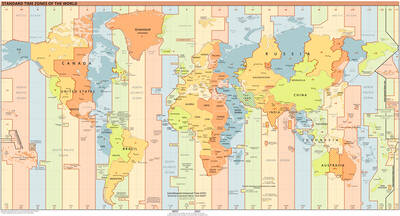
UNNECESSARY?: While some said that the switch would mean more sunlight exposure for workers, others said the government should promote flexible working hours instead An online debate has resurfaced on whether Taiwan should switch to the same time zone as Japan, with supporters citing its geographic location and saying that China would have no right to object. The debate erupted on Threads when users suggested that Taiwan should stop using the same time zone as China, Malaysia and Singapore, GMT+8, and instead switch one hour ahead to the same time zone as Japan and South Korea, GMT+9, which it is geographically closer to. Under GMT+9 the sun would set later year-round, meaning that people would see sunlight after getting off work even in the winter and
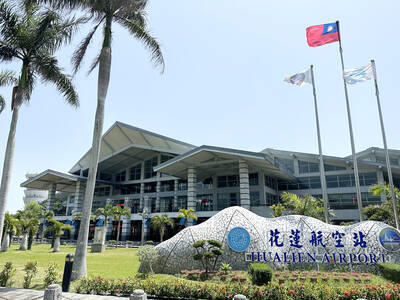
The Civil Aviation Administration (CAA) yesterday confirmed that Uni Air has submitted an application to suspend its Taipei-Hualien flights due to persistently low passenger rates. The airline, which is the only operator of the Taipei-Hualien route, proposed to suspend the service after Mandarin Airlines, another domestic flight carrier, applied to suspend flights to Hualien departing from Kaohsiung and Taichung earlier this year. The average load factor of the Taipei-Hualien flights during the first six months was 24.2 percent, CAA data showed. The average seat occupancy rate dropped even further to 17 percent last month, even though it was the beginning
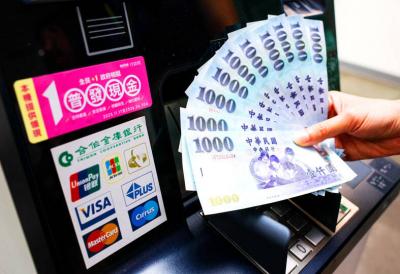
The government would distribute a NT$10,000 cash handout to all citizens next year as Taiwan’s economy continues to grow, President William Lai (賴清德) said today, emphasizing that economic growth could reach a 39-year high. The president made the remarks this morning at the Presidential Office after being briefed on the Executive Yuan’s proposed central government budget for next year for the second time. The forecasts for Taiwan’s economic growth have continued to improve, driven by its longstanding strengths in semiconductors, information and communications technology and manufacturing supply chains, Lai said. The government would focus on five key policies next year: advancing its new


 RSS
RSS