


Patterns of harassment faced by public figures are often different from that of the general public, as they are often harassed by strangers and might hesitate to seek help due to concerns over causing public controversy, Taiwan Academy of Psychiatry and the Law board member Lee Chun-hung (李俊宏) said yesterday, urging people to seek help before the situation worsens.
Commenting on an attack on CTBC Brothers cheerleader Wang Ching-wen (王敬汶) on Saturday, Lee said that, as public figures, cheerleaders face a different pattern of stalking compared with cases more commonly seen among the general public, such as disputes in intimate relationships or domestic violence.
In many instances, the perpetrators are strangers, driven by obsessive fan behavior or distorted perceptions of a relationship, leading to conduct that crosses legal boundaries, he said, adding that in some cases, such behavior might also stem from other forms of hostility or animosity.

Photo: Screengrab from Wang’s Instagram
Handshake sessions and fan meetings that allow close interactions between fans and figures have become popular in the past few years, Lee said, adding that in countries like Japan and South Korea, where fan cultures developed earlier than in Taiwan, they have measures such as real-name authentication, venue-entry security checks and even AI facial recognition to protect public figures.
In these countries, when public figures post real-time updates on social media, they might also use tactics such as delaying posts to ensure that their current location cannot be tracked by fans, he said.
Taiwan has also been influenced by East Asian pop culture in the past few years, leading to various fandom behaviors, Lee said. Most fans are rational and respect the boundaries between themselves and their idols, but it is still difficult to guarantee that there are no radical, obsessive fans — such as Hsu, he added.
While Taiwanese entertainment companies have followed Japanese and South Korean practices to protect their artists, there is still room for improvement, he said.
Even when public figures are aware that a fan has engaged in excessive or inappropriate stalking behavior, they might still hesitate to report it to police or pursue legal action, out of concern that doing so could trigger public controversy, he said.
However, people should proactively seek help from the police if they encounter such situations, he said, adding that it allows the authorities to assess if a written warning should be issued, or if they should apply to the court for a protection order.
If an incident does occur later, police would already have the relevant information on file, allowing for a faster response and more immediate assistance, he said.
Meanwhile, Lawyer Liu Wei-ting (劉韋廷) said on a post on social media that the most heartbreaking part of the incident is that Wang had sent out signals for help before the attack.
Wang in February wrote on social media that she hoped fans would stop following her after work and give her some personal space, he said.
In many cases, the victims do not remain silent, but the problem is that when they speak up, those around them downplay interactions as encountering “over-enthusiastic fans,” he said.
Liu said if someone is subjected to long-term stalking, tailing, loitering, repeated contact, surveillance or covert filming, and have suffered psychological distress, they do not need to wait for a bodily injury incident to occur before taking action.
According to the Stalking and Harassment Prevention Act (跟蹤騷擾防制法), victims can report the matter to the police, he said.
“If you feel afraid, terrified or even feel that you are being continuously stalked, surveilled or harassed by a specific person, do not take it lightly, and do not just think the other person is just being overly enthusiastic” Liu said, urging all celebrities, public figures and the general public to report incidents to the police immediately.
Additional reporting by Lin Nan-gu
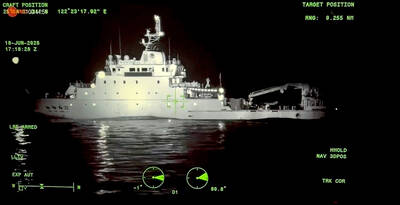
EXCUSES: Beijing is using government and research vessels as a pretext to harass the nation and enter its EEZ, and engage in ‘hegemonic expansion,’ the coast guard said The Coast Guard Administration yesterday said it drove away Chinese oceanographic research vessel Xiang Yang Hong 22 (向陽紅33) from restricted waters after warning it that it was in Taiwan’s exclusive economic zone (EEZ). The Chinese vessel entered restricted waters off the coast of Yilan County’s Suao (蘇澳) at 11:35pm on Thursday, the coast guard said, adding that it dispatched the Lanyu patrol vessel and the boat PP-10077 to shadow the Chinese ship and issue radio warnings ordering it to leave. China has no sovereignty over waters off Taiwan’s east coast, Lanyu’s crew told Xiang Yang Hong 22 over the radio, and demanded

BAIT AND SWITCH: Allowing KMT-run counties to sell to China while the threat of abrupt cancelations hangs overhead is another form of coercion, officials said Beijing is using agricultural purchase offers announced during the Straits Forum to deepen Taiwan’s dependence on the Chinese market, a Taiwanese official said yesterday as they criticized the Taitung County commissioner’s participation in the initiative. During the Straits Forum held in Xiamen on Saturday, Chinese officials announced a sales and purchase agreement for agricultural products from some counties led by the Chinese Nationalist Party (KMT). Taitung County Commissioner Yao Ching-ling (饒慶鈴), who was barred from attending the event in person by the Mainland Affairs Council, participated via video. Under the agreement, China would purchase atemoyas, pomeloes, tea and grouper harvested in Taitung,

SHIFTING FIRE: While the tempo of purely military exercises around Taiwan has gone down somewhat, Beijing is working to isolate Lai diplomatically from support abroad Chinese President Xi Jinping (習近平) is shifting tactics in his campaign to pressure Taiwan, ramping up diplomatic isolation of the nation while dialing down provocative displays of military aggression. Taiwan recorded a daily average of five Chinese military aircraft crossing the Taiwan Strait’s buffer line with China through May this year — half the number logged in the same period last year. In March, Beijing did not send a single fighter jet near Taiwan for seven days, the longest absence on record outside of typhoon season. In comparison, China sent 153 planes near Taiwan during one day at its peak in
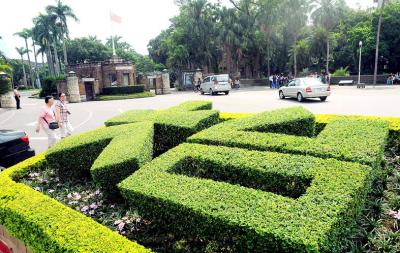
Four Taiwanese universities have been ranked among the world's top 200 institutions in the Quacquarelli Symonds (QS) World University Rankings for next year, the highest Taiwan has ever placed in the category, with National Taiwan University (NTU) achieving its best performance at 54th globally and 17th in Asia. The four Taiwanese institutions in the global top 200 are NTU (54th), National Tsing Hua University (142nd), National Yang Ming Chiao Tung University (177th) and National Cheng Kung University (191st), the rankings showed. All four universities achieved their highest-ever global rankings this year, QS data showed. National Cheng Kung University entered the top 200 for


 RSS
RSS