


China has established a vast global network of organizations to expand its influence abroad, an Australian national security expert said, suggesting that Taiwan develop an international public database to track the network’s activities.
The Chinese Communist Party’s (CCP) United Front Work Department mobilizes Chinese communities around the world through the China Council for the Promotion of Peaceful National Reunification, cultivating groups that promote “peaceful reunification,” Australian Strategic Policy Institute senior analyst Geoff Wade said.
These groups present themselves as grass-roots organizations, but they are actually “a propaganda and manipulation network... whose unrelenting role is to advance the party’s [CCP] influence,” he wrote in an article published on the institute’s Web site on Wednesday last week.
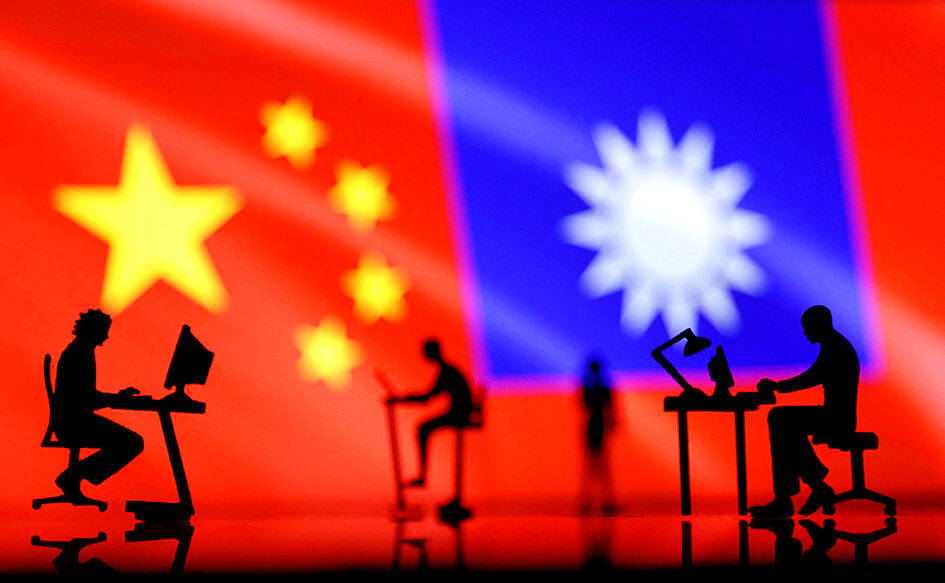
Photo: Reuters
“’Reunification’ in the name means achieving control of Taiwan by Beijing; ‘peaceful’ just makes it sound nicer,” Wade said.
Last month, some of these groups in Niger, Cameroon, Tanzania, Chad and Angola issued “boilerplate statements” against a speech President William Lai (賴清德) made on May 20, he said.
Similar groups in Congo, Guinea and Mozambique also criticized Lai’s planned visit to Eswatini, and a group in Namibia “lambasted a visit to Taiwan by the Paraguayan president,” he added.
These statements, issued only in Chinese, “all reflect CCP messaging from the China Council for the Promotion of Peaceful National Reunification,” Wade said.
These groups spread are only the tip of the iceberg of the CCP’s “united front” network, Wade told CNA in an article published on Saturday.
Over the past half-century, China has built the world’s largest “para-diplomatic influence network,” Wade said.
Groups under this network exert influence in social, political and economic spheres, and collect intelligence for the CCP, at times, they even engage in espionage activities, he said.
Democratic countries should focus on ensuring political transparency and enhance analytical research in response to “united front” organizations and the threats they pose, he added.
There are hundreds of “united front” groups in Australia, the US, Canada, Europe, Japan, South Korea and New Zealand, Wade said, adding that Beijing encourages the establishment of such organizations to control overseas Chinese communities and expand China’s influence abroad.
Considering that these groups operate and report in Chinese, the international community can rely on Taiwan to help understand their activities, he said.
Wade suggested that Taiwan establish a global public database to document the activities of these organizations and map their relationship networks.
Taiwan is more familiar with the CCP and its operations than anywhere else in the world, making it the best place to establish a center to study “united front” organizations and their activities, he said.
Such a center would provide valuable information to the international community and deepen Taiwan’s ties with countries that are concerned about China’s expanding influence and espionage activities, Wade said, adding that it would benefit the whole world.
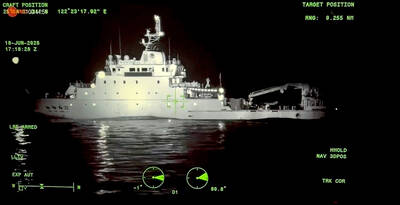
EXCUSES: Beijing is using government and research vessels as a pretext to harass the nation and enter its EEZ, and engage in ‘hegemonic expansion,’ the coast guard said The Coast Guard Administration yesterday said it drove away Chinese oceanographic research vessel Xiang Yang Hong 22 (向陽紅33) from restricted waters after warning it that it was in Taiwan’s exclusive economic zone (EEZ). The Chinese vessel entered restricted waters off the coast of Yilan County’s Suao (蘇澳) at 11:35pm on Thursday, the coast guard said, adding that it dispatched the Lanyu patrol vessel and the boat PP-10077 to shadow the Chinese ship and issue radio warnings ordering it to leave. China has no sovereignty over waters off Taiwan’s east coast, Lanyu’s crew told Xiang Yang Hong 22 over the radio, and demanded
BAIT AND SWITCH: Allowing KMT-run counties to sell to China while the threat of abrupt cancelations hangs overhead is another form of coercion, officials said Beijing is using agricultural purchase offers announced during the Straits Forum to deepen Taiwan’s dependence on the Chinese market, a Taiwanese official said yesterday as they criticized the Taitung County commissioner’s participation in the initiative. During the Straits Forum held in Xiamen on Saturday, Chinese officials announced a sales and purchase agreement for agricultural products from some counties led by the Chinese Nationalist Party (KMT). Taitung County Commissioner Yao Ching-ling (饒慶鈴), who was barred from attending the event in person by the Mainland Affairs Council, participated via video. Under the agreement, China would purchase atemoyas, pomeloes, tea and grouper harvested in Taitung,

SHIFTING FIRE: While the tempo of purely military exercises around Taiwan has gone down somewhat, Beijing is working to isolate Lai diplomatically from support abroad Chinese President Xi Jinping (習近平) is shifting tactics in his campaign to pressure Taiwan, ramping up diplomatic isolation of the nation while dialing down provocative displays of military aggression. Taiwan recorded a daily average of five Chinese military aircraft crossing the Taiwan Strait’s buffer line with China through May this year — half the number logged in the same period last year. In March, Beijing did not send a single fighter jet near Taiwan for seven days, the longest absence on record outside of typhoon season. In comparison, China sent 153 planes near Taiwan during one day at its peak in

Four Taiwanese universities have been ranked among the world's top 200 institutions in the Quacquarelli Symonds (QS) World University Rankings for next year, the highest Taiwan has ever placed in the category, with National Taiwan University (NTU) achieving its best performance at 54th globally and 17th in Asia. The four Taiwanese institutions in the global top 200 are NTU (54th), National Tsing Hua University (142nd), National Yang Ming Chiao Tung University (177th) and National Cheng Kung University (191st), the rankings showed. All four universities achieved their highest-ever global rankings this year, QS data showed. National Cheng Kung University entered the top 200 for


 RSS
RSS