


China is rapidly developing quadruped robots, known as “robotic wolves,” as part of its push toward “intelligentized warfare,” the most advanced stage of its military modernization beyond mechanization, an article by the Foundation for Defense of Democracies (FDD) said last month.
The article, titled “China’s War Wolves: From Commercial Tech to Combat Power,” said that Beijing’s use of scalable robotic systems could lead the People’s Liberation Army (PLA) to “adopt a more aggressive risk calculus in a crisis,” as these technologies are used to simulate potential conflict in Taiwan.
Robotic wolves are “only the first wave of a much larger Chinese effort” to integrate AI-enabled autonomous systems and data-centric operations into combat, it said, urging the US and its allies to “act now” to counter the increasing threats of autonomous and semi-autonomous combat systems.
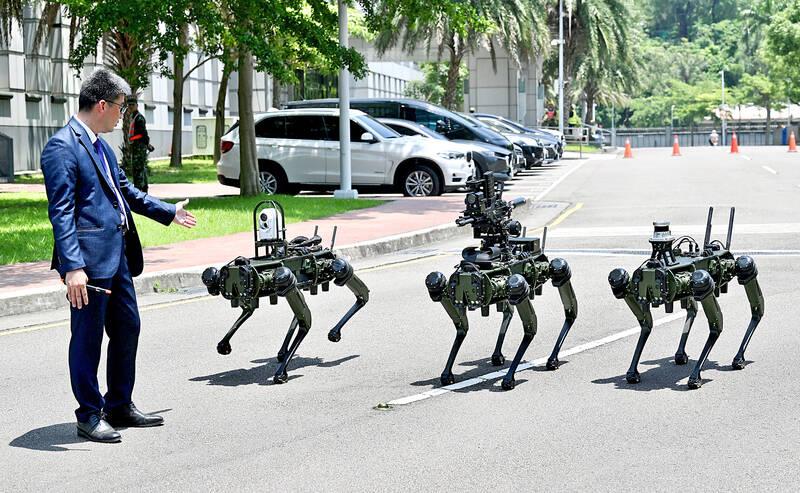
Photo: Lo Pei-de, Taipei Times
Any decision for China on when to invade Taiwan would largely depend on whether the PLA could field the platforms required to execute an invasion, including robotic wolves designed to operate in the most attrition-intensive phases of the fight, it said.
Chinese state media and PLA training footage have already shown robotic wolves in field exercises, the Washington-based research institute said.
The robotic wolves, the size of large dogs, are equipped with cameras, sensors, lidar and, in some cases, munitions, it said.
They can be used on the frontline to reduce exposure for humans, move through explosive or hazardous areas, deliver supplies and operate in coordinated swarms, while relaying intelligence to support logistics, the article said.
They can operate for up to two hours, have a range of up to 10 kilometers and remain operational after up to 30 minutes in water, while armed variants can employ small arms or rockets, it added.
The robots require human approval for the use of deadly force, it said.
Chinese state-run newspaper the People’s Daily has tied the development to lessons learned from Ukraine, as the PLA moves to address capability gaps in urban combat, with future operations potentially reaching “the streets of a Taiwanese city,” the article said.
These robotic systems are still in development and remain vulnerable to jamming, spoofing or cyber intrusion, require regular battery replacement or recharging and their sensors may be impacted by smoke, fog and lasers, it said.
They are further detectable with infrared sensors and can be disabled by even light weapons, it added.
The article suggested that the US should attempt to exploit these vulnerabilities and develop a dedicated Defense Department counter-robotics strategy while expanding domestic robotics production.
It should further support Taiwan’s counter-robotics preparedness through training and tactics, while equipping the country with low-cost countermeasures such as jammers, it said.
Moreover, it recommended the US increase the cost of producing, sustaining and deploying such systems by constraining financial channels that support China’s autonomous and semi-autonomous systems.
That could include initiating a Section 232 investigation into the national security risks posed by foreign robotics manufacturers that could result in tariffs on Chinese robotics, it said.
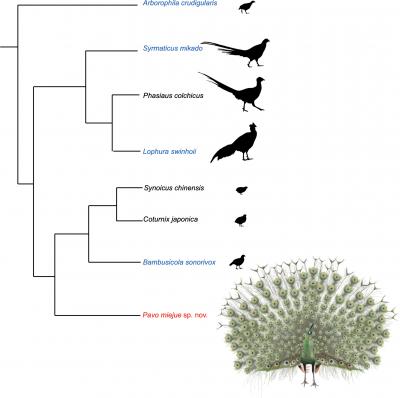
Through analyzing fossil evidence, a research team at National Taiwan University (NTU) discovered the largest endemic bird to have lived in Taiwan, naming it Pavo miejue, or extinct peafowl (滅絕孔雀). The Mikado pheasant, which is printed on the back of the NT$1,000 bank note, was previously believed to be the biggest endemic bird to Taiwan. The research team’s findings suggest that Pavo miejue lived during the Pleistocene epoch tens of thousands of years ago. It is the first endemic extinct bird species discovered and formally named in Taiwan. The study was coauthored by NTU Institute of Ecology and Evolutionary Biology professor Tsai Cheng-hsiu (蔡政修),
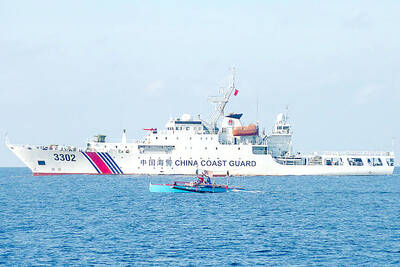
EXPANSIONIST: China deploys an average of 40 to 50 warships and coast guard vessels daily in the South China Sea, despite pledges not to militarize the region, an official said China is attempting to expand its influence across the First Island Chain and increase pressure on Japan by sending coast guard vessels into waters off of Taiwan under the pretext of maritime negotiations with Japan and the Philippines, a national security official said yesterday. China’s recent actions in the waters east of Taiwan and Japan and the Philippines’ exclusive economic zones (EEZ) are attempts to establish dominance in First Island Chain waters, said the official who declined to be named, adding that this is “expansion disguised as law enforcement.” Framing China’s actions solely as a cross-strait issue is a serious misjudgment that

Taiwan Taoyuan International Airport is to suspend its automated Skytrain service connecting Terminal 1 and Terminal 2 starting on July 1 to facilitate connection works for the upcoming Terminal 3, the airport operator said today. Passengers and staff who need to travel between the two terminals after the suspension can instead use the Taoyuan MRT or the airport's 24-hour shuttle bus service, Taoyuan International Airport Corp said. The Taoyuan MRT Airport Line directly links the two terminals, while the shuttle buses are to operate around the clock, the company added. The Skytrain provides free transportation between the airport’s two terminals for travelers and
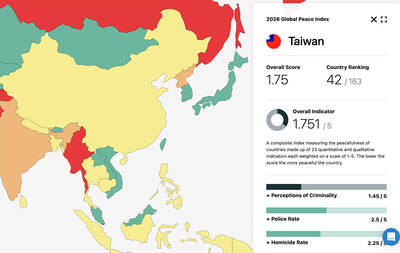
Taiwan ranked 42nd in terms of peacefulness among 163 countries, down five places from last year, according to this year’s Global Peace Index. With an overall score of 1.751, Taiwan dropped from 37th last year, the report published by the global Institute for Economics and Peace showed. The overall score measures a country’s level of peacefulness using 23 quantitative and qualitative indicators across three domains — ongoing domestic and international conflict, societal safety and security, and militarization. While Taiwan ranked 42nd worldwide, it was listed in ninth place among the 19 Asian-Pacific countries in the report, after New Zealand, Singapore, Japan, Malaysia,


 RSS
RSS