


As China weaponizes its global dominance in critical material supply chains, more countries should look to Taiwan’s raw earth refining technology to create non-red supply chains, Kristy Hsu (徐遵慈), director of the Taiwan ASEAN Studies Center at Chung-Hua Institution for Economic Research, said yesterday during a forum discussion with the Brookings Institution.
The Center for Asia Policy Studies at the Washington-based think tank and the Research Institute of Economy, Trade and Industry yesterday hosted a webinar titled “New Frontiers in the Trade-economic Security Nexus in Asia.”
Panelists discussed how US President Donald Trump’s administration has inserted economic security goals in US trade policy and the impact on its partners in Taiwan, Japan and Southeast Asia.
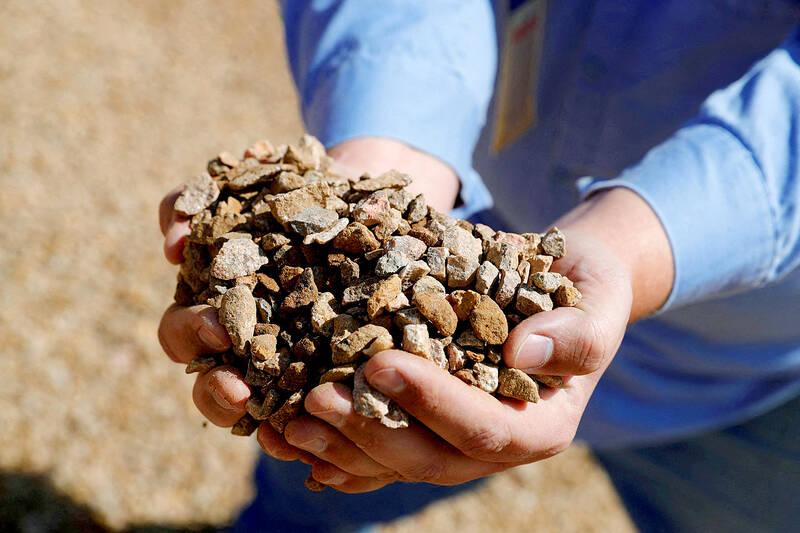
Photo: Reuters
Hsu, who is also a senior fellow at the Center for Asia-Pacific Resilience and Innovation, said that the US is already aware that Taiwan’s Industrial Technology Research Institute has developed rare earth technologies, although other nations have yet to take hold of the opportunity.
Critical minerals should not be politicized, and instead should be opened to any nations that can contribute to the creation of a non-China supply chain, she said.
It should be a priority for countries to cooperate and bring together technology, capital, human resources and natural resources to produce a stable, secure supply of critical minerals separate from China, she said.
“We don’t have much time left,” as China uses its dominance in rare minerals as a “very, very important weapon,” she said.
Taiwan is looking to purchase rare earths from the US, and is also in talks with Australia and Canada to strengthen global rare earth supply chain security, Minister of Economic Affairs Kung Ming-hsin (龔明鑫) said earlier this year.
Moreover, Taiwan plans to build a pilot-scale rare earth production line within three years that could meet about half of domestic demand, he said.
As Taiwan lacks significant reserves of rare earth minerals, cooperation with the US in the mining and refining of critical minerals and technologies for recycling electronic waste would be vital to ensuring supply chain security, he added.
Yesterday’s webinar also focused on the impact of Trump’s trade policies on Taiwan.
Earlier this year, Taiwan and the US signed the Agreement on Reciprocal Trade and a memorandum of understanding on economic and investment cooperation, although the agreements are still pending legislative review, Hsu said.
Those agreements would affect Taiwan’s exports, imports, investments and trade policies, she said.
Lower tariff rates on Taiwanese export products such as traditional industrial goods, textiles and auto parts would help boost competitiveness, although these products only account for about 20 percent of Taiwan’s total exports to the US, she said.
The remaining 80 percent are exempt under Section 232 tariffs or other policies, she added.
Meanwhile, opening Taiwan’s import market to US industrial and agricultural products with zero tariffs may have wider-reaching impacts yet to be seen on Taiwan’s farmers, food security and biodiversity, she said.
In terms of investments, Taiwan has pledged US$250 billion in private investment and US$250 billion in government-backed credit guarantees to the US.
However, Trump’s plan to harness the most advanced technology in Taiwan, such as 2-nanometer microchips, and relocate at least 40 percent of the most advanced chipmaking capacity to the US has raised concerns in Taiwan, she said.
Finally, Taiwan’s alignment with US policy on controlling trade with China may force it to diversify markets, as currently China and Hong Kong make up 25 to 30 percent of Taiwan’s export market, she said.
For Taiwan, it is particularly difficult to find new markets and develop bilateral and regional trade agreements, she said.
US trade agreements in Southeast Asia are also presenting challenges for Taiwanese investment in Vietnam, Thailand and Cambodia, she added.
Taiwan’s view on Trump’s tariffs and economic policies remains divided, although the real debate would begin when the Executive Yuan sends the agreements to the legislature for approval, Hsu said.

UPGRADE: The Kang Ding-class frigate is replacing its Chaparall missiles with Tien Chien II and Hua Yang VLS, which would provide it with long-range, 360° air defense Taiwan plans to produce 1,200 to 1,376 Hai Chien II missiles (海劍二, Sea Sword II) — also known as TC-2N — to serve as the standard air defense system of the navy’s surface combatant fleet, a source said yesterday. Last week, the Hai Chien II, the naval version of the Tien Kung II missile (天劍二, Sky Sword II), completed a live-fire test in waters off the National Chungshan Institute of Science and Technology’s Jiupeng facility (九鵬) in Pingtung County’s Manjhou Township (滿州). The MIM72 Chaparral and other dated air defense missiles that currently arm Taiwanese ships have inadequate range to combat Chinese

REASONS FOR TRAVEL: An assistant professor said that proposed amendments to penalize drivers if they used drugs overseas would not deter people from traveling People who operate a motor vehicle under the influence of marijuana would have their driver’s license revoked, even if they used the substance while overseas, the Ministry of Transportation and Communications said yesterday, citing proposed amendments to the Road Traffic Management and Penalty Act (道路交通管理處罰條例). The amendments would also authorize the government to revoke the licenses of people determined to have used Category 1 or Category 2 narcotics, even if they were not operating a vehicle while under the influence of drugs, as well as ban them from taking the license test for three years, the ministry said. People aged 18 or
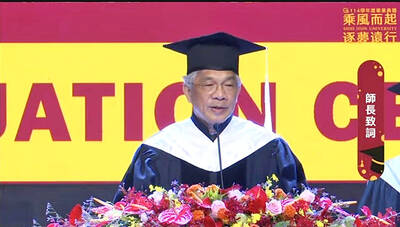
Shih Hsin University President Chen Ching-he (陳清河) yesterday issued a public apology for comments made in his commencement speech last week, stating that he has asked the school to suspend his duties and halt his wages for two months as a show of contrition. At the commencement ceremony on May 30, Chen said, “If you don’t manage your time well, or your own emotions, or your health, then I am telling every one of you — put a quick end to ‘you,’ because the world has no need for ‘you.’” The comments have sparked significant controversy online, and Chen through an open
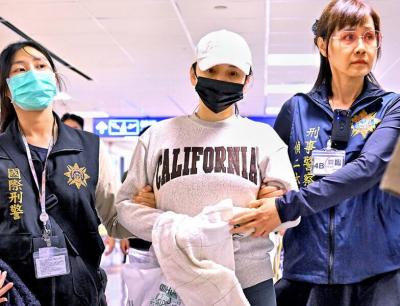
Johanne Liou (劉喬安), a Taiwanese woman who shot to unwanted fame during the Sunflower movement protests in 2014, returned to Taiwan last night after being deported from the US. She is to stand trial in Taiwan for charges involving embezzlement, fraud and drug crimes. The Criminal Investigation Bureau (CIB) said it took her into custody at Taiwan Taoyuan International Airport and would first question her before transferring her to the New Taipei District Prosecutors’ Office. She was arrested upon disembarking a flight from San Francisco that landed shortly before 7pm. Liou absconded to the US in 2019 after jumping bail


 RSS
RSS