


A bill proposed by Chinese Nationalist Party (KMT) caucus whip Fu Kun-chi to allow naturalized Chinese spouses to run for office or assume government posts without giving up their Chinese citizenship is confusing sole allegiance to the Republic of China (ROC), an official said yesterday.
Chinese spouses currently cannot hold public office if they possess dual nationality, but Fu and 15 KMT lawmakers on Nov. 26 last year proposed an amendment to Article 1 of the Nationality Act (國籍法).
The draft amendment says that “the application of this Act to people of the Mainland Area shall be governed by the special provisions of Article 11 of the Additional Articles of the Constitution (憲法增修條文) and the Act Governing Relations Between the People of the Taiwan Area and the Mainland Area (台灣地區與大陸地區人民關係條例).”

Photo: Reuters
It also says that “regarding people of the Mainland Area who have obtained household registration in the Taiwan Area, their eligibility to run for and hold public office will be governed by the provisions of the special act mentioned above, not subject to Article 20 of the Act, which mandates the renunciation of foreign nationality.”
Article 20 of the act stipulates that Taiwanese with dual nationality cannot hold elected office in Taiwan, with those who are elected required to renounce their foreign nationality and complete the process within one year of taking office.
Sources say that if the KMT’s proposed amendment is passed, Chinese nationals could hold public office in Taiwan without renouncing their Chinese citizenship, while other naturalized foreigners would still be required to give up their original nationality.
An official familiar with immigration issues yesterday said the act applies equally to all Taiwanese and demonstrates loyalty to the country, adding that it does not specifically target people from China. Rather, anyone who wishes to hold public office must renounce any nationality other than that of the ROC, as it is a duty of loyalty required for holding public office, the official said.
That Chinese spouses are unable to renounce their Chinese citizenship is due to the actions of the Chinese government, which has nothing to do with the Taiwanese government, they said.
If Taiwan’s lawmakers distort the nature of the problem and amend the Nationality Act so that only Chinese spouses become an exception, it would be highly unfair to other citizens, they added.
Everyone living in Taiwan should abide by the Nationality Act, and the KMT legislators’ proposal to amend the act is confusing the concept of sole allegiance to the ROC, the official said.
Democratic Progressive Party (DPP) Legislator Wang Ting-yu (王定宇) yesterday said Taiwanese should be aware that Chinese law mandates Chinese citizens have a legal obligation to support its national intelligence efforts.
He urged KMT lawmakers to withdraw the bill, warning that if it were passed, it would effectively open the door for China to absorb Taiwan.
Other DPP lawmakers also criticized Fu, arguing that the changes could allow Chinese nationals to hold any public office in Taiwan, and even run for president.
In response, Fu’s office told the DPP to “read the law carefully.”
The office was quoted by local media as saying that the Presidential and Vice Presidential Election and Recall Act (總統副總統選罷法) already explicitly bars residents of China from registering as candidates.
The office accused the DPP of misinterpreting existing legislation.
Fu’s office said they have not proposed amending Article 20 of the act, but instead proposed changes to Article 1.
The amendment was intended to ensure legal consistency, it said, urging the DPP not to deliberately distort the proposal or resort to fearmongering.
Additional reporting by Lin Che-yuan


UPGRADE: The Kang Ding-class frigate is replacing its Chaparall missiles with Tien Chien II and Hua Yang VLS, which would provide it with long-range, 360° air defense Taiwan plans to produce 1,200 to 1,376 Hai Chien II missiles (海劍二, Sea Sword II) — also known as TC-2N — to serve as the standard air defense system of the navy’s surface combatant fleet, a source said yesterday. Last week, the Hai Chien II, the naval version of the Tien Kung II missile (天劍二, Sky Sword II), completed a live-fire test in waters off the National Chungshan Institute of Science and Technology’s Jiupeng facility (九鵬) in Pingtung County’s Manjhou Township (滿州). The MIM72 Chaparral and other dated air defense missiles that currently arm Taiwanese ships have inadequate range to combat Chinese

REASONS FOR TRAVEL: An assistant professor said that proposed amendments to penalize drivers if they used drugs overseas would not deter people from traveling People who operate a motor vehicle under the influence of marijuana would have their driver’s license revoked, even if they used the substance while overseas, the Ministry of Transportation and Communications said yesterday, citing proposed amendments to the Road Traffic Management and Penalty Act (道路交通管理處罰條例). The amendments would also authorize the government to revoke the licenses of people determined to have used Category 1 or Category 2 narcotics, even if they were not operating a vehicle while under the influence of drugs, as well as ban them from taking the license test for three years, the ministry said. People aged 18 or
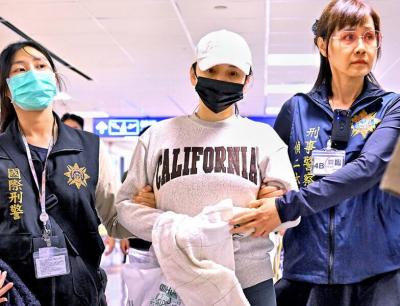
Johanne Liou (劉喬安), a Taiwanese woman who shot to unwanted fame during the Sunflower movement protests in 2014, returned to Taiwan last night after being deported from the US. She is to stand trial in Taiwan for charges involving embezzlement, fraud and drug crimes. The Criminal Investigation Bureau (CIB) said it took her into custody at Taiwan Taoyuan International Airport and would first question her before transferring her to the New Taipei District Prosecutors’ Office. She was arrested upon disembarking a flight from San Francisco that landed shortly before 7pm. Liou absconded to the US in 2019 after jumping bail
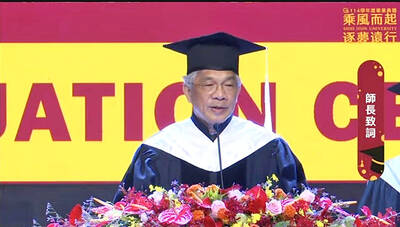
Shih Hsin University President Chen Ching-he (陳清河) yesterday issued a public apology for comments made in his commencement speech last week, stating that he has asked the school to suspend his duties and halt his wages for two months as a show of contrition. At the commencement ceremony on May 30, Chen said, “If you don’t manage your time well, or your own emotions, or your health, then I am telling every one of you — put a quick end to ‘you,’ because the world has no need for ‘you.’” The comments have sparked significant controversy online, and Chen through an open


 RSS
RSS