


Taiwan’s pivotal role in the global artificial intelligence (AI) supply chain is irreplaceable for the foreseeable future, but underinvestment in asymmetric defense would be concerning, a former White House National Security Council (NSC) official told a Research Institute for Democracy, Society and Emerging Technology forum in Taipei yesterday.
Taiwan and the US should not lose sight of the big picture over short-term tactical issues, and must collectively improve deterrence to protect their indispensable technological lifelines, said David Feith, a senior fellow at the Washington-based Hudson Institute and former senior director for Technology and National Security at the NSC.
There are still misconceptions within the US regarding the “supply chain relocation” of semiconductors, Feith told the Taipei-based think tank’s annual forum, titled “National Strategic Summit on Supply Chain Resilience.”
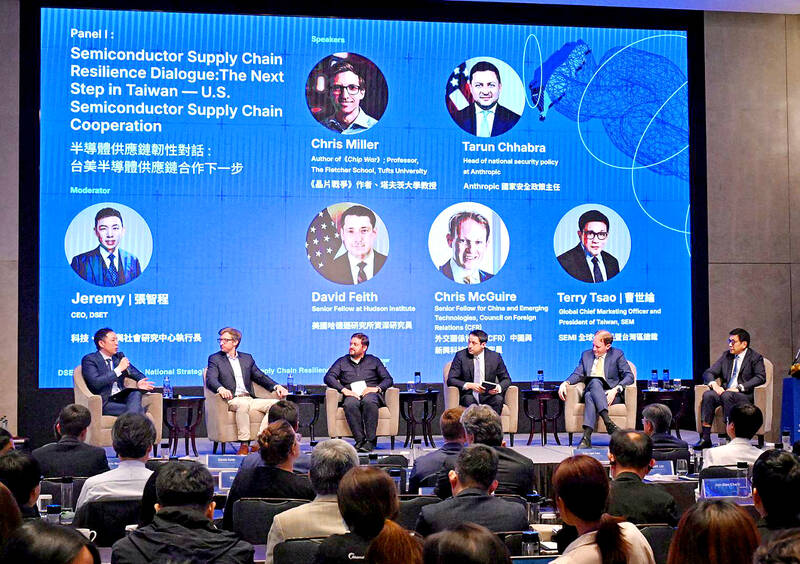
Photo: Fang Pin-chao, Taipei Times
While Taiwan Semiconductor Manufacturing Co (TSMC) has set up facilities in Arizona and achieved a milestone by producing Blackwell wafers in October last year, it does not mean “the US will no longer need Taiwan within 18 months,” as some rumors have claimed, he said.
The US-made wafers need to be sent to Taiwan for advanced packaging and other manufacturing processes, he added.
Expectations regarding the speed and advancement of “onshoring” are sometimes overly optimistic, which masks the fact that the US will remain immensely reliant on Taiwan’s hardware manufacturing ecosystem for many years to come to maintain its AI global leadership, Feith said.
Taiwan and the US face the strategic risks of “underinvestment” in two main areas: onshoring in the US and defense capability in Taiwan, he said.
Although TSMC chairman and chief executive officer C.C. Wei’s (魏哲家) visit to the White House in March has set an excellent tone for Taiwan-US diplomacy, domestic challenges in the US, such as factory permits and labor restrictions, might still limit the efforts of Taiwanese firms in the US, ultimately inflicting immense political and strategic damage on Washington, he said.
Supply chain relocation needs to speed up and not be limited to advanced manufacturing processes, with packaging, printed circuit boards and other mature processes like those of United Microelectronics Corp needed, Feith said.
That would prevent China from weaponizing control over foundational mature chips to coerce global supply chains, as it did with rare earth elements, he said.
The other risk is if Taipei underinvests in its national defense, Feith said, adding that Taiwan’s investments in its defense budget, overall spending, and drones and other asymmetric capabilities, have yet to reach a proportion commensurate with its wealth levels and the security risks it faces.
This is seen as a genuine strategic concern in Washington, he said.
The fundamental reason for discussing supply chain resilience is because Chinese President Xi Jinping (習近平) and the Chinese Communist Party seek to annex Taiwan, he said.
People in Taiwan and the US should not lose focus over short-term tactical issues, such as potential delays in arms sales following a meeting between US President Donald Trump and Xi, but should instead point out that Beijing’s hostile and destructive strategic designs constitute the single source threatening global peace and technological prosperity, Feith said.
Chris Miller, a nonresident senior fellow at the Washington-based American Enterprise Institute and author of Chip War, told the forum that the international community should give Taiwan greater recognition.
Foreign media often describe Taiwan as “the most dangerous place on Earth,” which is completely incorrect in terms of causality, because the true source of risk is China, not Taiwan, Miller said.
Accurate wording should be used to clarify the source of the risk, which would help lead to the correct solution — namely, that China must cease its intimidation, while Taiwan and the US should boost their deterrence capabilities to mitigate the risk, he said.
Trump’s claim that “Taiwan stole our chip industry” is factually inaccurate, as an examination of trade data reveals that US enterprises have consistently viewed Taiwan as an indispensable and trustworthy technological partner, he said.
Addressing the claim that the US is “hollowing out” Taiwan’s chip industry, Miller said the comment is obviously a flawed political weapon, as Taiwan’s semiconductor industry is experiencing its best-ever development.
Anyone who believes Taiwan is being hollowed out has clearly not been to Hsinchu or Tainan in a very long time, he added.
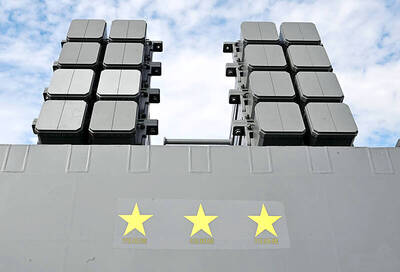
UPGRADE: The Kang Ding-class frigate is replacing its Chaparall missiles with Tien Chien II and Hua Yang VLS, which would provide it with long-range, 360° air defense Taiwan plans to produce 1,200 to 1,376 Hai Chien II missiles (海劍二, Sea Sword II) — also known as TC-2N — to serve as the standard air defense system of the navy’s surface combatant fleet, a source said yesterday. Last week, the Hai Chien II, the naval version of the Tien Kung II missile (天劍二, Sky Sword II), completed a live-fire test in waters off the National Chungshan Institute of Science and Technology’s Jiupeng facility (九鵬) in Pingtung County’s Manjhou Township (滿州). The MIM72 Chaparral and other dated air defense missiles that currently arm Taiwanese ships have inadequate range to combat Chinese

REASONS FOR TRAVEL: An assistant professor said that proposed amendments to penalize drivers if they used drugs overseas would not deter people from traveling People who operate a motor vehicle under the influence of marijuana would have their driver’s license revoked, even if they used the substance while overseas, the Ministry of Transportation and Communications said yesterday, citing proposed amendments to the Road Traffic Management and Penalty Act (道路交通管理處罰條例). The amendments would also authorize the government to revoke the licenses of people determined to have used Category 1 or Category 2 narcotics, even if they were not operating a vehicle while under the influence of drugs, as well as ban them from taking the license test for three years, the ministry said. People aged 18 or

HEAVY WEATHER: Typhoon Jangmi is due to crash straight into the Ryukyus as airlines look to shift flights to larger aircraft or cancel flights to Okinawa entirely Taiwan’s international air carriers announced flight adjustments over the weekend as Typhoon Jangmi is forecast to hit the Ryukyu Islands today and tomorrow. The Central Weather Administration (CWA) upgraded Jangmi from a tropical storm to a typhoon at 8am yesterday, with the eye located 580km south of Naha city. It was moving north at 19kph. Today, China Airlines’ CI-120, CI-121, CI-122 and CI-123 flights between Taoyuan and Naha, Okinawa, have been canceled as well as CI-132 and CI-133 between Kaohsiung and Naha. EVA Air’s BR-112, BR-113, BR-186 and BR-185 flights between Taoyuan and Naha are also canceled. Low-cost carrier Tigerair Taiwan canceled IT-230,
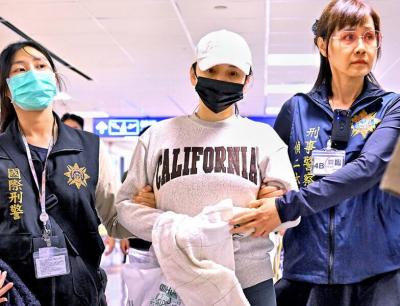
Johanne Liou (劉喬安), a Taiwanese woman who shot to unwanted fame during the Sunflower movement protests in 2014, returned to Taiwan last night after being deported from the US. She is to stand trial in Taiwan for charges involving embezzlement, fraud and drug crimes. The Criminal Investigation Bureau (CIB) said it took her into custody at Taiwan Taoyuan International Airport and would first question her before transferring her to the New Taipei District Prosecutors’ Office. She was arrested upon disembarking a flight from San Francisco that landed shortly before 7pm. Liou absconded to the US in 2019 after jumping bail


 RSS
RSS