


Taiwan is to sharply increase its arsenal of powerful anti-ship missiles to more than 1,800 by early 2029, as it seeks to enhance its capacity to counter a mounting threat of blockade or invasion by China, according to a Reuters calculation.
This expanding arsenal of weapons that can be fired from aircraft, ships and ground-based launchers is part of Taiwan’s shift toward a so-called asymmetric strategy, where the nation's defenders seek to offset China’s massive advantage in firepower with big numbers of affordable, but deadly weapons.
These also include shorter-range missiles and swarms of surface and aerial drones, current and former Taiwan military officers said.
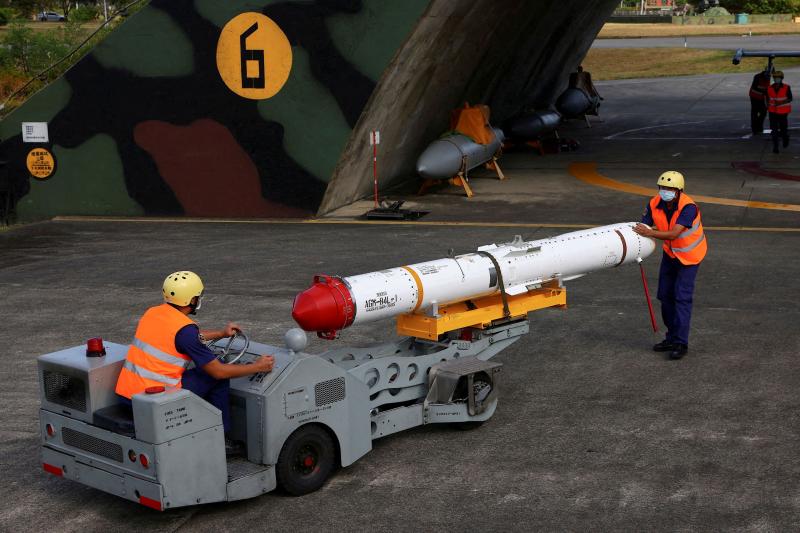
Photo: Ann Wang, Reuters
Taiwan aims to build a resilient force designed to survive an opening Chinese air-and-missile bombardment and emerge in a position to strike an invasion fleet of ships blockading the nation, the officers said.
They point to the success of Ukraine and Iran in using missiles and drones to level the playing field in battling more powerful adversaries.
The Reuters calculation of Taiwan’s growing anti-ship missile arsenal is based on arms trade data, US export approval documents, estimates from defense analysts and interviews with Taiwanese government officials.
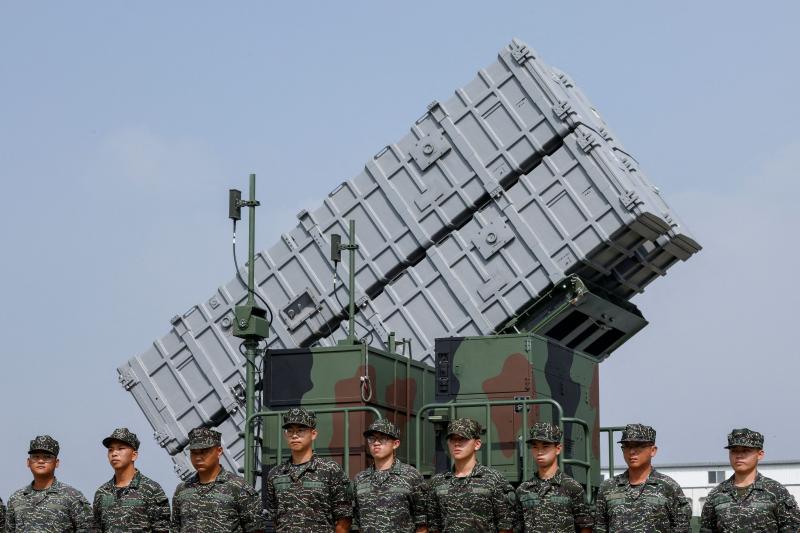
Photo: Tyrone Siu, Reuters
Additional precision missiles with sufficient range to attack Chinese vessels in the Taiwan Strait or forces at embarkation ports on China’s coast, are also in the pipeline after Taiwan’s opposition-controlled legislature approved an extra US$25 billion in defense spending for US munitions last month.
The spearhead of Taiwan’s anti-ship arsenal is made up of US-supplied Harpoon missiles and domestically produced Hsiung Feng missiles.
A big force of these weapons would allow Taiwan to set up a “kill zone” in the Taiwan Strait, an area where concentrated firepower would inflict heavy losses in a bid to defeat a Chinese invasion, said Ou Si-fu (歐錫富), deputy chief executive officer for research at the Institute for National Defense and Security Research, Taiwan’s top military think tank.
“Our goal is to stop them from landing and completing their mission, not to destroy every PLA [Chinese People’s Liberation Army] ship,” Ou said.
Investing in anti-ship missiles is a sensible move, said Grant Newsham, a retired US Marine Corps colonel and researcher at the Japan Forum for Strategic Studies.
If you are China, “one thing you’d not want to deal with are long-range precision weapons that can crack your ships in half before they even set out across the Taiwan Strait, or at any point between the Chinese mainland” and Taiwan’s shores, Newsham said.
“Employed properly and with adequate numbers, these missiles are a huge problem for a Chinese invasion force,” he added.
To mount an invasion across the Taiwan Strait, China would need to deploy an armada of warships and civilian transports, according to military experts.
China has the world’s biggest navy and a massive merchant fleet.
The Ministry of National Defense said in a statement that anti-ship missiles “can establish a powerful maritime strike capability and degrade the enemy’s combat effectiveness. Details regarding their deployment involve military security and are not disclosed.”
China’s Ministry of National Defense and Taiwan Affairs Office did not respond to a request for comment.
The Pentagon had no comment on Taiwan’s specific capabilities, delivery timelines or potential future security assistance packages, an official said in response to questions from Reuters.
The White House did not respond to questions for this story.
As part of efforts to further boost its defenses, Taiwan is seeking US President Donald Trump's approval for an arms sale package now in the pipeline worth up to US$14 billion.
Trump said last month he would soon decide on the sale after holding talks with Chinese President Xi Jinping (習近平) in Beijing.
During their talks, Xi warned Trump that mishandling Taiwan could lead to conflict between the two superpowers.
Ou and other military experts point to Ukraine’s success in attacking Russian warships and transports with missiles and surface drones in the Black Sea as evidence that this strategy could be effective for Taiwan in resisting a Chinese invasion or blockade. Iran’s continuing ability to attack shipping in the Strait of Hormuz and strike other regional targets despite more than a month of massive US and Israeli air-and-missile strikes demonstrated how a weaker power could retain the capacity to fight back, they said.
Proponents of this type of warfare say that anti-ship missiles, particularly mounted on ground-based mobile launchers, could be dispersed and concealed around Taiwan.
This would make it more difficult for the PLA to detect and destroy them in the initial waves of an attack.
One problem: Many of the nation's anti-ship missiles are still deployed on warships and at fixed ground installations where they are vulnerable to pre-emptive strikes, said Yuster Yu (于孝斌), a retired Taiwanese naval officer who served on the National Security Council.
“And, the Chinese know where they are,” he said.
Taiwan’s defense ministry said existing anti-ship missiles were “deployed in a mobile and dispersed manner to preserve combat effectiveness.”
Missiles in fixed positions were “equipped with protective and backup mechanisms and can be converted to mobile configurations as needed to enhance battlefield survivability,” it said.
While Taiwan’s military does not disclose the size of its weapons inventories, the figure of more than 1,800 anti-ship missiles includes 450 Boeing-made Harpoon missiles so far delivered to the nation, according to two senior Taiwanese government officials who spoke on condition of anonymity.
Deliveries of another 400 of these sea-skimming cruise missiles are to begin this year under an arms sale valued at US$2.4 billion that was approved in the final months of the first Trump administration in late 2020.
All of the 400 missiles are expected to be delivered by the end of March 2029, according to US government arms sales approval documents.
The Taiwanese navy said in a statement that according to the letter of offer signed by the US in 2021, the missiles would be delivered on schedule.
If these deliveries proceed as scheduled, Taiwan would have 850 Harpoon missiles by early 2029.
By then, the nation's military would also have about 1,000 or more domestically produced Hsiung Feng II and Hsiung Feng III anti-ship cruise missiles, Ou and two senior Taiwanese government officials said.
That would bring Taiwan’s anti-ship missile arsenal to about 1,850.
This estimate of where Taiwan’s anti-ship missile inventory is to stand by 2029 assumes US deliveries proceed largely on time and in full.
It does not account for potential production bottlenecks or competing wartime demands on US stocks that could slow deliveries.
One of the two senior Taiwanese officials told Reuters the delivery timetable could slip to 2030.
In separate arms deals, Washington has also approved the sale of another 195 air-launched Harpoon missiles or missiles derived from this weapon, valued at a combined US$1.36 billion, according to US government approval documents and arms trade data from the Stockholm International Peace Research Institute.
The two sides are still negotiating the terms of these deals and no delivery date has been agreed, one of the senior Taiwanese officials said.
A Pentagon official, Michael F. Miller, the director of the Defense Security Cooperation Agency, confirmed in testimony at a congressional hearing in March that Taiwan is the US' top priority for Harpoon deliveries.
To coordinate this extra firepower, Taiwan's military on July 1 is to form a new Littoral Combat Command to combine its coastal radars, anti-ship missiles and drones into one force.
For Taiwan's defenders, the anti-ship missiles are to bolster their objective of resisting an attempted invasion for long enough to give allied forces time to come to the nation's aid.
“We must always be prepared to fight a prolonged, war-of-attrition style battle,” Ou said.

NATIONAL SECURITY: Authorities are working to confirm the identities of the military personnel involved and investigating possible illegal conduct and regulatory violations Authorities are probing possible national security implications after Kinmen police and immigration officers on Sunday found a Chinese woman allegedly posing as a tourist while engaging in prostitution involving more than 10 military personnel. The woman, surnamed Chen (陳), has since been deported, authorities said, adding that investigators are still working to confirm the identities of those implicated, as the records only listed code names and aliases. The case stemmed from a report received by the Kinmen District Prosecutors’ Office on Friday last week from the Jinhu Precinct of the Kinmen County Police Bureau. On Sunday, police, along with the National Immigration

REASONS FOR TRAVEL: An assistant professor said that proposed amendments to penalize drivers if they used drugs overseas would not deter people from traveling People who operate a motor vehicle under the influence of marijuana would have their driver’s license revoked, even if they used the substance while overseas, the Ministry of Transportation and Communications said yesterday, citing proposed amendments to the Road Traffic Management and Penalty Act (道路交通管理處罰條例). The amendments would also authorize the government to revoke the licenses of people determined to have used Category 1 or Category 2 narcotics, even if they were not operating a vehicle while under the influence of drugs, as well as ban them from taking the license test for three years, the ministry said. People aged 18 or

GLOBALGIVING: ‘ Caving to external pressure is not acceptable for an organization that has cultivated justice reform and human rights for 30 years,’ one NGO said A slew of non-government organizations (NGOs) have withdrawn from the GlobalGiving fundraising platform after it announced it would use “Chinese Taipei” instead of “Taiwan” from next month. The Taiwan Good Rice Association wrote on Facebook on Friday that it was informed on April 28 via a teleconference call of the change, which was made because the platform wanted to operate in China. Taiwan Good Rice is to terminate all cooperative relationships with GlobalGiving in response to the platform’s “unilateral and non-negotiable” decision to remove references to Taiwan, the NGO said. “Taiwan is in the official name of Taiwan Good Rice Association and the

HEAVY WEATHER: Typhoon Jangmi is due to crash straight into the Ryukyus as airlines look to shift flights to larger aircraft or cancel flights to Okinawa entirely Taiwan’s international air carriers announced flight adjustments over the weekend as Typhoon Jangmi is forecast to hit the Ryukyu Islands today and tomorrow. The Central Weather Administration (CWA) upgraded Jangmi from a tropical storm to a typhoon at 8am yesterday, with the eye located 580km south of Naha city. It was moving north at 19kph. Today, China Airlines’ CI-120, CI-121, CI-122 and CI-123 flights between Taoyuan and Naha, Okinawa, have been canceled as well as CI-132 and CI-133 between Kaohsiung and Naha. EVA Air’s BR-112, BR-113, BR-186 and BR-185 flights between Taoyuan and Naha are also canceled. Low-cost carrier Tigerair Taiwan canceled IT-230,


 RSS
RSS