

The Cabinet yesterday unveiled proposed amendments and policies aimed at curbing drug-impaired driving, including lifetime license revocation for serious and repeat offenses.
At its weekly meeting, the Cabinet discussed how to implement a government-wide crackdown on drugs including etomidate, which has been linked to several drug-driving incidents in the past few months.
The government is to introduce 14 new measures across three areas: stopping supply of the drug at the source, enhanced enforcement and tougher drug driving penalties, Premier Cho Jung-tai (卓榮泰) said.
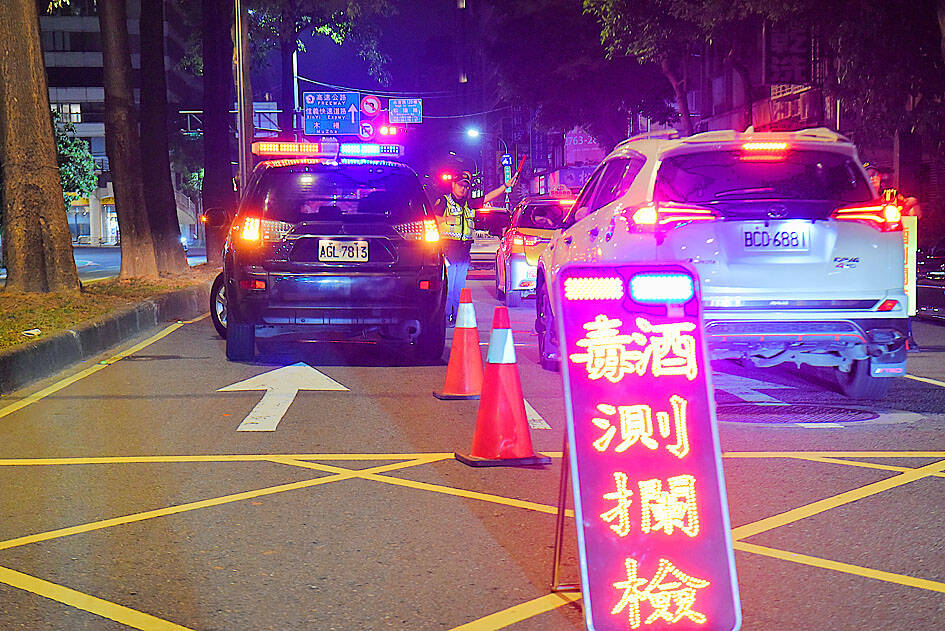
Photo: Wu Liang-yi, Taipei Times
He said he had instructed the Ministry of Justice to convene a narcotics review committee to consider reclassifying etomidate from a Category 2 to a Category 1 narcotic.
If reclassified, those convicted of manufacturing, transporting or distributing etomidate could face the death penalty, Cho said.
People found in possession of vapes could also face fines of up to NT$100,000, he added.
Deputy Minister of Justice Huang Mou-hsin (黃謀信) said the review committee is scheduled to meet on June 17.
Meanwhile, drivers who cause death or serious injury while driving under the influence of drugs, as well as repeat offenders, would face lifetime license revocation, Cho said.
The Ministry of Transportation and Communications also proposed extensive amendments to the Road Traffic Management and Penalty Act (道路交通管理處罰條例) to deter driving under the influence of drugs.
Based on the amendments, drug-impaired drivers would have their license revoked, rather than the current suspension of one to two years, and would be prohibited from applying for a new license for three years.
For first-time offenders, the starting fine would be NT$90,000 for motorcyclists and NT$120,000 for car drivers, up from NT$15,000 and NT$30,000 respectively, the amendment says.
Repeat offenders would be fined an additional NT$90,000 per offense, with no upper limit on cumulative penalties.
The amendments would also increase fines for refusing drug tests, raising the penalty for a first refusal from NT$180,000 to NT$270,000.
Repeat refusals would incur an additional NT$180,000 per offense, with no cap on total penalties.
Cho said the Cabinet would also discuss establishing a legal basis for rapid saliva testing of suspected drug-impaired drivers.
The tests could also be used alongside existing urine tests in schools to strengthen anti-drug efforts, he said.
Meanwhile, motorists caught driving without a license after revocation for drug driving would face an additional NT$36,000 fine, increased from the current NT$12,000.
Drug-impaired motorists operating without a license would be fined NT$96,000, including NT$60,000 for driving without a license and the aforementioned NT$36,000.
In addition, vehicles would be confiscated regardless of whether the driver is the registered owner, while passengers who knowingly ride with a drug-impaired driver would be fined NT$15,000.
The amendments further stipulate that those confirmed to have used Category 1 or 2 narcotics would have their licenses revoked and be prohibited from applying for a new license for two years, even if they were not driving.
Those confirmed to have used category 3 or 4 drugs would have their licenses suspended for one year.
Those penalized for drug driving or drug use must complete addiction treatment or related educational programs and fulfill the required observation period before they are allowed to reapply for a driving license or license renewal, based on the amendments.
Before the amendments are approved in the legislature, the ministry would first implement revised Road Traffic Safety Rules (道路交通安全規則) to prohibit drug-impaired motorists from operating vehicles unless they have completed addiction treatment or educational programs.
The revised rules would stipulate that a short-term driving license valid for three years would be issued, along with continuous monitoring over a six-year period.
Those who continue to use drugs would be barred from reapplying for a license.

The National Police Agency’s Third Special Police Corps yesterday said that from May to July, it intercepted five smuggling operations from China, seizing more than 70,000 counterfeit Beyblades with an estimated infringement value of NT$34.45 million (US$1.08 million). It added that any bootleg unit that reached the local market could present hidden health hazards to players. Beyblades, a line of spinning toy tops used in competitive gaming and developed in Japan by toy company Takara Tomy, have become popular in Taiwan, making them a target for fraudsters. The Third Special Police Corps, dedicated to safeguarding maritime borders and trade lines,
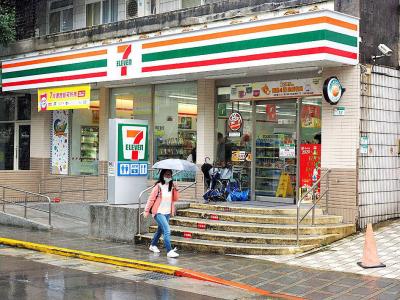
Five customers who made purchases at 7-Eleven stores across Taiwan won the top NT$10 million (US$313,716) special prize in the July-August uniform invoice lottery, including one who spent just NT$27 on photocopying, the convenience store chain said today. The five special prize winners made their purchases at stores in Taoyuan, Taipei, Taichung and Kaohsiung, 7-Eleven operator President Chain Store Corp said. The five winning purchases included NT$29 spent on snacks at a store in Taoyuan's Zhongli District (中壢), NT$27 on photocopying at a store in Taipei's Zhongzheng District (中正), NT$139 on City Cafe coffee and daily necessities at a store in Taipei's
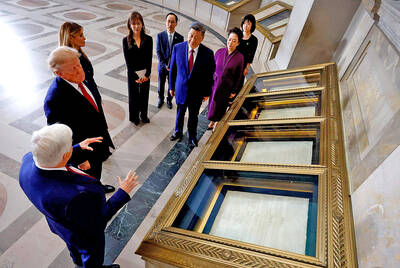
Chinese President Xi Jinping (習近平) reportedly cut short his visit to the National Archives in Washington after the Chinese delegation objected to plans to view the Treaty of San Francisco, sources in Washington’s media circles said. Xi and his wife, Peng Liyuan (彭麗媛), concluded their three-day state visit to the US on Friday after having tea with US President Donald Trump and first lady Melania Trump at the White House and visiting the archives. Chinese democracy advocates and members of pro-China groups gathered outside the venue during Xi’s visit, with the two groups exchanging competing slogans while police kept them separated. The US

TRICKY ISSUE: Taiwan’s defense of the ROC in WWII could conflict with the government’s narrative on Taiwanese history and identity, an academic said Chinese President Xi Jinping (習近平) had no standing to discuss US-China relations in World War II (WWII), as the People’s Republic of China did not exist at that time, Mainland Affairs Council (MAC) Deputy Minister Shen Yu-chung (沈有忠) said yesterday. Taipei would ensure that Washington has a clear understanding that it was the Republic of China (ROC), not the People’s Republic of China (PRC), that was a steadfast ally of the US in WWII, Shen said. Shen was referring to a White House fact sheet released on Friday about Xi’s meeting with US President Donald Trump in Washington. It said that “the two


 RSS
RSS