


Cities around Taiwan are seeking to deter drunk-driving and drug-driving by fully releasing the names and photos of repeat offenders.
Police data showed that the number of drug-driving cases referred for prosecution rose from 43 cases in 2021 and 46 in 2022 to 315 in 2023, before jumping to 2,619 in 2024 and 8,659 last year. This year, 4,725 drug-driving cases were recorded nationwide between January and April alone, close to three times the number reported during the same period a year earlier.
The Ministry of Transportation and Communications showed last week that the number of traffic fatalities caused by drunk driving in January and February increased by 10 compared with the same period last year, representing a surge of 71.4 percent.
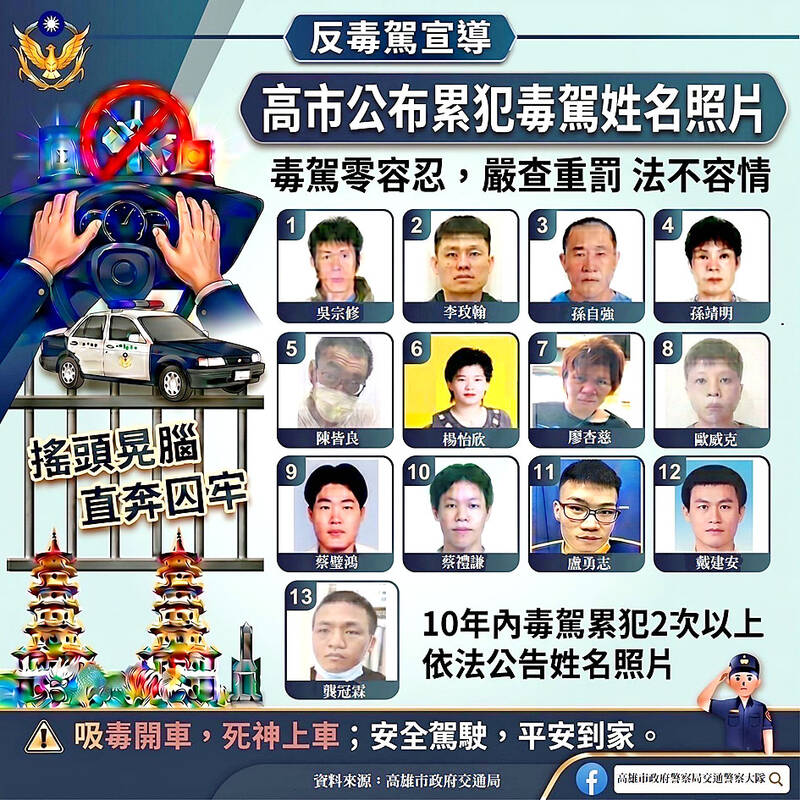
Photo courtesy of the Kaohsiung Police Department’s traffic division
The Kaohsiung Police Department’s traffic division yesterday posted the names and photographs of 13 repeat drug-driving offenders on social media after the city recorded 739 cases from January and last month, an increase of 299 cases compared with the same period last year.
“Drug-impaired driving poses an irreversible threat to the lives and property of innocent road users. We hope that by making relevant information public, it will help exert social deterrence and strengthen preventive effects,” the post said.
The traffic division added that it has planned 323 targeted operations against drug-impaired driving this year, with continued roadside inspections, patrols and intensified stop-and-check measures incorporated into their procedures.
In Taipei, repeat drug-impaired or drunk driving cases were announced. One suspect has been caught refusing sobriety tests on four occasions. Two other repeat offenders — both with three or more offenses involving drunk or drug-related impaired driving or refusal to take tests in April and having household registration in Taipei — have had their photographs printed on color posters, which would be displayed at neighborhood offices and police precincts.
In Miaoli County, the police disclosed three repeat drug-impaired driving offenders, adding that such offenses not only carry criminal liability but administrative penalties as well, including fines and suspension or revocation of driving licenses.
The Pingtung County Police Department likewise announced a “zero-tolerance policy” toward repeat offenders of drug- and alcohol-impaired driving and released the names of ten repeat offenders.
Following the revised “Procedures for Handling Suspected Drug-Impaired Driving (取締疑似施用毒品後駕車作業程序)” implemented last month, drivers who exhibit signs such as erratic driving, disorientation, incoherent speech, or muscle tremors can be subjected to rapid saliva testing, and those who test positive can be arrested on the spot.
Penalties for drug-impaired driving include fines of up to NT$120,000 for cars and NT$90,000 for motorcycles, immediate vehicle impoundment, and license suspension. For repeat offenses within 10 years, a second conviction carries a maximum fine of NT$120,000 and a three-year license suspension, with progressively harsher penalties for subsequent violations.
In addition, drug-impaired driving offenders are now included under preventive detention provisions, allowing authorities to detain repeat offenders to prevent further incidents.

NATIONAL SECURITY: Authorities are working to confirm the identities of the military personnel involved and investigating possible illegal conduct and regulatory violations Authorities are probing possible national security implications after Kinmen police and immigration officers on Sunday found a Chinese woman allegedly posing as a tourist while engaging in prostitution involving more than 10 military personnel. The woman, surnamed Chen (陳), has since been deported, authorities said, adding that investigators are still working to confirm the identities of those implicated, as the records only listed code names and aliases. The case stemmed from a report received by the Kinmen District Prosecutors’ Office on Friday last week from the Jinhu Precinct of the Kinmen County Police Bureau. On Sunday, police, along with the National Immigration

GLOBALGIVING: ‘ Caving to external pressure is not acceptable for an organization that has cultivated justice reform and human rights for 30 years,’ one NGO said A slew of non-government organizations (NGOs) have withdrawn from the GlobalGiving fundraising platform after it announced it would use “Chinese Taipei” instead of “Taiwan” from next month. The Taiwan Good Rice Association wrote on Facebook on Friday that it was informed on April 28 via a teleconference call of the change, which was made because the platform wanted to operate in China. Taiwan Good Rice is to terminate all cooperative relationships with GlobalGiving in response to the platform’s “unilateral and non-negotiable” decision to remove references to Taiwan, the NGO said. “Taiwan is in the official name of Taiwan Good Rice Association and the
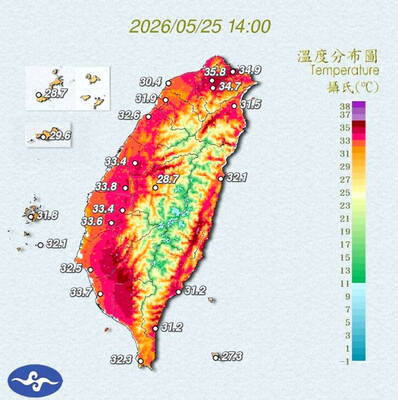
STAY COOL: The HPA recommended that people stay hydrated, use air-conditioning or fans while indoors, wear loose-fitting clothes and walk in the shade while outdoors Employers must implement measures such as installing cooling equipment, and providing drinking water and rest breaks for outdoor workers starting from Monday next week, the Taipei Department of Labor said on Sunday. Employers who fail to comply could face fines of NT$30,000 to NT$300,000 under the Occupational Safety and Health Act (職業安全衛生法), the department said. Businesses in Taipei employing fewer than 100 workers, as well as registered self-employed workers with labor insurance coverage, could receive on-site assessments and guidance from occupational safety consultants to help them apply for central government subsidies to implement or improve heat-protection measures, it said. Under the Ministry of

Chinese Nationalist Party (KMT) Chairwoman Cheng Li-wun (鄭麗文) yesterday briefed her party’s Central Standing Committee regarding her scheduled visit to the US between Monday next week and June 16, saying that her purpose would be to persuade the US that the Republic of China (ROC) Constitution was a “one China” constitution that would foster stable and peaceful cross-strait relations. The ROC Constitution is the most important defense for all Taiwanese citizens, as it upholds our democracy and has contributed to our robust economy, which aligns with international and US interests, she said. “We would not be troublemakers and drag the US under,”


 RSS
RSS