


A new policy that lowers the age at which drivers are required to renew their licenses to 70 from 75 is to take effect on Sunday, after a deadly crash involving a 78-year-old driver last year, the Highway Bureau said.
The agency proposed the revision after a 78-year-old man surnamed Yu (余) sped through a school zone in New Taipei City’s Sansia District (三峽) on May 19, killing two students and a parent and injuring 12 others. Yu later died from his injuries.
Under the new policy, drivers aged 70 to 74 who pass a physical examination and complete a free two-hour road safety course would receive licenses valid until they turn 75.
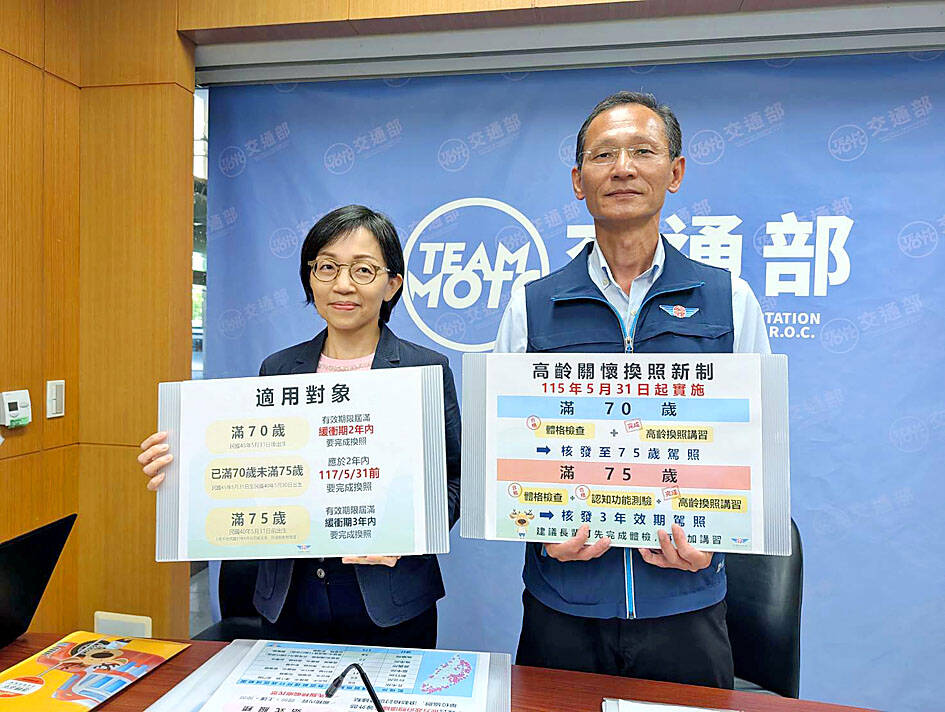
Photo: Wu Liang-yi, Taipei Times
Drivers aged 75 or older would be required to renew their licenses every three years, after passing a cognitive test, physical examination and safety education course.
Affected drivers can reserve a place in the two-hour safety education course online and take it at a motor vehicle office, senior citizen center, driving school or other designated location, the bureau said.
The course would include the latest traffic safety regulations and defensive driving material, and require applicants to watch a video on road hazard perception that simulates real road conditions, it said.
Drivers aged 70 to 74 are not obligated to undergo cognitive tests when renewing licenses, as a Ministry of Health and Welfare epidemiological survey in 2023 and a National Health Insurance database study showed the prevalence of dementia was nearly twice as high in the 75-to-79 age group as in the 70-to-74 age group, it said.
The cognitive test for drivers aged 75 or older would evaluate their orientation to time and place, requiring them to correctly state the date and their location, the bureau said.
Their short-term memory and cognitive ability would also be assessed by asking them to correctly recall at least three of 10 pictures shown to them, it said.
They would also be required to draw a clock showing a time to test their hand-brain coordination and judgement, it said.
If drivers fail the cognitive test, they can instead undergo evaluations at approved medical facilities to prove they do not have dementia, it added.
The bureau said it is developing a new physical examination form for drivers aged 75 or older that would incorporate doctors’ recommendations and drivers’ self-assessments.
A grace period for drivers aged 70 to 74 when the new policy takes effect would have until the end of May 2028 to renew their licenses, while those turning 70 after the new policy takes effect would have a two-year grace period starting from their 70th birthday, it said.
The new system is expected to affect about 1.288 million drivers, with renewal notices to be mailed beginning next month.
People caught driving with expired licenses could face fines of NT$1,800 to NT$3,600, have their licenses confiscated and be prohibited from driving.
To encourage elderly people to voluntarily stop driving, the Ministry of Transportation and Communications has launched a TPass subsidy program offering drivers aged 70 or older who surrender their licenses a 50 percent monthly rebate on public transportation and taxi fares, capped at NT$1,500 per month for two years.
Drivers aged 75 or older with a record of traffic violations resulting in accidents would be required to complete driving training before renewing their licenses starting on Dec. 31.
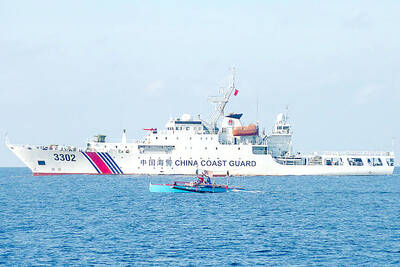
EXPANSIONIST: China deploys an average of 40 to 50 warships and coast guard vessels daily in the South China Sea, despite pledges not to militarize the region, an official said China is attempting to expand its influence across the First Island Chain and increase pressure on Japan by sending coast guard vessels into waters off of Taiwan under the pretext of maritime negotiations with Japan and the Philippines, a national security official said yesterday. China’s recent actions in the waters east of Taiwan and Japan and the Philippines’ exclusive economic zones (EEZ) are attempts to establish dominance in First Island Chain waters, said the official who declined to be named, adding that this is “expansion disguised as law enforcement.” Framing China’s actions solely as a cross-strait issue is a serious misjudgment that
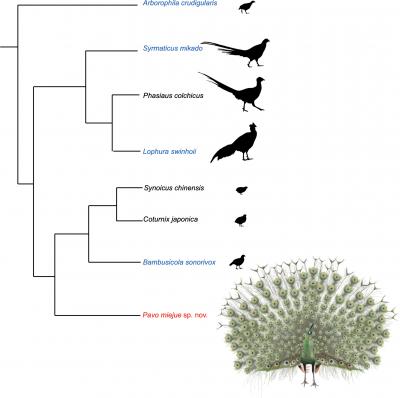
Through analyzing fossil evidence, a research team at National Taiwan University (NTU) discovered the largest endemic bird to have lived in Taiwan, naming it Pavo miejue, or extinct peafowl (滅絕孔雀). The Mikado pheasant, which is printed on the back of the NT$1,000 bank note, was previously believed to be the biggest endemic bird to Taiwan. The research team’s findings suggest that Pavo miejue lived during the Pleistocene epoch tens of thousands of years ago. It is the first endemic extinct bird species discovered and formally named in Taiwan. The study was coauthored by NTU Institute of Ecology and Evolutionary Biology professor Tsai Cheng-hsiu (蔡政修),
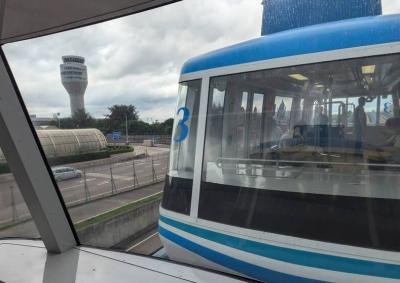
Taiwan Taoyuan International Airport is to suspend its automated Skytrain service connecting Terminal 1 and Terminal 2 starting on July 1 to facilitate connection works for the upcoming Terminal 3, the airport operator said today. Passengers and staff who need to travel between the two terminals after the suspension can instead use the Taoyuan MRT or the airport's 24-hour shuttle bus service, Taoyuan International Airport Corp said. The Taoyuan MRT Airport Line directly links the two terminals, while the shuttle buses are to operate around the clock, the company added. The Skytrain provides free transportation between the airport’s two terminals for travelers and
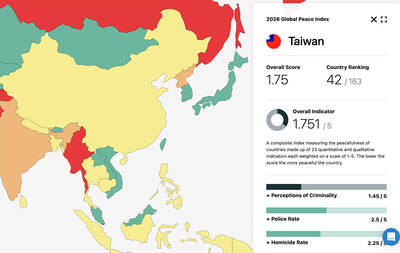
Taiwan ranked 42nd in terms of peacefulness among 163 countries, down five places from last year, according to this year’s Global Peace Index. With an overall score of 1.751, Taiwan dropped from 37th last year, the report published by the global Institute for Economics and Peace showed. The overall score measures a country’s level of peacefulness using 23 quantitative and qualitative indicators across three domains — ongoing domestic and international conflict, societal safety and security, and militarization. While Taiwan ranked 42nd worldwide, it was listed in ninth place among the 19 Asian-Pacific countries in the report, after New Zealand, Singapore, Japan, Malaysia,


 RSS
RSS