


Chinese Nationalist Party (KMT) lawmakers yesterday proposed a “hidden camera control” law, pushing for real-name purchases and stricter inspections, after hidden cameras were found at several aesthetic clinics.
The rising in digital gender-based violence cases involving miniature or disguised hidden cameras has become a major concern, with such devices increasingly used for covert filming, seriously violations people’s privacy and safety, states the draft bill proposed by legislators including Hsu Chiao-hsin (徐巧芯), Wang Hung-wei (王鴻薇) and Lo Chih-chiang (羅智強).
There is a lack of control over how such devices are obtained, it says, adding that only a few local governments have introduced rules requiring inspections for hidden cameras in public spaces, leading to uneven protection standards.

Photo: CNA
The proposal seeks to tighten regulation at the source by introducing real-name registration for purchases and a licensing system for sales. It would also elevate requirements for regular anti-surveillance inspections in public venues to the national legal level, aiming to establish a more comprehensive framework against voyeurism.
Local regulations alone are insufficient, as consumers could still purchase pinhole camera devices abroad, it states.
Therefore, a comprehensive national framework is needed, Hsu said.
Aside from introducing real-name registration requirements for the manufacture, import and sale of such devices, the proposal would require online platforms to verify sellers’ licenses and enforce real-name transactions, she said.
It also requires managers of private spaces, such as bathrooms, changing rooms and medical examination rooms, to carry out regular checks for hidden cameras and keep records, she added.
The bill includes penalties to curb voyeurism, Hsu said.
In related developments, local officials yesterday said that five Airlee aesthetic clinics in Taipei and New Taipei City, and two Saint Eir clinics and one Dr Shine clinic in Taichung have been ordered to suspend services for six months over alleged hidden camera offenses.
The investigation into Airlee Group Co, which operates 18 clinics nationwide, began after a person on May 2 posted on Threads that she noticed a smoke detector that appeared to be hiding a recording device while changing in a room at Airlee’s Banciao branch.
Airlee chairman Chang Ju-shan (常如山) was questioned by prosecutors on Wednesday last week and held incommunicado.
The New Taipei City Department of Health said it confirmed with prosecutors that three Airlee branches in Linkou (林口), Sinjhuang (新莊) and Yonghe (永和) districts had concealed surveillance equipment in treatment and operating rooms where patients were allegedly secretly filmed.
Such acts are a serious breach of Article 108 of the Medical Care Act (醫療法), which bans practices that are obscene or endanger human health, the department said.
The clinics deliberately engaged in grave offenses and were ordered to pay a NT$500,000 fine each, the department said, adding that their operations have been suspended until Nov. 14.
The Taipei City Government has also ordered two Airlee branches in Daan (大安) and Zhongshan (中山) districts to suspend operations for six months over the same offenses and fined each branch NT$500,000, the city’s Department of Health said yesterday.
The Daan branch was also fined NT$250,000 for contravening official fee regulations by setting unauthorized charges.
On Thursday, two Airlee branches in Kaohsiung were ordered to suspend medical services for six months over multiple violations, including the alleged unauthorized filming of patients.
Taichung City Health Bureau Director Tseng Tzu-chan (曾梓展) said their health department found that two Saint Eir clinic branches had installed cameras in treatment areas, contravening regulations.
One Dr Shine clinic was found to have secretly recorded patients’ medical images without consent, with 23 video clips discovered in treatment and laser rooms, Tseng said.
The three clinics in Taichung were each fined NT$500,000 and ordered to suspend operations for six months, Tseng added.
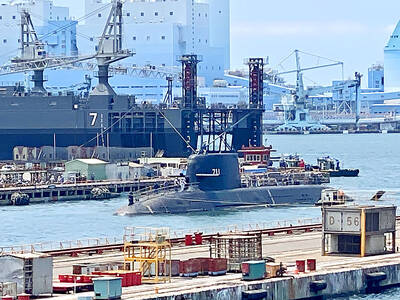
AGING: While Japan has 22 submarines, Taiwan only operates four, two of which were commissioned by the US in 1945 and 1946, and transferred to Taiwan in 1973 Taiwan would need at least 12 submarines to reach modern fleet capabilities, CSBC Corp, Taiwan chairman Chen Cheng-hung (陳政宏) said in an interview broadcast on Friday, citing a US assessment. CSBC is testing the nation’s first indigenous defense submarine, the Hai Kun (海鯤, Narwhal), which is scheduled to be delivered to the navy next month or in July. The Hai Kun has completed torpedo-firing tests and is scheduled to undergo overnight sea trials, Chen said on an SET TV military affairs program. Taiwan would require at least 12 submarines to establish a modern submarine force after assessing the nation’s operational environment and defense
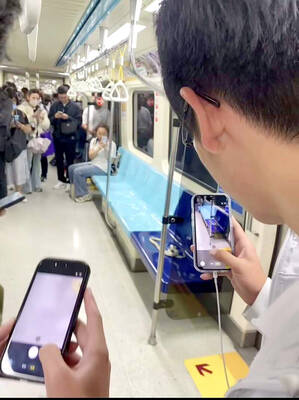
A white king snake that frightened passengers and caused a stir on a Taipei MRT train on Friday evening has been claimed by its owner, who would be fined, Taipei Rapid Transit Corp (TRTC) said yesterday. A person on Threads posted that he thought he was lucky to find an empty row of seats on Friday after boarding a train on the Bannan (Blue) Line, only to spot a white snake with black stripes after sitting down. Startled, he jumped up, he wrote, describing the encounter as “terrifying.” “Taipei’s rat control plan: Release snakes on the metro,” one person wrote in reply, referring
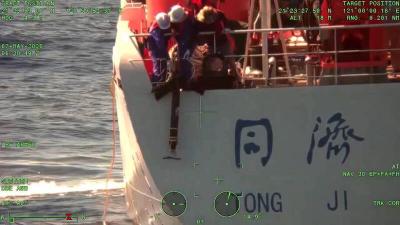
The coast guard today said that it had disrupted "illegal" operations by a Chinese research ship in waters close to the nation and driven it away, part of what Taipei sees a provocative pattern of China's stepped up maritime activities. The coast guard said that it on Thursday last week detected the Chinese ship Tongji (同濟號), which was commissioned only last year, 29 nautical miles (54km) southeast of the southern tip of Taiwan, although just outside restricted waters. The ship was observed lowering ropes into the water, suspected to be the deployment of scientific instruments for "illegal" survey operations, and the coast
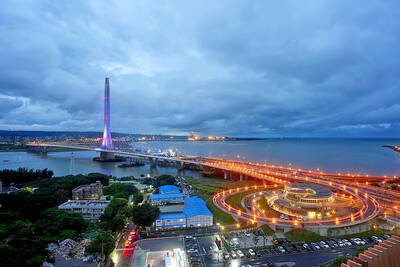
An inauguration ceremony was held yesterday for the Danjiang Bridge, the world’s longest single-mast asymmetric cable-stayed bridge, ahead of its official opening to traffic on Tuesday, marking a major milestone after nearly three decades of planning and construction. At the ceremony in New Taipei City attended by President William Lai (賴清德), Premier Cho Jung-tai (卓榮泰), Minister of Transportation and Communications Chen Shih-kai (陳世凱) and New Taipei City Mayor Hou Yu-ih (侯友宜), the bridge was hailed as both an engineering landmark and a long-awaited regional transport link connecting Tamsui (淡水) and Bali (八里)


 RSS
RSS