


A survey released by the Taipei Women’s Rescue Foundation suggests social workers are increasingly concerned about wartime risks, with more than 80 percent saying they support emergency training.
The survey garnered 1,051 valid responses from current and prospective social workers, nearly 80 percent of who were women, the foundation said.
Results showed that respondents rated the likelihood of “Taiwan experiencing war in the future” 5.65 out of 10 on average.
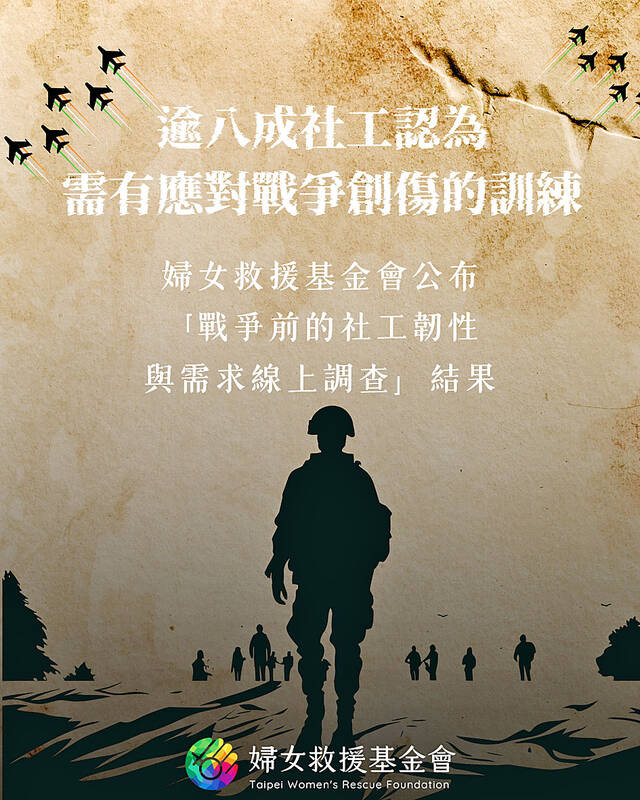
Photo courtesy of the foundation
Their top five greatest concerns were: “air raids or armed conflict occurring at any time” (83.63 percent), “looting and physical violence over supplies” (82.59 percent), “shortages of essential supplies” (77.35 percent), “lack of medical care and medication” (72.40 percent), and “fear, panic, and post-traumatic stress symptoms” (69.84 percent), the foundation said.
The survey also found that even in a wartime setting, 78.12 percent of social workers said they would continue working if certain conditions were met, while 10.47 percent said they would be fully willing to do so.
However, that would depend on key safeguards, such as basic workplace safety protections (88.79 percent), security for their families (79.66 percent), and access to pre-conflict professional training (67.24 percent), the foundation said.
Meanwhile, 71.46 percent said they believed they would still be able to continue helping others even if they themselves were affected by war-related trauma.
As for the training most sought after by social workers, the survey showed the top areas include wartime psychological first aid (81.26 percent), the role and functions of social workers in wartime (80.30 percent), responding to violence and medical needs during conflict (75.64 percent), and trauma-informed care and secondary traumatic stress management (72.98 percent).
The foundation called on the government to quickly integrate social workers, psychologists and other helping professionals into Taiwan’s national resilience framework.
The government also needs to clear social worker roles before, during and after conflict, along with professional training, safety support systems and guidelines for transitioning between peacetime and wartime services, it said.
Citing international research, the foundation also highlighted that women, children and adolescents are especially vulnerable in conflict, often facing or witnessing sexual and gender-based violence, including sexual assault and intimate partner violence.
It urged the government to set up a wartime deployment framework to allow professionals to provide rescue, counseling, and treatment, helping to maintain social stability and support post-conflict recovery.
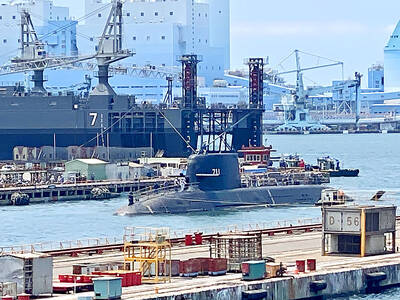
AGING: While Japan has 22 submarines, Taiwan only operates four, two of which were commissioned by the US in 1945 and 1946, and transferred to Taiwan in 1973 Taiwan would need at least 12 submarines to reach modern fleet capabilities, CSBC Corp, Taiwan chairman Chen Cheng-hung (陳政宏) said in an interview broadcast on Friday, citing a US assessment. CSBC is testing the nation’s first indigenous defense submarine, the Hai Kun (海鯤, Narwhal), which is scheduled to be delivered to the navy next month or in July. The Hai Kun has completed torpedo-firing tests and is scheduled to undergo overnight sea trials, Chen said on an SET TV military affairs program. Taiwan would require at least 12 submarines to establish a modern submarine force after assessing the nation’s operational environment and defense

A white king snake that frightened passengers and caused a stir on a Taipei MRT train on Friday evening has been claimed by its owner, who would be fined, Taipei Rapid Transit Corp (TRTC) said yesterday. A person on Threads posted that he thought he was lucky to find an empty row of seats on Friday after boarding a train on the Bannan (Blue) Line, only to spot a white snake with black stripes after sitting down. Startled, he jumped up, he wrote, describing the encounter as “terrifying.” “Taipei’s rat control plan: Release snakes on the metro,” one person wrote in reply, referring
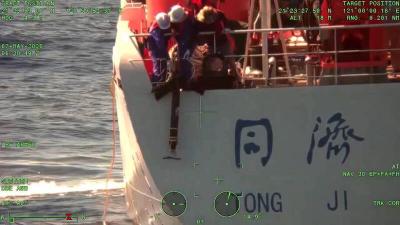
The coast guard today said that it had disrupted "illegal" operations by a Chinese research ship in waters close to the nation and driven it away, part of what Taipei sees a provocative pattern of China's stepped up maritime activities. The coast guard said that it on Thursday last week detected the Chinese ship Tongji (同濟號), which was commissioned only last year, 29 nautical miles (54km) southeast of the southern tip of Taiwan, although just outside restricted waters. The ship was observed lowering ropes into the water, suspected to be the deployment of scientific instruments for "illegal" survey operations, and the coast
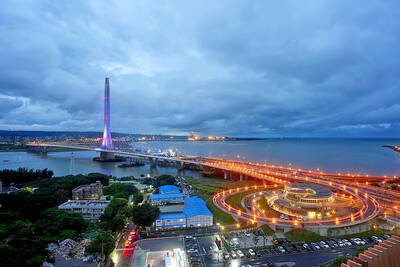
An inauguration ceremony was held yesterday for the Danjiang Bridge, the world’s longest single-mast asymmetric cable-stayed bridge, ahead of its official opening to traffic on Tuesday, marking a major milestone after nearly three decades of planning and construction. At the ceremony in New Taipei City attended by President William Lai (賴清德), Premier Cho Jung-tai (卓榮泰), Minister of Transportation and Communications Chen Shih-kai (陳世凱) and New Taipei City Mayor Hou Yu-ih (侯友宜), the bridge was hailed as both an engineering landmark and a long-awaited regional transport link connecting Tamsui (淡水) and Bali (八里)


 RSS
RSS