


The White House’s decision not to mention Taiwan in its official summary of talks between US President Donald Trump and Chinese President Xi Jinping (習近平) suggests the US does not see the issue as up for negotiation, analysts said on Thursday.
Trump and Xi held more than two hours of talks in Beijing on Thursday during Trump’s state visit to China, but the two sides’ summary differed sharply on Taiwan.
Brookings Institution China expert Patricia Kim said the differing summaries reflected contrasting messaging strategies.
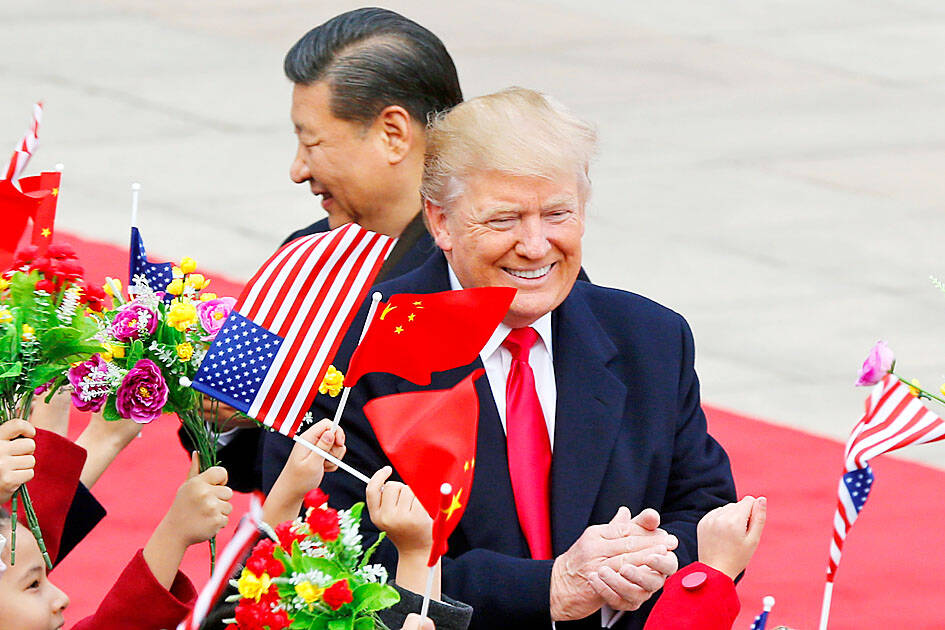
Photo: AP
“Beijing wants to show that it pressed on the Taiwan issue aggressively, whereas Washington wants to keep the focus on economic cooperation,” Kim said.
While China’s state-run Xinhua news agency said Xi described Taiwan as “the most important issue” in US-China relations and warned that mishandling it could lead to “clashes and even conflicts,” the White House summary omitted Taiwan entirely, focusing instead on economic cooperation and Iran.
Kim said that the countries were “managing the optics differently.”
Kim also highlighted what she described as a fundamental “gap in interpretation” regarding the US’ “one China” policy.
While Washington does not support Taiwanese independence, it maintains that helping Taiwan defend itself through arms sales and security cooperation is necessary to prevent Taipei from negotiating with Beijing under pressure, she said.
“The problem is Beijing views these US actions as encouraging Taiwan independence,” Kim said, adding that the differing interpretations would likely continue to fuel tensions.
Thomas Shattuck, senior program manager of the University of Pennsylvania’s Perry World House, said the omission of Taiwan from the White House summary itself carried a message.
“Taiwan is No. 1 for China,” Shattuck said. “The US, by not including Taiwan in the readout, shows that that’s not really something up for negotiation.”
Before the summit, Trump had suggested he would discuss US arms sales to Taiwan with Xi, raising concerns in Taiwan over whether Washington’s policy could shift.
While reports had suggested Trump delayed final approval of a major arms package for Taiwan to help ensure the summit preceded smoothly, Shattuck said Trump was unlikely to block such sales over the long term because of their economic benefits to the US.
“When foreign countries buy arms through the foreign military sales process, that creates US jobs,” Shattuck said. “For someone who is big on the economy and manufacturing, why would you hurt US businesses by preventing Taiwan from buying very expensive stuff?”
Pointing to remarks by US Secretary of State Marco Rubio after the summit reaffirming that US policy toward Taiwan remained unchanged, Kim said: “For now, it looks like the worst outcomes have been avoided.”
“And that should be reassuring for Taiwan,” she added.
In Taipei yesterday, an expert told a forum on the Trump-Xi talks that Taiwan should remain alert to possible subtle shifts in Washington's approach toward Taipei, despite the absence of stated changes in the US' Taiwan policy following the summit between Trump and Xi.
Ronan Fu (傅澤民), an assistant research fellow at Academia Sinica's Institute of Political Science, said Taiwan should place greater emphasis on its long-term strategic value and shared interests with the US, rather than relying solely on democratic values, because "Trump is temporary."
Fu said Chinese and US readouts of Thursday's summit in Beijing reflected sharply different priorities, with Beijing placing Taiwan at the center of its public messaging while the White House avoided mentioning Taiwan altogether.
Although US media outlets across the political spectrum largely oppose treating Taiwan as a bargaining chip in US-China negotiations, Fu argued that Beijing could seek symbolic concessions from Trump through softer wording or delays in US arms sales to Taiwan in the future.
He cited commentary in Foreign Policy magazine warning that even minor rhetorical adjustments on Taiwan could carry major strategic implications because "small words" in US-China diplomacy can produce "large consequences."
"Taiwan should pay particular attention to whether strategic space will be gradually narrowed under this kind of 'unanswered rhetoric,'" Fu said, referring to Beijing's push for a more stable and manageable relationship with Washington.
Hung Yao-nan (洪耀南), deputy director of Tamkang University's Institute of China Studies, said Beijing appeared to be using the summit to promote a new framework for "constructive strategic stability" in US-China relations while warning Washington against crossing its red lines on Taiwan.
Underscoring Beijing's use of the language of "stability" to manage, instead of resolve, strategic rivalry, Hung said China was attempting to frame Taiwan as central to the overall stability of US-China ties.
"Stability never equals peace, and silence never equals commitment," he said.
Hsu Tsun-tzu (徐遵慈), an associate research fellow and director at the Chung-Hua Institution for Economic Research, said trade tensions between Washington and Beijing were likely to persist despite temporary signs of easing following the summit.
Trump's second-term China policy is now focused not only on reducing trade deficits, but also on limiting China's technological competitiveness and global influence, she said.
Kuo Yu-jen (郭育仁), vice president of the Institute for National Policy Research, instead emphasized the lack of a major breakthrough at the summit, referring to it as "largely expected" given the structural nature of US-China rivalry.
"The absence of a clear conclusion was itself the conclusion," he said, adding that both Washington and Beijing currently appeared more focused on preventing tensions from escalating rather than resolving their core disputes.

NATIONAL SECURITY: Authorities are working to confirm the identities of the military personnel involved and investigating possible illegal conduct and regulatory violations Authorities are probing possible national security implications after Kinmen police and immigration officers on Sunday found a Chinese woman allegedly posing as a tourist while engaging in prostitution involving more than 10 military personnel. The woman, surnamed Chen (陳), has since been deported, authorities said, adding that investigators are still working to confirm the identities of those implicated, as the records only listed code names and aliases. The case stemmed from a report received by the Kinmen District Prosecutors’ Office on Friday last week from the Jinhu Precinct of the Kinmen County Police Bureau. On Sunday, police, along with the National Immigration
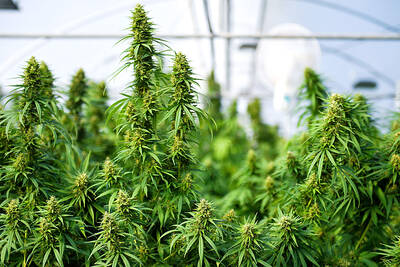
REASONS FOR TRAVEL: An assistant professor said that proposed amendments to penalize drivers if they used drugs overseas would not deter people from traveling People who operate a motor vehicle under the influence of marijuana would have their driver’s license revoked, even if they used the substance while overseas, the Ministry of Transportation and Communications said yesterday, citing proposed amendments to the Road Traffic Management and Penalty Act (道路交通管理處罰條例). The amendments would also authorize the government to revoke the licenses of people determined to have used Category 1 or Category 2 narcotics, even if they were not operating a vehicle while under the influence of drugs, as well as ban them from taking the license test for three years, the ministry said. People aged 18 or

GLOBALGIVING: ‘ Caving to external pressure is not acceptable for an organization that has cultivated justice reform and human rights for 30 years,’ one NGO said A slew of non-government organizations (NGOs) have withdrawn from the GlobalGiving fundraising platform after it announced it would use “Chinese Taipei” instead of “Taiwan” from next month. The Taiwan Good Rice Association wrote on Facebook on Friday that it was informed on April 28 via a teleconference call of the change, which was made because the platform wanted to operate in China. Taiwan Good Rice is to terminate all cooperative relationships with GlobalGiving in response to the platform’s “unilateral and non-negotiable” decision to remove references to Taiwan, the NGO said. “Taiwan is in the official name of Taiwan Good Rice Association and the

HEAVY WEATHER: Typhoon Jangmi is due to crash straight into the Ryukyus as airlines look to shift flights to larger aircraft or cancel flights to Okinawa entirely Taiwan’s international air carriers announced flight adjustments over the weekend as Typhoon Jangmi is forecast to hit the Ryukyu Islands today and tomorrow. The Central Weather Administration (CWA) upgraded Jangmi from a tropical storm to a typhoon at 8am yesterday, with the eye located 580km south of Naha city. It was moving north at 19kph. Today, China Airlines’ CI-120, CI-121, CI-122 and CI-123 flights between Taoyuan and Naha, Okinawa, have been canceled as well as CI-132 and CI-133 between Kaohsiung and Naha. EVA Air’s BR-112, BR-113, BR-186 and BR-185 flights between Taoyuan and Naha are also canceled. Low-cost carrier Tigerair Taiwan canceled IT-230,


 RSS
RSS