


The White House's decision not to mention Taiwan in its official summary of talks between US President Donald Trump and Chinese President Xi Jinping (習近平) suggests Washington does not see the issue as up for negotiation, analysts said yesterday.
Trump and Xi held more than two hours of talks in Beijing yesterday during Trump's state visit to China, but the two sides' readouts differed sharply on Taiwan.
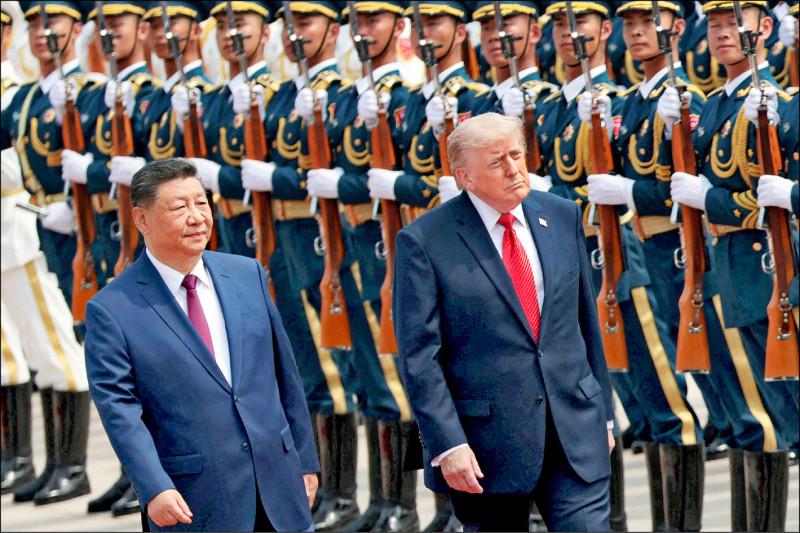
Photo: Reuters
Patricia Kim, a China expert at the Brookings Institution, said the differing summaries reflected contrasting messaging strategies.
"Beijing wants to show that it pressed on the Taiwan issue aggressively, whereas Washington wants to keep the focus on economic cooperation," Kim said.
While China's state-run Xinhua News Agency said Xi described Taiwan as "the most important issue" in US-China relations and warned that mishandling it could lead to "clashes and even conflicts," the White House readout omitted Taiwan entirely, focusing instead on economic cooperation and Iran.
Kim said that Beijing and Washington were "managing the optics differently."
Kim also highlighted what she described as a fundamental "gap in interpretation" regarding the US "one China" policy.
While Washington does not support Taiwan independence, it maintains that helping Taiwan defend itself through arms sales and security cooperation is necessary to prevent Taipei from negotiating with Beijing under pressure, she said.
"The problem is Beijing views these US actions as encouraging Taiwan independence," Kim said, adding that the differing interpretations would likely continue to fuel tensions.
Thomas Shattuck, a senior program manager at the University of Pennsylvania's Perry World House, said the omission of Taiwan from the White House readout itself carried a message.
"Taiwan is No. 1 for China," Shattuck said. "The United States, by not including Taiwan in the readout, shows that that's not really something up for negotiation."
Before the summit, Trump had suggested he would discuss US arms sales to Taiwan with Xi, raising concerns in Taiwan over whether Washington's policy could shift.
While reports had suggested Trump delayed final approval of a major arms package for Taiwan to help ensure the summit proceeded smoothly, Shattuck said Trump was unlikely to block such sales over the long term because of their economic benefits to the US.
"When foreign countries buy arms through the foreign military sales process, that creates US jobs," Shattuck said. "For someone who is big on the economy and manufacturing, why would you hurt US businesses by preventing Taiwan from buying very expensive stuff?"
Pointing to remarks by US Secretary of State Marco Rubio after the summit reaffirming that US policy toward Taiwan remained unchanged, Kim said: "For now, it looks like the worst outcomes have been avoided."
"And that should be reassuring for Taiwan," she said.
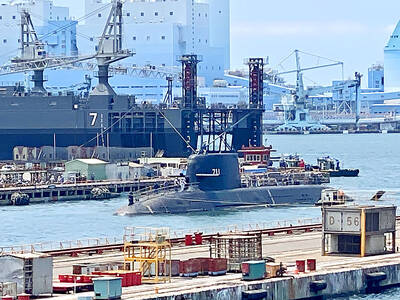
AGING: While Japan has 22 submarines, Taiwan only operates four, two of which were commissioned by the US in 1945 and 1946, and transferred to Taiwan in 1973 Taiwan would need at least 12 submarines to reach modern fleet capabilities, CSBC Corp, Taiwan chairman Chen Cheng-hung (陳政宏) said in an interview broadcast on Friday, citing a US assessment. CSBC is testing the nation’s first indigenous defense submarine, the Hai Kun (海鯤, Narwhal), which is scheduled to be delivered to the navy next month or in July. The Hai Kun has completed torpedo-firing tests and is scheduled to undergo overnight sea trials, Chen said on an SET TV military affairs program. Taiwan would require at least 12 submarines to establish a modern submarine force after assessing the nation’s operational environment and defense
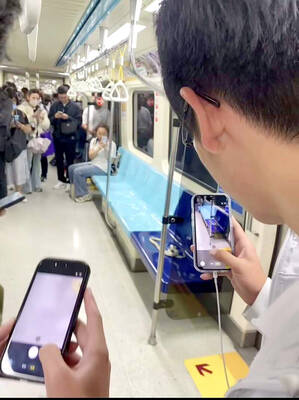
A white king snake that frightened passengers and caused a stir on a Taipei MRT train on Friday evening has been claimed by its owner, who would be fined, Taipei Rapid Transit Corp (TRTC) said yesterday. A person on Threads posted that he thought he was lucky to find an empty row of seats on Friday after boarding a train on the Bannan (Blue) Line, only to spot a white snake with black stripes after sitting down. Startled, he jumped up, he wrote, describing the encounter as “terrifying.” “Taipei’s rat control plan: Release snakes on the metro,” one person wrote in reply, referring
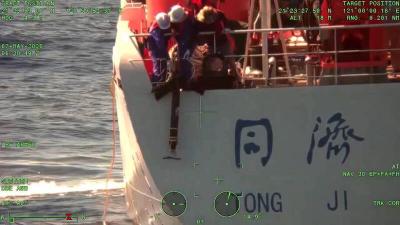
The coast guard today said that it had disrupted "illegal" operations by a Chinese research ship in waters close to the nation and driven it away, part of what Taipei sees a provocative pattern of China's stepped up maritime activities. The coast guard said that it on Thursday last week detected the Chinese ship Tongji (同濟號), which was commissioned only last year, 29 nautical miles (54km) southeast of the southern tip of Taiwan, although just outside restricted waters. The ship was observed lowering ropes into the water, suspected to be the deployment of scientific instruments for "illegal" survey operations, and the coast
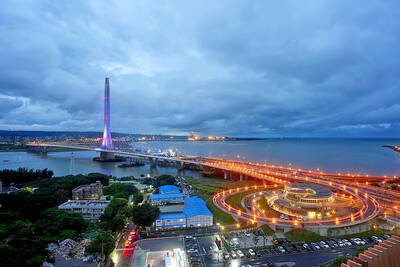
An inauguration ceremony was held yesterday for the Danjiang Bridge, the world’s longest single-mast asymmetric cable-stayed bridge, ahead of its official opening to traffic on Tuesday, marking a major milestone after nearly three decades of planning and construction. At the ceremony in New Taipei City attended by President William Lai (賴清德), Premier Cho Jung-tai (卓榮泰), Minister of Transportation and Communications Chen Shih-kai (陳世凱) and New Taipei City Mayor Hou Yu-ih (侯友宜), the bridge was hailed as both an engineering landmark and a long-awaited regional transport link connecting Tamsui (淡水) and Bali (八里)


 RSS
RSS