


Thinking Taiwan, a Taiwan-based online platform founded by former president Tsai Ing-wen (蔡英文), has relaunched its English edition with a focus on the Indo-Pacific region amid growing global polarization and uncertainty.
First launched in 2014, the English edition aims to foster "rational, pragmatic and productive discussions" by bringing together academics, policy experts and think tank researchers from around the world, according to a statement released today.

Photo: screen grab from the Thinking Taiwan Web site
The relaunched English edition is to focus on three main areas — regional security, international political economy and China-related issues — while promoting dialogue on developments in the Indo-Pacific, the statement said.
Among the first contributors featured on the platform is political scientist Andrew J. Nathan, who examines China's political system through the concept of "fragile stability."
Other contributors include Roy Lee (李淳), Taiwan's former representative to the EU and former deputy minister of foreign affairs, who analyzes Taiwan's semiconductor supply chains amid intensifying US-China competition, and Daniel Twining, who discusses Taiwan's role as a frontline democracy in Asia.
The initial lineup also features Gray Sergeant, whose work focuses on Indo-Pacific and Euro-Atlantic security links, and Athena Tong, who researches Taiwan's undersea cable infrastructure resilience.
The platform said it plans to continue working with international academics and think tanks while promoting exchanges between Taiwan and the global community through original analysis and translated content.
The relaunch came after Tsai said in a Facebook post in October last year that the Chinese edition of Thinking Taiwan, founded under the Thinking Taiwan Foundation in 2012, would be revamped and brought back into publication.
The platform published submitted articles from the public that covered wide-ranging topics from public policy and current affairs to culture and civic issues.
An English edition was later introduced as part of efforts to boost Taiwan's international visibility.
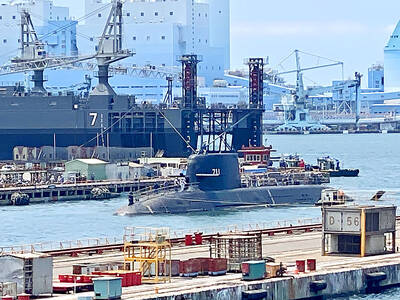
AGING: While Japan has 22 submarines, Taiwan only operates four, two of which were commissioned by the US in 1945 and 1946, and transferred to Taiwan in 1973 Taiwan would need at least 12 submarines to reach modern fleet capabilities, CSBC Corp, Taiwan chairman Chen Cheng-hung (陳政宏) said in an interview broadcast on Friday, citing a US assessment. CSBC is testing the nation’s first indigenous defense submarine, the Hai Kun (海鯤, Narwhal), which is scheduled to be delivered to the navy next month or in July. The Hai Kun has completed torpedo-firing tests and is scheduled to undergo overnight sea trials, Chen said on an SET TV military affairs program. Taiwan would require at least 12 submarines to establish a modern submarine force after assessing the nation’s operational environment and defense

A white king snake that frightened passengers and caused a stir on a Taipei MRT train on Friday evening has been claimed by its owner, who would be fined, Taipei Rapid Transit Corp (TRTC) said yesterday. A person on Threads posted that he thought he was lucky to find an empty row of seats on Friday after boarding a train on the Bannan (Blue) Line, only to spot a white snake with black stripes after sitting down. Startled, he jumped up, he wrote, describing the encounter as “terrifying.” “Taipei’s rat control plan: Release snakes on the metro,” one person wrote in reply, referring
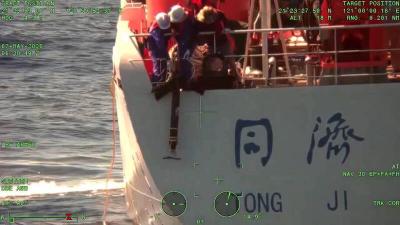
The coast guard today said that it had disrupted "illegal" operations by a Chinese research ship in waters close to the nation and driven it away, part of what Taipei sees a provocative pattern of China's stepped up maritime activities. The coast guard said that it on Thursday last week detected the Chinese ship Tongji (同濟號), which was commissioned only last year, 29 nautical miles (54km) southeast of the southern tip of Taiwan, although just outside restricted waters. The ship was observed lowering ropes into the water, suspected to be the deployment of scientific instruments for "illegal" survey operations, and the coast
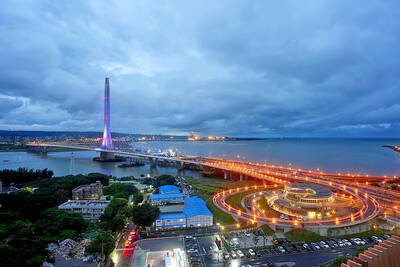
An inauguration ceremony was held yesterday for the Danjiang Bridge, the world’s longest single-mast asymmetric cable-stayed bridge, ahead of its official opening to traffic on Tuesday, marking a major milestone after nearly three decades of planning and construction. At the ceremony in New Taipei City attended by President William Lai (賴清德), Premier Cho Jung-tai (卓榮泰), Minister of Transportation and Communications Chen Shih-kai (陳世凱) and New Taipei City Mayor Hou Yu-ih (侯友宜), the bridge was hailed as both an engineering landmark and a long-awaited regional transport link connecting Tamsui (淡水) and Bali (八里)


 RSS
RSS