


At least six of the 38 major carbon emitters in Taiwan that won sustainability awards lack a net zero pledge, environmental groups said yesterday, urging stricter evaluation mechanisms to prevent “greenwashing.”
The Green Citizens’ Action Alliance and the Taiwan Climate Action Network published a report examining the sustainability performance of the companies that won a prestigious local sustainability award last year. The four major awards include the National Sustainable Development Awards, the Taiwan Corporate Sustainability Awards (TCSA), the CommonWealth Magazine’s Excellence in Corporate Social Responsibility Awards and the Global Views ESG (environmental, social and governance) Awards.
The major carbon emitters in Taiwan can be divided into two main categories: semiconductors and manufacturing, alliance vice secretary-general Tseng Hung-wen (曾虹文) said.
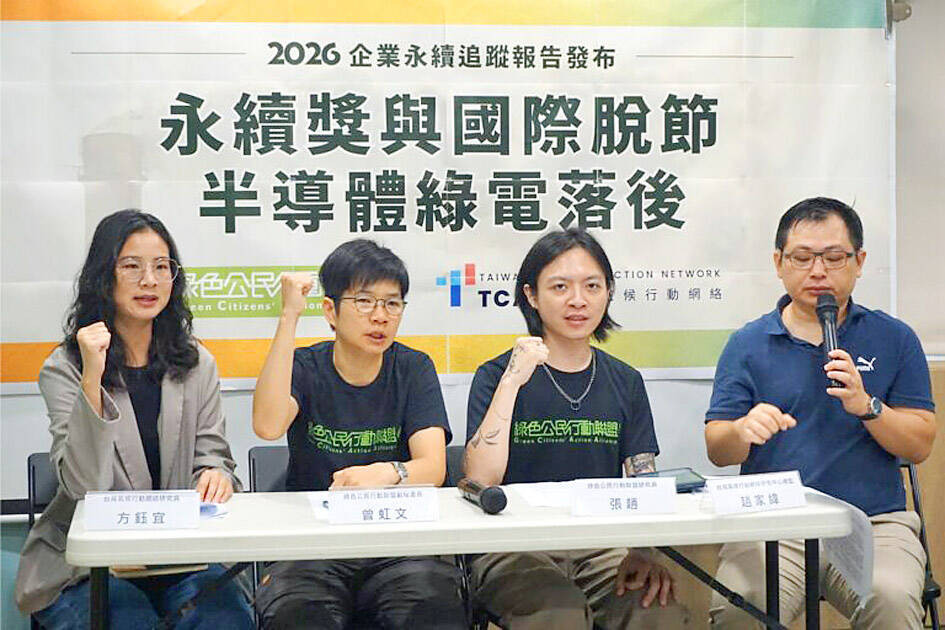
Photo courtesy of the Green Citizens’ Action Alliance
Semiconductor companies are energy-heavy users, and are expected to boost their energy performance or renewable use, while the manufacturing sector are considered “hard-to-abate” industries due to their coal reliance, she said.
About half of domestic carbon emissions are produced by hard-to-abate industries — such as steel, petrochemical and cement — and their major emitters account for 80 percent of total emissions, Tseng said.
Taiwan’s overall carbon reduction progress would be hampered if the energy reduction of those major emitters are insufficient, she added.
Of the 38 award-winning semiconductor or manufacturing major emitters, 36 won the TCSA last year, but six of them have yet to declare a net zero pledge and 28 are not yet aligned with the government’s target of increasing green power generation to 30 percent of all power generation by 2030, Tseng said.
The steel, petrochemical and cement industries collectively make up 90 percent of coal use in Taiwan, she said.
Nine of the 36 TCSA-winning emitters are coal users, but eight of them have yet to set a coal phaseout timeline, and five have increased their coal use, the alliance secretary-general said.
For example, Far Eastern New Century Corp (遠東新世紀) won the TCSA’s Climate Leader Award despite increased coal use, Tseng said, adding that the company had a fatal occupational accident last year.
Alliance researcher Chang Chao (張趙) said up to 40 percent of last year’s 93 TCSA-winning manufacturers had labor violations.
Three of them — China Steel Corp, CPC Corp, Taiwan, and Teco Electric and Machinery Co — had fatal occupational accidents in 2024, he said.
Legal compliance should be a basic requirement in evaluating corporate sustainability performance, Chang said.
Companies with major environmental or labor violations, such as fatal occupational accidents, should not be a candidate for sustainability awards, he said.
Taiwan Climate Action Network Research Center director Chao Chia-wei (趙家緯) said the 38 award-winning major emitters account for 20 percent of emissions in Taiwan.
Nearly 70 percent of the award-winning semiconductor major emitters’ carbon reduction targets fell behind the government’s carbon reduction timeline, he said.
Award-giving units should set stricter criteria for evaluating climate performance of such major emitters, Chao said.

NATIONAL SECURITY: Authorities are working to confirm the identities of the military personnel involved and investigating possible illegal conduct and regulatory violations Authorities are probing possible national security implications after Kinmen police and immigration officers on Sunday found a Chinese woman allegedly posing as a tourist while engaging in prostitution involving more than 10 military personnel. The woman, surnamed Chen (陳), has since been deported, authorities said, adding that investigators are still working to confirm the identities of those implicated, as the records only listed code names and aliases. The case stemmed from a report received by the Kinmen District Prosecutors’ Office on Friday last week from the Jinhu Precinct of the Kinmen County Police Bureau. On Sunday, police, along with the National Immigration

REASONS FOR TRAVEL: An assistant professor said that proposed amendments to penalize drivers if they used drugs overseas would not deter people from traveling People who operate a motor vehicle under the influence of marijuana would have their driver’s license revoked, even if they used the substance while overseas, the Ministry of Transportation and Communications said yesterday, citing proposed amendments to the Road Traffic Management and Penalty Act (道路交通管理處罰條例). The amendments would also authorize the government to revoke the licenses of people determined to have used Category 1 or Category 2 narcotics, even if they were not operating a vehicle while under the influence of drugs, as well as ban them from taking the license test for three years, the ministry said. People aged 18 or

GLOBALGIVING: ‘ Caving to external pressure is not acceptable for an organization that has cultivated justice reform and human rights for 30 years,’ one NGO said A slew of non-government organizations (NGOs) have withdrawn from the GlobalGiving fundraising platform after it announced it would use “Chinese Taipei” instead of “Taiwan” from next month. The Taiwan Good Rice Association wrote on Facebook on Friday that it was informed on April 28 via a teleconference call of the change, which was made because the platform wanted to operate in China. Taiwan Good Rice is to terminate all cooperative relationships with GlobalGiving in response to the platform’s “unilateral and non-negotiable” decision to remove references to Taiwan, the NGO said. “Taiwan is in the official name of Taiwan Good Rice Association and the

HEAVY WEATHER: Typhoon Jangmi is due to crash straight into the Ryukyus as airlines look to shift flights to larger aircraft or cancel flights to Okinawa entirely Taiwan’s international air carriers announced flight adjustments over the weekend as Typhoon Jangmi is forecast to hit the Ryukyu Islands today and tomorrow. The Central Weather Administration (CWA) upgraded Jangmi from a tropical storm to a typhoon at 8am yesterday, with the eye located 580km south of Naha city. It was moving north at 19kph. Today, China Airlines’ CI-120, CI-121, CI-122 and CI-123 flights between Taoyuan and Naha, Okinawa, have been canceled as well as CI-132 and CI-133 between Kaohsiung and Naha. EVA Air’s BR-112, BR-113, BR-186 and BR-185 flights between Taoyuan and Naha are also canceled. Low-cost carrier Tigerair Taiwan canceled IT-230,


 RSS
RSS