


Premier Cho Jung-tai (卓榮泰) yesterday ordered agencies to evaluate the feasibility of implementing a real-name registration system for the purchase of hidden cameras, following a string of scandals involving major aesthetic medicine clinics.
The call came amid controversy over major chains including Dr. Shine and Aierlee Inc (愛爾麗) allegedly installing surveillance cameras in consultation and treatment rooms.
Clinic owners said such practices are common in the industry.
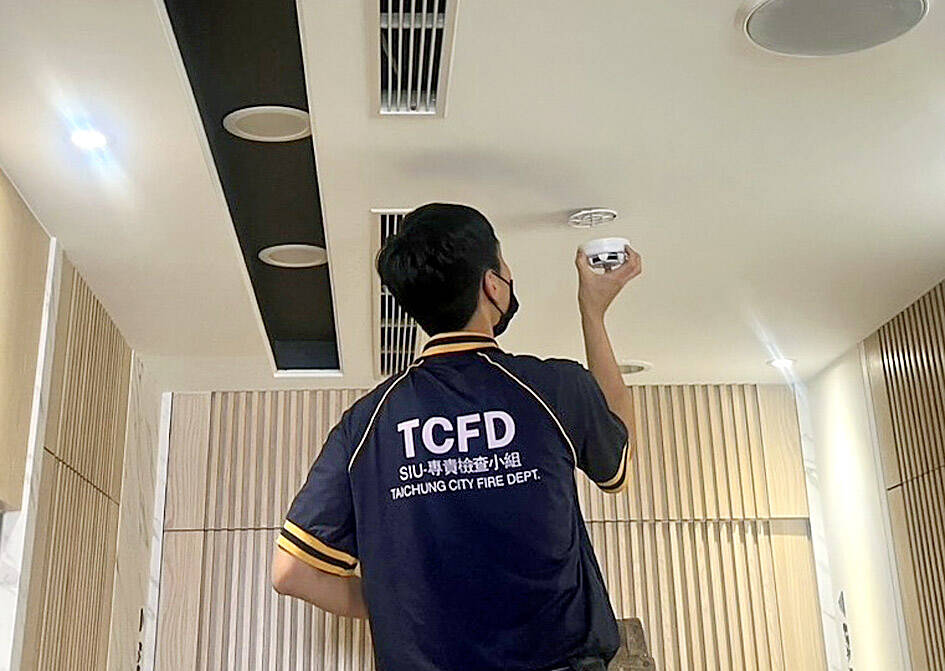
Photo courtesy of the Taichung City Government
A cross-ministerial task force has been formed to prevent illegal surveillance and distribution of footage, Cho was quoted as saying during the weekly Cabinet meeting.
Illegal surveillance in any location involving privacy — such as cosmetic clinics, gyms or hotels — is prohibited, he said, ordering the task force to launch investigations immediately.
The government has a zero-tolerance policy toward any act of illicit surveillance, he said, adding that if surveillance is required in public spaces, the public must be informed.
Whether it would be efficient to prevent crime by requiring people to provide their names when purchasing special photographic equipment should be considered, Cho said.
The Ministry of Digital Affairs would look into how to control the online sale of surveillance and photography equipment, he added.
Ministry of Health and Welfare Department of Medical Affairs Director-General Liu Yueh-ping (劉越萍) said hospitals and clinics can set up fixed surveillance equipment in public areas for security, but they must be visible and people must be made aware that recording is taking place.
Under the law, recording in public spaces does not require consent, but people must be made aware they are being recorded, Liu said.
If surveillance in low-privacy spaces such as clinic rooms, consultation rooms, and dentist and otolaryngologist clinics is necessary, patients must be informed of the purpose, how the footage is stored and managed, and their written consent obtained beforehand, Liu said.
Surveillance in operating rooms, examination rooms and changing rooms should be prohibited, unless there is a specific and special need, such as for educational purposes, Liu said, adding that in such cases, filming should be limited to specific areas, the person filmed must be anonymized and written consent obtained beforehand.
Separately, Taiwan Micro Invasive Aesthetic Society president Chen Chun-kuang (陳俊光) said medical disputes and related violence have been on the rise, and the installation of fixed surveillance equipment in public or non-private spaces was intended to safeguard patient security and provide objective evidence of events.
The nature of such surveillance is completely different from illegal surveillance and its subsequent distribution online, Chen said.
The issue at hand is whether the equipment is legal, whether the position in which it was installed invaded privacy and whether the purpose of surveillance was proper, Chen said.
Requiring people to sign an agreement every time they visit a clinic would only increase the workload for clinics, he said.
Per Article 6 of the Personal Data Protection Act (個人資料保護法), clinics are obligated to ensure that the health records, patient history and other information are kept safe, which requires surveillance to a certain degree, Chen added.

NATIONAL SECURITY: Authorities are working to confirm the identities of the military personnel involved and investigating possible illegal conduct and regulatory violations Authorities are probing possible national security implications after Kinmen police and immigration officers on Sunday found a Chinese woman allegedly posing as a tourist while engaging in prostitution involving more than 10 military personnel. The woman, surnamed Chen (陳), has since been deported, authorities said, adding that investigators are still working to confirm the identities of those implicated, as the records only listed code names and aliases. The case stemmed from a report received by the Kinmen District Prosecutors’ Office on Friday last week from the Jinhu Precinct of the Kinmen County Police Bureau. On Sunday, police, along with the National Immigration

GLOBALGIVING: ‘ Caving to external pressure is not acceptable for an organization that has cultivated justice reform and human rights for 30 years,’ one NGO said A slew of non-government organizations (NGOs) have withdrawn from the GlobalGiving fundraising platform after it announced it would use “Chinese Taipei” instead of “Taiwan” from next month. The Taiwan Good Rice Association wrote on Facebook on Friday that it was informed on April 28 via a teleconference call of the change, which was made because the platform wanted to operate in China. Taiwan Good Rice is to terminate all cooperative relationships with GlobalGiving in response to the platform’s “unilateral and non-negotiable” decision to remove references to Taiwan, the NGO said. “Taiwan is in the official name of Taiwan Good Rice Association and the

REASONS FOR TRAVEL: An assistant professor said that proposed amendments to penalize drivers if they used drugs overseas would not deter people from traveling People who operate a motor vehicle under the influence of marijuana would have their driver’s license revoked, even if they used the substance while overseas, the Ministry of Transportation and Communications said yesterday, citing proposed amendments to the Road Traffic Management and Penalty Act (道路交通管理處罰條例). The amendments would also authorize the government to revoke the licenses of people determined to have used Category 1 or Category 2 narcotics, even if they were not operating a vehicle while under the influence of drugs, as well as ban them from taking the license test for three years, the ministry said. People aged 18 or

HEAVY WEATHER: Typhoon Jangmi is due to crash straight into the Ryukyus as airlines look to shift flights to larger aircraft or cancel flights to Okinawa entirely Taiwan’s international air carriers announced flight adjustments over the weekend as Typhoon Jangmi is forecast to hit the Ryukyu Islands today and tomorrow. The Central Weather Administration (CWA) upgraded Jangmi from a tropical storm to a typhoon at 8am yesterday, with the eye located 580km south of Naha city. It was moving north at 19kph. Today, China Airlines’ CI-120, CI-121, CI-122 and CI-123 flights between Taoyuan and Naha, Okinawa, have been canceled as well as CI-132 and CI-133 between Kaohsiung and Naha. EVA Air’s BR-112, BR-113, BR-186 and BR-185 flights between Taoyuan and Naha are also canceled. Low-cost carrier Tigerair Taiwan canceled IT-230,


 RSS
RSS