


Following the legislature’s removal of drone procurement from a special defense budget act, a local defense expert yesterday urged the military to clarify its uncrewed aerial vehicle strategy, and open its drone design specifications to private manufacturers to lower costs and enable mass production.
Shu Hsiao-huang (舒孝煌), a research fellow at the state-run Institute for National Defense and Security Research, suggested that the Chungshan Institute of Science and Technology (CSIST) release drone specifications to civilian manufacturers for mass production.
The policy, if adopted, would prove an effective cost-reduction measure that could drive per-drone costs down to NT$100,000 to NT$200,000, and encourage fair competition among domestic manufacturers while ensuring stable supply, Shu said.
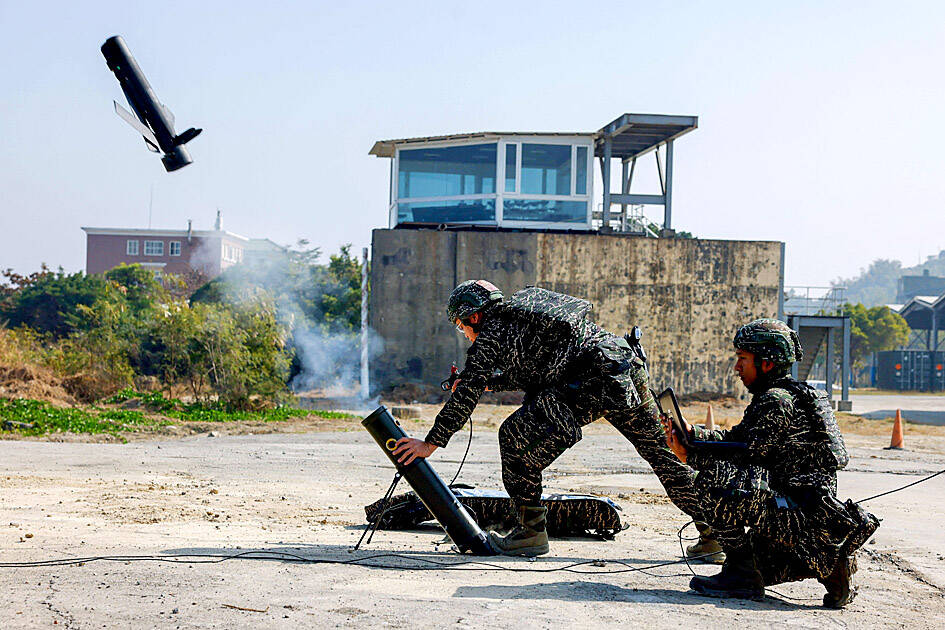
Photo: Ann Wang, Reuters
The Ukraine-Russia War and the US-Israel war on Iran have demonstrated the usefulness of long-range drones, he said, citing how the Ukrainian drones have achieved near-total paralysis of Russian air capabilities, while Iranian drones have hit more than 200 targets in the region.
Such drones can also be used offensively to launch one-way swarm attacks, or source strikes to reduce the enemy’s stocks of anti-air missiles and munitions, Shu said.
The Ministry of National Defense must have long-range strike capabilities, such as harassing enemy airfields, ports and other strategic locations, which would disrupt the enemy’s plans and limit their staging grounds, Shu said.
It is imperative to set aside an annual budget for drone procurement and research and development, as a stream of continued orders would incentivize manufacturers to upgrade their products, he said.
Drone technology is advancing at breakneck speed, and purchasing them over the years would allow the military to procure cutting-edge devices, Shu said.
The ministry must have a general strategy in its drone platform purchases, Shu said, citing how the military’s upcoming Littoral Combat Command, to be established in July, is purchasing large amounts of first-person-view drones and other small drones to shore up the military’s littoral combat capabilities, but lacks similar platforms to counter air incursions.
The military must have a designation, or mission purpose, assigned to micro, small and long-range drones, Shu said.
He added that it is worrying how the army has not yet clarified how it intends to acquire targets for its High Mobility Artillery Rocket System, the Army Tactical Missile System or the M109A7 self-propelled howitzers.
Shu warned that the Chinese People’s Liberation Army is among the first to adopt drone swarm strategies and that its drone fleet far exceeds Taiwan’s, meaning Taiwan’s anti-air missiles could be depleted trying to counter Chinese drones.
The military has yet to provide concrete plans and contingencies for countering low-altitude drone strikes, Shu said, adding that subsequent discussions on the autonomous national defense industry’s capabilities should focus on how to use drones as a force multiplier.
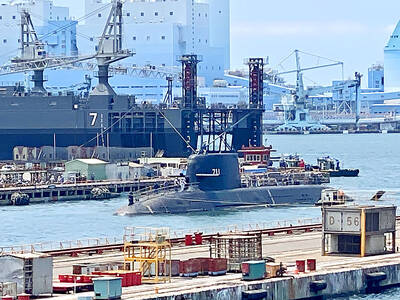
AGING: While Japan has 22 submarines, Taiwan only operates four, two of which were commissioned by the US in 1945 and 1946, and transferred to Taiwan in 1973 Taiwan would need at least 12 submarines to reach modern fleet capabilities, CSBC Corp, Taiwan chairman Chen Cheng-hung (陳政宏) said in an interview broadcast on Friday, citing a US assessment. CSBC is testing the nation’s first indigenous defense submarine, the Hai Kun (海鯤, Narwhal), which is scheduled to be delivered to the navy next month or in July. The Hai Kun has completed torpedo-firing tests and is scheduled to undergo overnight sea trials, Chen said on an SET TV military affairs program. Taiwan would require at least 12 submarines to establish a modern submarine force after assessing the nation’s operational environment and defense

A white king snake that frightened passengers and caused a stir on a Taipei MRT train on Friday evening has been claimed by its owner, who would be fined, Taipei Rapid Transit Corp (TRTC) said yesterday. A person on Threads posted that he thought he was lucky to find an empty row of seats on Friday after boarding a train on the Bannan (Blue) Line, only to spot a white snake with black stripes after sitting down. Startled, he jumped up, he wrote, describing the encounter as “terrifying.” “Taipei’s rat control plan: Release snakes on the metro,” one person wrote in reply, referring
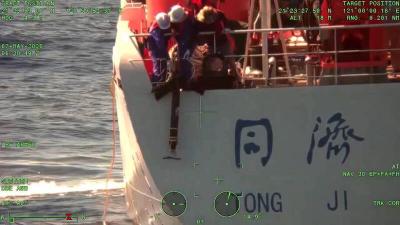
The coast guard today said that it had disrupted "illegal" operations by a Chinese research ship in waters close to the nation and driven it away, part of what Taipei sees a provocative pattern of China's stepped up maritime activities. The coast guard said that it on Thursday last week detected the Chinese ship Tongji (同濟號), which was commissioned only last year, 29 nautical miles (54km) southeast of the southern tip of Taiwan, although just outside restricted waters. The ship was observed lowering ropes into the water, suspected to be the deployment of scientific instruments for "illegal" survey operations, and the coast
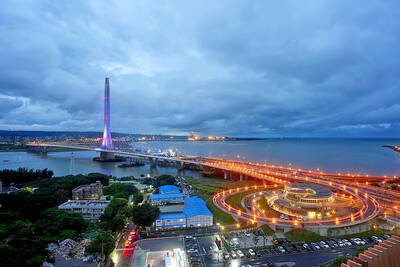
An inauguration ceremony was held yesterday for the Danjiang Bridge, the world’s longest single-mast asymmetric cable-stayed bridge, ahead of its official opening to traffic on Tuesday, marking a major milestone after nearly three decades of planning and construction. At the ceremony in New Taipei City attended by President William Lai (賴清德), Premier Cho Jung-tai (卓榮泰), Minister of Transportation and Communications Chen Shih-kai (陳世凱) and New Taipei City Mayor Hou Yu-ih (侯友宜), the bridge was hailed as both an engineering landmark and a long-awaited regional transport link connecting Tamsui (淡水) and Bali (八里)


 RSS
RSS