


US President Donald Trump and Chinese President Xi Jinping (習近平) are seeking strategic stability rather than a “grand deal” during their summit in Beijing, Taiwanese academics said yesterday, adding that establishing better communication mechanisms around trade and the military is their shared goal.
Trump yesterday met with Xi at the Great Hall of the People in Beijing in his first visit to China since returning to the White House and his first state visit there since November 2017.
Based on their opening remarks, Xi focused on US-China relations and global affairs, while Trump highlighted his personal relationship with Xi, said Wang Hsin-hsien (王信賢), a distinguished professor at National Chengchi University’s Graduate Institute of East Asian Studies.
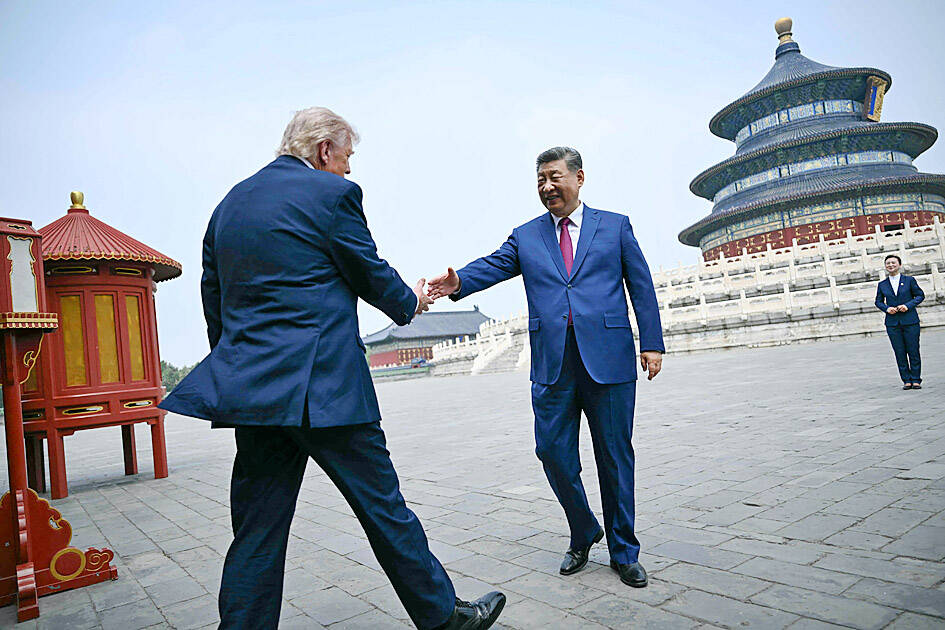
Photo: AFP
Trump attempted to showcase his ability to manage US-China risks to boost his domestic popularity ahead of the US midterm elections in November, Wang said.
The presence of US Secretary of Defense Pete Hegseth and Chinese Minister of National Defense Dong Jun (董軍) at the negotiating table is an unusual development, Wang said, adding that it likely reflects concerns over military security, nuclear arms control and US arms sales to Taiwan.
According to a readout from China Central Television, Xi said during the meeting that Taiwan is the most important issue in US-China relations.
If handled well, bilateral relations could remain generally stable, but if handled poorly, clashes or conflicts could occur, pushing relations into a dangerous situation, the Chinese president was quoted as saying.
Taiwanese independence and peace in the Taiwan Strait are as incompatible as “fire and water,” Xi added.
Wang said that Xi’s remarks on Taiwan were stronger than in the past.
By utilizing words such as “collision,” “conflict,” “extremely dangerous” and “fire and water,” Beijing has elevated its characterization of the Taiwan issue, he said, adding that Beijing is hoping for “US-China comanagement of Taiwanese independence.”
Regarding Chinese Vice President Han Zheng (韓正) greeting Trump at the airport, Wang said that although Han has stepped down from the Chinese Communist Party’s Politburo Standing Committee, he remains a national-level leader, meaning Beijing did not lower its reception standards for Trump.
National Cheng Kung University political science professor Wang Hung-jen (王宏仁) said that Xi’s opening remarks attempted to project an image of US-China cogovernance to the international community.
The summit could indeed help stabilize regional dynamics, a result anticipated by neighboring countries, such as Japan and South Korea, which hope to avoid continued friction, he said.
Wang Hung-jen added that Hegseth’s presence alongside Dong showed that the US remains militarily wary of China, and Hegseth might be using the trip to gauge the reality of recent personnel changes in the Chinese People’s Liberation Army.
While the long-term US-China rivalry would not change, the meeting could at least provide short-term stability, Wang Hung-jen said.
Later yesterday, the White House issued a statement about the meeting that made no mention of the Taiwan issue, but included details such as the two sides having discussed ways to enhance bilateral economic cooperation.
Wang Hung-jen said that from Washington’s perspective, Taiwan was never meant to be a major topic in this round of talks, and the US side had no intention of engaging in serious discussions with Beijing on the issue, as there has been no major recent development involving Taiwan.
He said Beijing’s account was therefore "somewhat misleading," as it appeared aimed at creating the impression that the US and China were jointly handling the Taiwan issue, when the White House statement showed that was not the case.
Beijing could be trying to "manipulate the messaging" around the meeting, he added.
Any meaningful concession would have been reflected in Beijing’s official readout of the meeting, said William Yang (楊晧暐), a senior analyst for Northeast Asia for International Crisis Group, as Xi’s stark warning to Trump over Taiwan may indicate he did not make concessions yesterday.
“The lack of such mention and the relatively stern tone suggest Trump may not have budged on Taiwan in principle,” Yang said.

NATIONAL SECURITY: Authorities are working to confirm the identities of the military personnel involved and investigating possible illegal conduct and regulatory violations Authorities are probing possible national security implications after Kinmen police and immigration officers on Sunday found a Chinese woman allegedly posing as a tourist while engaging in prostitution involving more than 10 military personnel. The woman, surnamed Chen (陳), has since been deported, authorities said, adding that investigators are still working to confirm the identities of those implicated, as the records only listed code names and aliases. The case stemmed from a report received by the Kinmen District Prosecutors’ Office on Friday last week from the Jinhu Precinct of the Kinmen County Police Bureau. On Sunday, police, along with the National Immigration

GLOBALGIVING: ‘ Caving to external pressure is not acceptable for an organization that has cultivated justice reform and human rights for 30 years,’ one NGO said A slew of non-government organizations (NGOs) have withdrawn from the GlobalGiving fundraising platform after it announced it would use “Chinese Taipei” instead of “Taiwan” from next month. The Taiwan Good Rice Association wrote on Facebook on Friday that it was informed on April 28 via a teleconference call of the change, which was made because the platform wanted to operate in China. Taiwan Good Rice is to terminate all cooperative relationships with GlobalGiving in response to the platform’s “unilateral and non-negotiable” decision to remove references to Taiwan, the NGO said. “Taiwan is in the official name of Taiwan Good Rice Association and the

HEAVY WEATHER: Typhoon Jangmi is due to crash straight into the Ryukyus as airlines look to shift flights to larger aircraft or cancel flights to Okinawa entirely Taiwan’s international air carriers announced flight adjustments over the weekend as Typhoon Jangmi is forecast to hit the Ryukyu Islands today and tomorrow. The Central Weather Administration (CWA) upgraded Jangmi from a tropical storm to a typhoon at 8am yesterday, with the eye located 580km south of Naha city. It was moving north at 19kph. Today, China Airlines’ CI-120, CI-121, CI-122 and CI-123 flights between Taoyuan and Naha, Okinawa, have been canceled as well as CI-132 and CI-133 between Kaohsiung and Naha. EVA Air’s BR-112, BR-113, BR-186 and BR-185 flights between Taoyuan and Naha are also canceled. Low-cost carrier Tigerair Taiwan canceled IT-230,
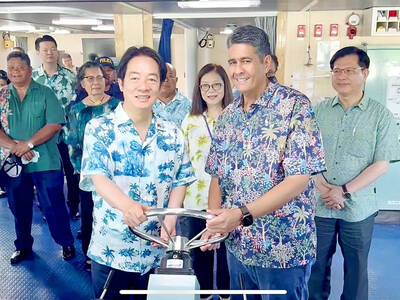
MULTIPRONGED APPROACH: China has sought to pressure Palau across a number of fronts, but the island nation has staunchly resisted overtures to ditch Taiwan Palau has been firm in backing Taiwan despite Chinese pressure that uses tourism economics, cyberattacks and criminal infiltration as tools to threaten the Pacific ally into renouncing its recognition of Taiwan as a sovereign state. The Presidential Office yesterday announced that Vice President Hsiao Bi-khim (蕭美琴) would visit Palau from Saturday to Wednesday next week at the invitation of Palauan President Surangel Whipps Jr. Whipps in April said in an interview that China had outspokenly asked Palau to “denounce Taiwan.” “And we have said: ‘We have no enemies, but nobody tells us who our friends are,’” he said. Whipps has told reporters multiple times


 RSS
RSS