


Premier Cho Jung-tai (卓榮泰) today said he has instructed the Ministry of National Defense to consider proposing another special act or budget, or expanding the scale of the annual budget, in response to the exclusion of defense procurement items in the supplementary budget act passed on Friday last week.
The Legislative Yuan passed the third reading of a special defense budget of NT$780 billion (US$24.75 billion), with a budget ceiling of NT$300 billion for the first round of US arms procurement and a cap of NT$480 billion for the second round.
The bill fell short of the eight-year NT$1.25 trillion budget requested by the government.
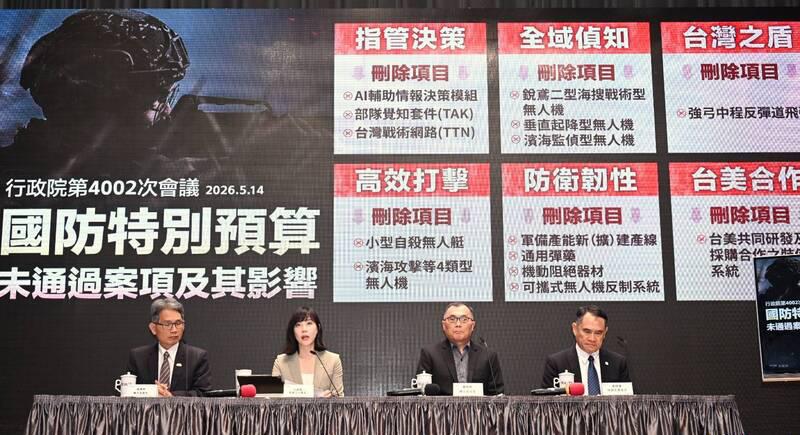
Photo: Fang Pin-chao, Taipei Times
The ministry today reported to the Executive Yuan on the items not included in the budget and their effect on national defense.
Failure to pass certain items would undermine the integrity of joint operational capability planning, defense resilience and Taiwan-US cooperation, Executive Yuan spokeswoman Michelle Lee (李慧芝) quoted Cho as saying.
The original NT$1.25 trillion budget included three main parts: the “Taiwan Shield” or “T-Dome” for air defense, high-tech systems to build precision strike capability and support for the domestic defense industry, Cho said, adding that they are indispensable to Taiwan’s arms procurement.
The government would seek a way out that is in accordance with the Constitution and Budget Act (預算法), he said.
The deleted portions of the budget would have four major effects, he said.
First, command and control decisionmaking would be affected, as the artificial intelligence-assisted intelligence decisionmaking module, the Taiwan Tactical Network and Team Awareness Kit were struck from the budget, Cho said.
That would delay the military’s ability to rapidly analyze intelligence for joint operations and theater commands, he said.
Second, awareness of enemy movements would be reduced and response time would be compressed, due to the removal of the Albatross II Uncrewed Aerial Vehicle (UAV), vertical takeoff and landing UAVs and coastal surveillance UAVs, Cho said.
Third, the scope of anti-missile interception would be reduced, due to the removal of the Tien Kung (天弓, Sky Bow) missiles, a series of UAVs and suicide uncrewed surface vessels, he said.
Fourth, defense resilience would be affected by the removal of new or expanded military production lines, general-purpose ammunition and mobile obstacle equipment, reducing ammunition stockpile readiness across the armed forces, Cho said.
Moreover, equipment systems jointly developed and procured by Taiwan and the US were also struck from the bill, which could delay international cooperation and undermine Taiwan’s perceived self-defence resolve, he added.
The deadline for Taiwan’s initial payment for the procurement of High Mobility Artillery Rocket Systems is set for May 31, Cho said.
He hopes that the ruling and opposition parties in the legislature pass a special budget and send it to committee for review, Cho said, urging the legislature not to delay at such a critical moment and risk losing already-negotiated arms procurement projects.
Additional reporting by Chung Li-hua

NATIONAL SECURITY: Authorities are working to confirm the identities of the military personnel involved and investigating possible illegal conduct and regulatory violations Authorities are probing possible national security implications after Kinmen police and immigration officers on Sunday found a Chinese woman allegedly posing as a tourist while engaging in prostitution involving more than 10 military personnel. The woman, surnamed Chen (陳), has since been deported, authorities said, adding that investigators are still working to confirm the identities of those implicated, as the records only listed code names and aliases. The case stemmed from a report received by the Kinmen District Prosecutors’ Office on Friday last week from the Jinhu Precinct of the Kinmen County Police Bureau. On Sunday, police, along with the National Immigration

GLOBALGIVING: ‘ Caving to external pressure is not acceptable for an organization that has cultivated justice reform and human rights for 30 years,’ one NGO said A slew of non-government organizations (NGOs) have withdrawn from the GlobalGiving fundraising platform after it announced it would use “Chinese Taipei” instead of “Taiwan” from next month. The Taiwan Good Rice Association wrote on Facebook on Friday that it was informed on April 28 via a teleconference call of the change, which was made because the platform wanted to operate in China. Taiwan Good Rice is to terminate all cooperative relationships with GlobalGiving in response to the platform’s “unilateral and non-negotiable” decision to remove references to Taiwan, the NGO said. “Taiwan is in the official name of Taiwan Good Rice Association and the

HEAVY WEATHER: Typhoon Jangmi is due to crash straight into the Ryukyus as airlines look to shift flights to larger aircraft or cancel flights to Okinawa entirely Taiwan’s international air carriers announced flight adjustments over the weekend as Typhoon Jangmi is forecast to hit the Ryukyu Islands today and tomorrow. The Central Weather Administration (CWA) upgraded Jangmi from a tropical storm to a typhoon at 8am yesterday, with the eye located 580km south of Naha city. It was moving north at 19kph. Today, China Airlines’ CI-120, CI-121, CI-122 and CI-123 flights between Taoyuan and Naha, Okinawa, have been canceled as well as CI-132 and CI-133 between Kaohsiung and Naha. EVA Air’s BR-112, BR-113, BR-186 and BR-185 flights between Taoyuan and Naha are also canceled. Low-cost carrier Tigerair Taiwan canceled IT-230,

REASONS FOR TRAVEL: An assistant professor said that proposed amendments to penalize drivers if they used drugs overseas would not deter people from traveling People who operate a motor vehicle under the influence of marijuana would have their driver’s license revoked, even if they used the substance while overseas, the Ministry of Transportation and Communications said yesterday, citing proposed amendments to the Road Traffic Management and Penalty Act (道路交通管理處罰條例). The amendments would also authorize the government to revoke the licenses of people determined to have used Category 1 or Category 2 narcotics, even if they were not operating a vehicle while under the influence of drugs, as well as ban them from taking the license test for three years, the ministry said. People aged 18 or


 RSS
RSS