


The Legislative Yuan today held a second hearing in the impeachment case against President William Lai (賴清德), who was not in attendance.
Lai, the first Taiwanese president to be targeted by an impeachment motion, declined an invitation to attend, while the ruling Democratic Progressive Party also boycotted the hearing.
Chinese Nationalist Party (KMT) and Taiwan People’s Party (TPP) lawmakers on Dec. 19 last year moved to impeach Lai, accusing him of dereliction of duty and unconstitutional actions, after he refused to ratify amendments that had passed a third reading in the legislature.

Photo: Tu Chien-jung, Taipei Times
Public hearings were held on Jan. 14 and 15, with plenary committee reviews on Jan. 21 and 22. Lai did not attend those either.
The Legislative Yuan has now held two hearings, yesterday and today, and voting is scheduled to commence on Tuesday next week.
Seven legislators spoke at today’s hearing, all from the KMT.
Deputy Legislative Speaker Johnny Chiang (江啟臣), of the KMT, said that the Legislative Yuan had invited Lai to the second hearing in accordance with Article 43 of the Act Governing the Legislative Yuan's Power (立法院職權行使法), but was told by the Presidential Office that he would not attend.
According to a consensus reached by legislative caucuses, if the impeached party is not in attendance, legislators would speak on behalf of each party caucus, he said.
As DPP lawmakers also did not attend the hearing, KMT and TPP lawmakers would present their views at the meeting, he said.
Democratic Progressive Party (DPP) caucus chief executive Chuang Jui-hsiung (莊瑞雄) said that as political infighting continues, DPP lawmakers would not play along with the opposition’s “farce” by attending the hearings, but would express their rejection of the impeachment case at next week’s vote.
Impeaching the president requires an incredibly high threshold, he said, adding that the KMT’s arguments remain repetitive and unoriginal, and treat highly political issues as grounds for impeachment.
KMT caucus secretary-general Lin Pei-hsiang (林沛祥) said that the impeachment movement aims to protect democracy, and in Taiwan, no one figure is above the Constitution or the law.
It is unacceptable for a democratically elected president to refuse to be bound by democratic institutions, he added.
Under the Additional Articles of the Constitution of the Republic of China (中華民國憲法增修條文), an impeachment motion against the president or vice president introduced in the Legislative Yuan must be proposed by at least one-half of all legislators and approved by at least two-thirds of all legislators.
In other words, it would require at least 76 votes in favor for the case to be submitted to the Constitutional Court for review.
The DPP holds 51 of the 113 legislative seats, while the KMT holds 54 and the TPP eight.
Once the case enters Constitutional Court proceedings, it must be approved by at least two-thirds of the sitting justices for the impeachment to be upheld.
Additional reporting by Lo Kuo-chia
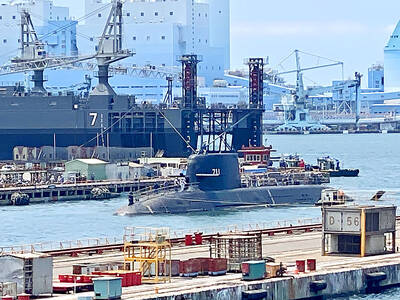
AGING: While Japan has 22 submarines, Taiwan only operates four, two of which were commissioned by the US in 1945 and 1946, and transferred to Taiwan in 1973 Taiwan would need at least 12 submarines to reach modern fleet capabilities, CSBC Corp, Taiwan chairman Chen Cheng-hung (陳政宏) said in an interview broadcast on Friday, citing a US assessment. CSBC is testing the nation’s first indigenous defense submarine, the Hai Kun (海鯤, Narwhal), which is scheduled to be delivered to the navy next month or in July. The Hai Kun has completed torpedo-firing tests and is scheduled to undergo overnight sea trials, Chen said on an SET TV military affairs program. Taiwan would require at least 12 submarines to establish a modern submarine force after assessing the nation’s operational environment and defense

A white king snake that frightened passengers and caused a stir on a Taipei MRT train on Friday evening has been claimed by its owner, who would be fined, Taipei Rapid Transit Corp (TRTC) said yesterday. A person on Threads posted that he thought he was lucky to find an empty row of seats on Friday after boarding a train on the Bannan (Blue) Line, only to spot a white snake with black stripes after sitting down. Startled, he jumped up, he wrote, describing the encounter as “terrifying.” “Taipei’s rat control plan: Release snakes on the metro,” one person wrote in reply, referring
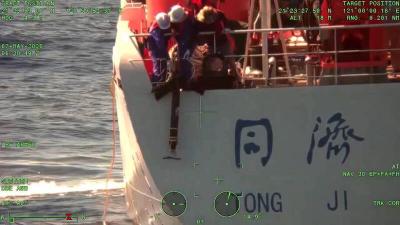
The coast guard today said that it had disrupted "illegal" operations by a Chinese research ship in waters close to the nation and driven it away, part of what Taipei sees a provocative pattern of China's stepped up maritime activities. The coast guard said that it on Thursday last week detected the Chinese ship Tongji (同濟號), which was commissioned only last year, 29 nautical miles (54km) southeast of the southern tip of Taiwan, although just outside restricted waters. The ship was observed lowering ropes into the water, suspected to be the deployment of scientific instruments for "illegal" survey operations, and the coast

Taiwan’s two cases of hantavirus so far this year are on par with previous years’ case numbers, and the government is coordinating rat extermination work, so there should not be any outbreaks, Centers for Disease Control (CDC) Director-General Philip Lo (羅一鈞) said today in an interview with the Liberty Times (the Taipei Times’ sister newspaper). An increase in rat sightings in Taipei and New Taipei City has raised concerns about the spread of hantavirus, as rats can carry the disease. In January, a man in his 70s who lived in Taipei’s Daan District (大安) tested positive posthumously for hantavirus, Taiwan’s


 RSS
RSS