


Taiwan would show the world it can contribute to global health and excluding the nation from the WHO is a loss for the organization and the world, the deputy ministers of the Ministry of Health and Welfare (MOHW) and Ministry of Foreign Affairs (MOFA) said yesterday.
The Foundation of Medical Professionals Alliance in Taiwan, which has been part of a campaign for Taiwan to rejoin the WHO since 1997, invited Deputy Minister of Health and Welfare Lu Chien-te (呂建德) and Deputy Minister of Foreign Affairs Chen Ming-chi (陳明祺) to a news conference in Taipei.
Alliance executive director Lin Shih-chia (林世嘉) said as Taiwan continues to increase its national strength, the annual campaign for lobbying international support for Taiwan during the World Health Assembly (WHA) no longer needs to “appeal to sympathy.”
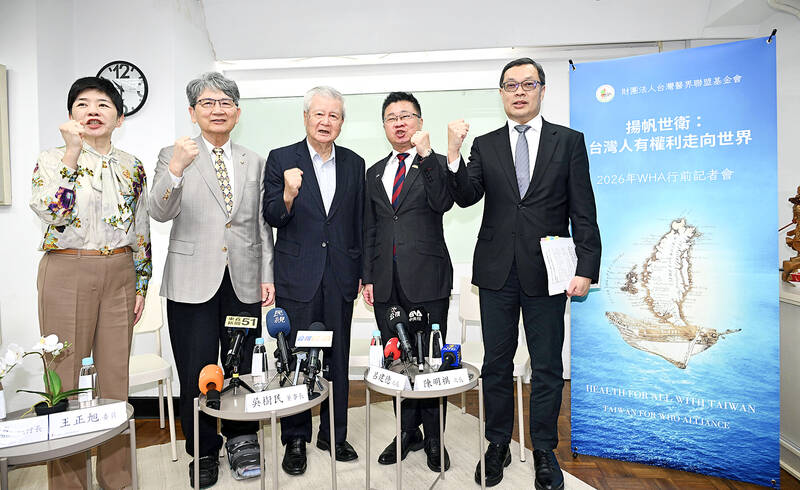
Photo: Lo Pei-de, Taipei Times
Alliance members would fly to Geneva, Switzerland, for a lobbying campaign on the sidelines of the assembly from Monday to Saturday next week, as Taiwan has not been invited to attend for the 10th consecutive year due to pressure from China.
Taiwan has overcome some major public health crises, including SARS, an influenza H1N1 outbreak and the COVID-19 pandemic, and accumulated rich experience, including establishing a high-coverage National Health Insurance (NHI) system and effective infectious disease prevention, which can be shared with the world, Lin said.
The nation has transformed from a victim into a crucial partner, capable of providing global public health experience and resources, she said.
The government’s WHA Action Team has three important missions: First, Taiwan no longer aims to appeal for sympathy, but instead demonstrate to the WHO that Taiwan is indispensable, Lu said.
The second is demonstrating Taiwan’s healthcare accomplishments, including achieving the WHO’s hepatitis C elimination goal ahead of schedule, and 99.98 percent NHI coverage — one of the best in the world, he said.
Even so-called communist China cannot achieve such high coverage, and its healthcare quality is getting worse, he said.
“I earnestly invite Chinese President Xi Jinping (習近平) to visit Taiwan and learn from our NHI system,” Lu said, adding that if former Chinese leader Mao Zedong (毛澤東) could come out of his grave, he would tell Xi to reflect on his policies — such as spending so much on military expansion, but not taking care of China’s own people.
The third goal is to promote Taiwan’s precision medicine and smart healthcare, including artificial intelligence application, he said, adding that 31 groups from the nation’s hospitals and healthcare industry would showcase its medical capacity and the spirit of “Taiwan can help” at an expo in Geneva.
“A WHO without Taiwan is incomplete. The WHO and the world need us,” he said.
Although Taiwan was again not invited, the ministries adopted a more proactive and creative method for this year’s campaign by holding the Taiwan Smart Medical and HealthTech Expo near the WHA venue, Chen said.
“Only by including Taiwan can the WHO fulfill its spirit of leaving no one behind,” he said, adding that the nation is a reliable partner that can make contributions to the world.
Taiwan also thanks all the like-minded countries and friends for speaking up for justice and supporting the nation, he added.

NATIONAL SECURITY: Authorities are working to confirm the identities of the military personnel involved and investigating possible illegal conduct and regulatory violations Authorities are probing possible national security implications after Kinmen police and immigration officers on Sunday found a Chinese woman allegedly posing as a tourist while engaging in prostitution involving more than 10 military personnel. The woman, surnamed Chen (陳), has since been deported, authorities said, adding that investigators are still working to confirm the identities of those implicated, as the records only listed code names and aliases. The case stemmed from a report received by the Kinmen District Prosecutors’ Office on Friday last week from the Jinhu Precinct of the Kinmen County Police Bureau. On Sunday, police, along with the National Immigration

GLOBALGIVING: ‘ Caving to external pressure is not acceptable for an organization that has cultivated justice reform and human rights for 30 years,’ one NGO said A slew of non-government organizations (NGOs) have withdrawn from the GlobalGiving fundraising platform after it announced it would use “Chinese Taipei” instead of “Taiwan” from next month. The Taiwan Good Rice Association wrote on Facebook on Friday that it was informed on April 28 via a teleconference call of the change, which was made because the platform wanted to operate in China. Taiwan Good Rice is to terminate all cooperative relationships with GlobalGiving in response to the platform’s “unilateral and non-negotiable” decision to remove references to Taiwan, the NGO said. “Taiwan is in the official name of Taiwan Good Rice Association and the

HEAVY WEATHER: Typhoon Jangmi is due to crash straight into the Ryukyus as airlines look to shift flights to larger aircraft or cancel flights to Okinawa entirely Taiwan’s international air carriers announced flight adjustments over the weekend as Typhoon Jangmi is forecast to hit the Ryukyu Islands today and tomorrow. The Central Weather Administration (CWA) upgraded Jangmi from a tropical storm to a typhoon at 8am yesterday, with the eye located 580km south of Naha city. It was moving north at 19kph. Today, China Airlines’ CI-120, CI-121, CI-122 and CI-123 flights between Taoyuan and Naha, Okinawa, have been canceled as well as CI-132 and CI-133 between Kaohsiung and Naha. EVA Air’s BR-112, BR-113, BR-186 and BR-185 flights between Taoyuan and Naha are also canceled. Low-cost carrier Tigerair Taiwan canceled IT-230,
MULTIPRONGED APPROACH: China has sought to pressure Palau across a number of fronts, but the island nation has staunchly resisted overtures to ditch Taiwan Palau has been firm in backing Taiwan despite Chinese pressure that uses tourism economics, cyberattacks and criminal infiltration as tools to threaten the Pacific ally into renouncing its recognition of Taiwan as a sovereign state. The Presidential Office yesterday announced that Vice President Hsiao Bi-khim (蕭美琴) would visit Palau from Saturday to Wednesday next week at the invitation of Palauan President Surangel Whipps Jr. Whipps in April said in an interview that China had outspokenly asked Palau to “denounce Taiwan.” “And we have said: ‘We have no enemies, but nobody tells us who our friends are,’” he said. Whipps has told reporters multiple times


 RSS
RSS