


The Drone Diplomacy Task Force yesterday signed a letter of intent (LOI) with the US-based Association for Uncrewed Vehicle Systems International (AUVSI) to promote talent exchanges and international certification.
The LOI was signed at XPONENTIAL, an autonomy and robotics exhibition in Detroit, Michigan, running from Monday through tomorrow.
The Drone Diplomacy Task Force, under the Ministry of Foreign Affairs, also participated in yesterday afternoon’s US-Taiwan Autonomous Systems Cooperation Forum.
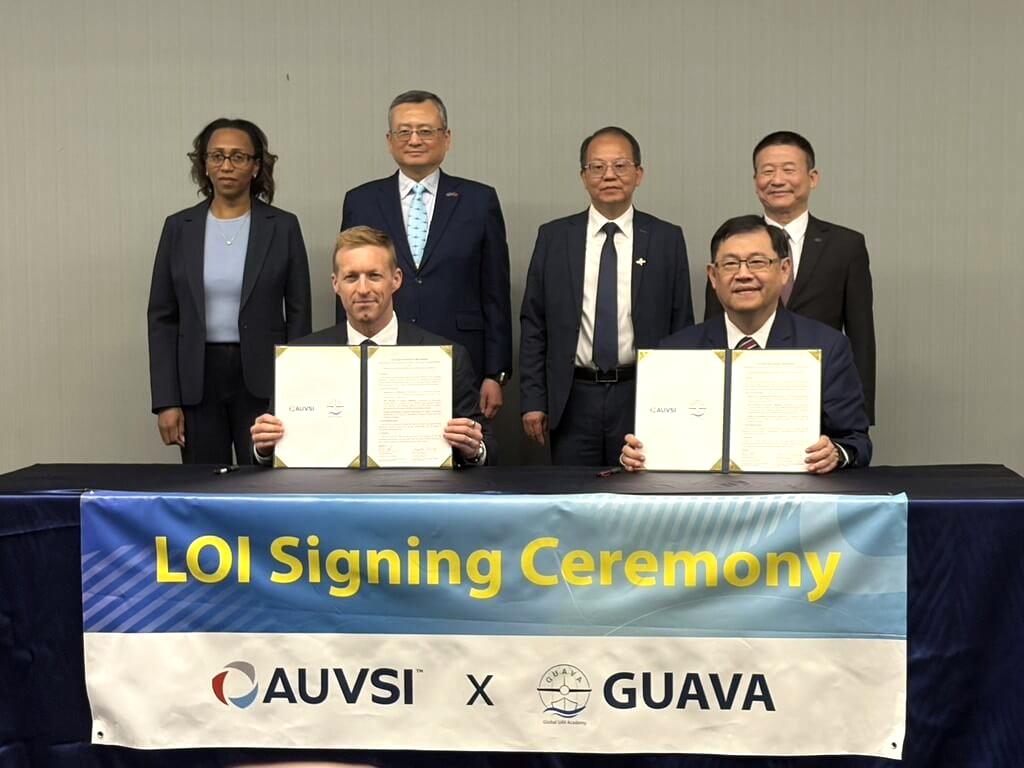
Photo courtesy of Taipei Economic and Cultural Office in Chicago
AUVSI CEO Michael Robbins, said that Taiwan is the association’s first choice for expanding its Green Unmanned Aircraft Systems certification due to its non-red supply chain and outstanding resilience, speed, scale and leadership in the uncrewed autonomous vehicle (UAV) sector.
Under the increasing threat of authoritarian states, democratic nations need to work together, he said, adding that Taiwan is not only home to strong manufacturing and research and development capabilities but also serves as a key front line in maintaining regional peace and stability in the Asia-Pacific.
AUVSI is the world’s largest trade association for uncrewed systems, robotics and autonomous technologies.
The Drone Diplomacy Task Force last week attended the SelectUSA Investment Summit, hosted by the US Department of Commerce in Maryland.
The task force was established after President William Lai (賴清德) in October pledged to develop Taiwan’s “five trusted industry sectors,” said Chiang Zhen-wei (江振瑋), director of the Department of NGO International Affairs and head of the Drone Diplomacy Task Force.
The five industries include semiconductors, artificial intelligence, military defense, security and surveillance, and next-generation communications.
The task force was then established by Minister of Foreign Affairs Lin Chia-lung (林佳龍) to further international cooperation in the UAV sector, similar to the work being done for semiconductor diplomacy, Chiang said.
Taiwan’s drone industry is largely made up of small and medium-sized enterprises with limited international visibility, he said, adding that he hopes additional support from the task force would enable the sector to achieve greater scale.
Meanwhile, the Taiwan Excellence Drone International Business Opportunities Alliance (TEDIBOA) signed a memorandum of understanding with the Michigan Drone Association and the North Dakota Trade Office at yesterday’s forum.
The TEDIBOA was established in September 2024 by the Ministry of Economic Affairs and is led by fighter jet developer Aerospace Industrial Development Corp.
The Russia-Ukraine war has redefined modern warfare, demonstrating the broad and practical applications of drones, TEDIBOA chairman Tsao Chin-pin (曹進平) said.
The industry previously focused on mass production and rapid deployment, but is now pivoting toward using limited budgets to produce highly effective UAVs that are cheaper, faster, more durable and more reliable, he said.
Reliable, non-red supply chains are now absolutely essential to UAV production, he added.
Taipei Economic and Cultural Office Chicago Director-General Dennis Lei (類延峰) said that Taiwan’s UAV industry is not only critical to national defense, but is a key part of US-Taiwan cooperation and the development of democratic supply chains, promoting national values and reliable technology.
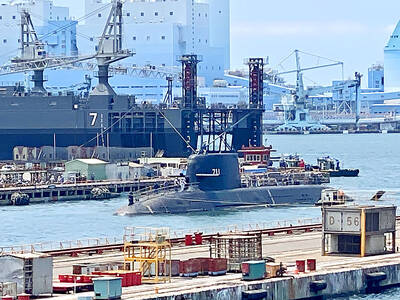
AGING: While Japan has 22 submarines, Taiwan only operates four, two of which were commissioned by the US in 1945 and 1946, and transferred to Taiwan in 1973 Taiwan would need at least 12 submarines to reach modern fleet capabilities, CSBC Corp, Taiwan chairman Chen Cheng-hung (陳政宏) said in an interview broadcast on Friday, citing a US assessment. CSBC is testing the nation’s first indigenous defense submarine, the Hai Kun (海鯤, Narwhal), which is scheduled to be delivered to the navy next month or in July. The Hai Kun has completed torpedo-firing tests and is scheduled to undergo overnight sea trials, Chen said on an SET TV military affairs program. Taiwan would require at least 12 submarines to establish a modern submarine force after assessing the nation’s operational environment and defense

A white king snake that frightened passengers and caused a stir on a Taipei MRT train on Friday evening has been claimed by its owner, who would be fined, Taipei Rapid Transit Corp (TRTC) said yesterday. A person on Threads posted that he thought he was lucky to find an empty row of seats on Friday after boarding a train on the Bannan (Blue) Line, only to spot a white snake with black stripes after sitting down. Startled, he jumped up, he wrote, describing the encounter as “terrifying.” “Taipei’s rat control plan: Release snakes on the metro,” one person wrote in reply, referring
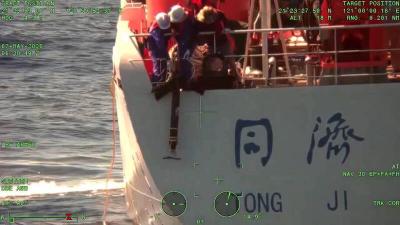
The coast guard today said that it had disrupted "illegal" operations by a Chinese research ship in waters close to the nation and driven it away, part of what Taipei sees a provocative pattern of China's stepped up maritime activities. The coast guard said that it on Thursday last week detected the Chinese ship Tongji (同濟號), which was commissioned only last year, 29 nautical miles (54km) southeast of the southern tip of Taiwan, although just outside restricted waters. The ship was observed lowering ropes into the water, suspected to be the deployment of scientific instruments for "illegal" survey operations, and the coast
Taiwan’s two cases of hantavirus so far this year are on par with previous years’ case numbers, and the government is coordinating rat extermination work, so there should not be any outbreaks, Centers for Disease Control (CDC) Director-General Philip Lo (羅一鈞) said today in an interview with the Liberty Times (the Taipei Times’ sister newspaper). An increase in rat sightings in Taipei and New Taipei City has raised concerns about the spread of hantavirus, as rats can carry the disease. In January, a man in his 70s who lived in Taipei’s Daan District (大安) tested positive posthumously for hantavirus, Taiwan’s


 RSS
RSS